
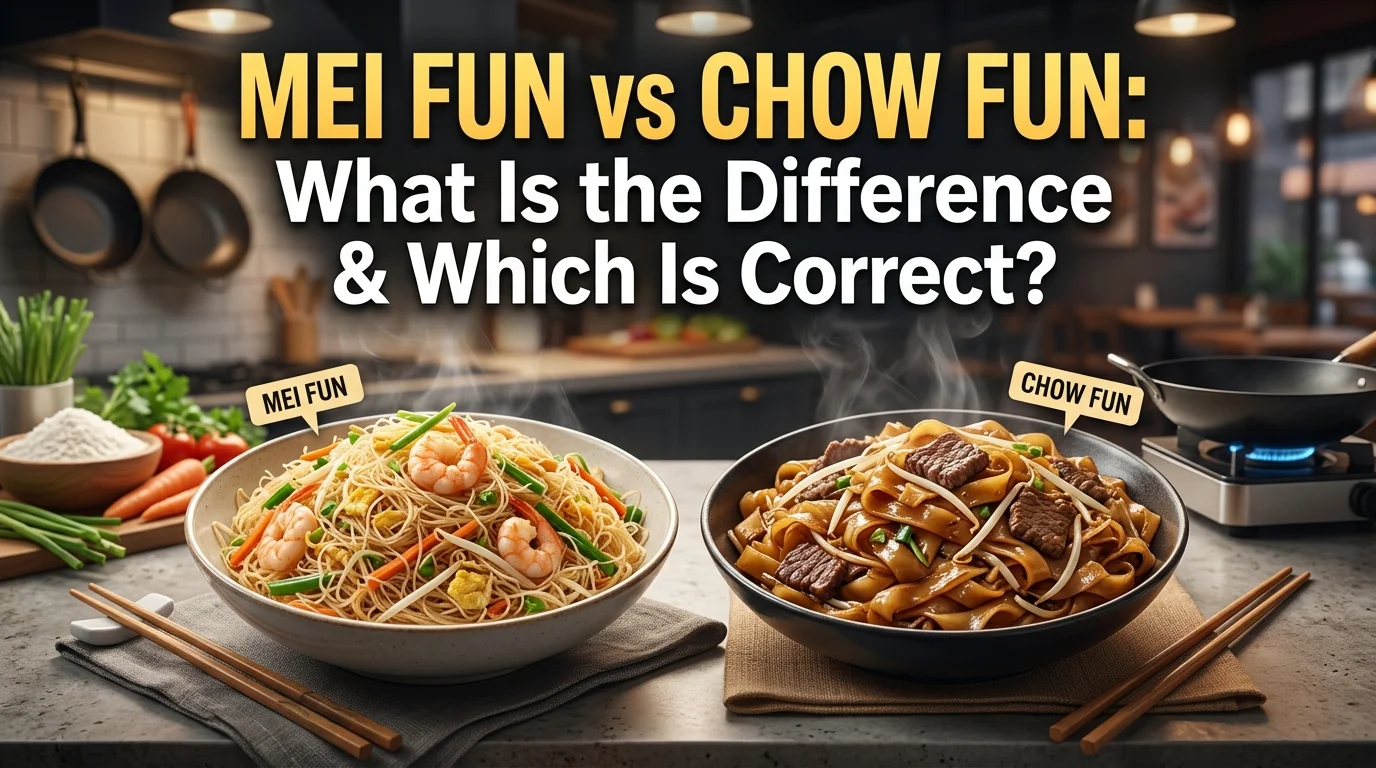
Mei Fun and Chow Fun are two popular Chinese noodle dishes that are often confused because their names sound similar and both are commonly served in Chinese restaurants. However, they are very different in noodle type, texture, cooking style, and flavor. Understanding the difference helps you order the right dish and appreciate each one better.
Comparison Overview
Mei Fun and Chow Fun are both traditional Chinese noodle dishes, but they use different noodles and cooking methods.
Mei Fun is made with thin rice vermicelli noodles, while Chow Fun uses wide flat rice noodles. Both can be stir-fried with vegetables, meat, or seafood, but their taste, texture, and overall eating experience are quite different.
| Feature | Mei Fun | Chow Fun |
| Noodle Type | Thin rice vermicelli | Wide flat rice noodles |
| Texture | Light and delicate | Chewy and soft |
| Cooking Style | Usually stir-fried dry | Stir-fried with slight sauce |
| Common Flavor | Mild, often curry-based | Smoky and savory |
| Popular Dish | Singapore Mei Fun | Beef Chow Fun |
Definition of Mei Fun
Mei Fun is a Chinese dish made from very thin rice noodles, often called rice vermicelli.
These noodles are light, soft, and absorb flavors quickly. Mei Fun is commonly stir-fried with vegetables, eggs, chicken, shrimp, or pork. A famous version is Singapore Mei Fun, which often includes curry powder for extra flavor.
Its main purpose is to create a light but flavorful noodle dish.
Definition of Chow Fun
Chow Fun is a Chinese noodle dish made with wide flat rice noodles.
These noodles are thicker, softer, and chewier than Mei Fun noodles. Chow Fun is usually cooked over high heat to create a smoky flavor called wok hei, which gives the dish its unique taste.
Its main purpose is to create a rich, hearty, and savory noodle meal.
Main Differences Between Mei Fun and Chow Fun
The biggest differences between Mei Fun and Chow Fun are the noodle shape, texture, and cooking style.
| Difference Area | Mei Fun | Chow Fun |
| Shape | Thin strands | Wide flat strips |
| Texture | Light and delicate | Thick and chewy |
| Flavor Style | Mild or curry flavored | Smoky and savory |
| Typical Sauce | Light seasoning | Soy-based sauce |
| Cooking Heat | Medium | High heat |
| Common Protein | Shrimp, chicken | Beef, chicken |
Noodle Texture and Appearance
Mei Fun looks like thin white threads.
Chow Fun looks like broad, flat ribbons.
If you want something light, choose Mei Fun. If you want something filling, choose Chow Fun.
Taste and Flavor Profile
Mei Fun often tastes lighter and can be slightly spicy, especially in Singapore-style versions.
Chow Fun tastes richer, saltier, and smokier because of soy sauce and high-heat cooking.
Which Dish Is More Popular?
Both are popular, but popularity depends on personal taste.
Mei Fun is preferred by people who like lighter meals.
Chow Fun is preferred by people who enjoy heavier noodle dishes.
Grammar Guide
Although Mei Fun and Chow Fun are food names, they should be used correctly in writing and speech.
How Each Term Is Used in Sentences
Use Mei Fun when referring to thin rice noodles.
Example: I ordered shrimp Mei Fun for dinner.
Use Chow Fun when referring to wide flat noodles.
Example: Beef Chow Fun is my favorite Chinese dish.
Common Mistakes Learners Make
Many people think both dishes use the same noodles.
Another common mistake is ordering Mei Fun expecting flat noodles.
Some people also misspell them as “May Fun” or “Chao Fun.”
Simple Rules to Remember
Think Mei = Mini for thin noodles.
Think Chow = Chunky for wide noodles.
Quick Tips for Writing and Speaking
Capitalize both words because they are dish names.
Say the full dish name for clarity, like Chicken Mei Fun or Beef Chow Fun.
When to Use Each One
Use Mei Fun when:
- You want thin noodles
- You prefer lighter meals
- You enjoy curry flavors
- You want less chewy texture
Use Chow Fun when:
- You want flat noodles
- You like chewy texture
- You prefer smoky flavor
- You want a heavier meal
When NOT to Use Each One
Do not use Mei Fun when you want flat noodles.
Do not use Chow Fun when you want very thin noodles.
Avoid using the names interchangeably because they describe different dishes.
Which One to Use (Decision Guide)
Choose Mei Fun if:
- You like thin noodles
- You want a lighter dish
- You enjoy delicate texture
Choose Chow Fun if:
- You like broad noodles
- You want bold flavor
- You enjoy chewy texture
Quick decision:
Light and thin? → Mei Fun
Chewy and smoky? → Chow Fun
Real-World Practical Examples
Mei Fun Examples
- I ordered vegetable Mei Fun for lunch.
- Singapore Mei Fun is slightly spicy.
- Mei Fun noodles cook very quickly.
- Many restaurants serve shrimp Mei Fun.
- Mei Fun is popular in Chinese takeout menus.
Chow Fun Examples
- Beef Chow Fun is a classic Cantonese dish.
- Chow Fun tastes better when cooked on high heat.
- Flat noodles make Chow Fun very filling.
- Chicken Chow Fun is popular in restaurants.
- Chow Fun often includes soy sauce and onions.
Self-Assessment (Fill in the Blanks)
- I will order ______ when I want thin rice noodles.
- I will order ______ when I want flat noodles.
- Singapore-style ______ often includes curry.
- Beef ______ usually uses wide noodles.
- Thin vermicelli describes ______.
- Wide rice ribbons describe ______.
- Smoky wok flavor is common in ______.
- Light texture is common in ______.
- If I want chewy noodles, I choose ______.
- If I want delicate noodles, I choose ______.
- The correct word is ______ because it uses thin noodles.
- The correct word is ______ because it uses flat noodles.
- Restaurant menus often list shrimp ______.
- Beef is commonly paired with ______.
- Curry flavor usually belongs to ______.
- Soy sauce flavor is stronger in ______.
- High heat cooking is common for ______.
- Quick cooking thin noodles are called ______.
- Broad chewy noodles are called ______.
- The lighter dish is usually ______.
Answers
- Mei Fun
- Chow Fun
- Mei Fun
- Chow Fun
- Mei Fun
- Chow Fun
- Chow Fun
- Mei Fun
- Chow Fun
- Mei Fun
- Mei Fun
- Chow Fun
- Mei Fun
- Chow Fun
- Mei Fun
- Chow Fun
- Chow Fun
- Mei Fun
- Chow Fun
- Mei Fun
Final Verdict
Mei Fun and Chow Fun are both delicious Chinese noodle dishes, but they are not the same. Mei Fun uses thin rice vermicelli noodles and offers a lighter, softer eating experience. Chow Fun uses wide flat rice noodles and delivers a chewier, smokier, and more filling meal. The correct choice depends entirely on your taste preference. If you want something delicate and light, choose Mei Fun. If you want something rich and hearty, choose Chow Fun. Knowing this difference helps you confidently order exactly what you want every time.
Conclusion About Mei Fun vs Chow Fun
Mei Fun vs Chow Fun is a simple comparison on the surface, but it highlights two very different styles of Chinese noodle dishes. Mei Fun is light, thin, and often mildly flavored, making it ideal for quick and delicate meals. Chow Fun, on the other hand, is thick, chewy, and rich with a smoky stir-fry taste that feels more filling. Both are delicious in their own way, and the better choice depends on personal preference. If you enjoy lighter textures, Mei Fun is perfect, while Chow Fun suits those who prefer bold, hearty flavors and a more satisfying noodle experience.
FAQs
What is the main difference between Mei Fun and Chow Fun?
The main difference lies in the noodles used. Mei Fun is made from thin rice vermicelli, while Chow Fun uses wide flat rice noodles. This creates a difference in texture, flavor absorption, and cooking style. Mei Fun is lighter and softer, while Chow Fun is chewier, richer, and often stir-fried at high heat for a smoky flavor.
Which is healthier, Mei Fun or Chow Fun?
Both can be part of a balanced diet, but Mei Fun is generally considered lighter because it uses thinner noodles and often less oil. Chow Fun is more filling and sometimes contains more sauce and oil due to stir-frying. Healthiness depends on ingredients used, portion size, and cooking method rather than the noodle type alone.
Why does Chow Fun taste smoky?
Chow Fun gets its smoky flavor from high-heat cooking in a wok, known for creating a signature aroma and taste. This technique, often called wok hei, enhances the flavor of soy sauce, meat, and noodles. The wide rice noodles also absorb sauces well, contributing to its rich and savory taste profile.
Is Mei Fun always spicy?
No, Mei Fun is not always spicy. Some versions, like Singapore Mei Fun, include curry powder and mild spice, but many versions are completely mild. It often depends on the restaurant or recipe. Mei Fun is flexible and can be made with different flavors, including vegetarian, seafood, or simple soy-based seasoning.
Can I substitute Mei Fun for Chow Fun in recipes?
Yes, but the result will be different in texture and taste. Mei Fun noodles are thinner and cook faster, so they may not hold up as well in heavy sauces or high-heat stir-frying. Chow Fun noodles are sturdier and better suited for rich sauces and smoky wok cooking, making them more traditional for stir-fry dishes.
Which dish is more filling?
Chow Fun is generally more filling because it uses thicker, wider noodles that have a chewier texture. It also tends to be cooked with more sauce and protein, making it a heavier meal. Mei Fun is lighter and better suited for those who want a quick or less filling noodle dish.
What meats are commonly used in Mei Fun?
Mei Fun is commonly prepared with shrimp, chicken, pork, or eggs. It can also be made vegetarian with vegetables like cabbage, carrots, and bean sprouts. Its thin noodles absorb flavors quickly, so it pairs well with light proteins and seasonings, making it a flexible dish for many dietary preferences.
What meats are commonly used in Chow Fun?
Chow Fun is often prepared with beef, especially in the popular Beef Chow Fun dish. It can also include chicken, shrimp, or pork. The wide noodles pair well with stronger flavors and sauces, making meat-based versions especially popular in restaurants and traditional Cantonese cooking.
Which dish is more popular in restaurants?
Both are popular, but Chow Fun is especially common in Cantonese-style restaurants, while Mei Fun is widely found in Chinese takeout menus. Chow Fun is often preferred for sit-down meals due to its rich flavor, while Mei Fun is a popular quick and light option in casual dining.
How can I easily tell them apart when ordering?
You can tell them apart by looking at noodle descriptions. If the menu says thin rice noodles or vermicelli, it is Mei Fun. If it mentions wide flat rice noodles, it is Chow Fun. Remember, thin means lighter and soft, while wide means chewy and more filling.

Ethan Clarke is a language writer who specializes in breaking down similes, word meanings, and commonly confused terms. His work focuses on clear explanations, practical examples, and simple comparisons that help readers understand how English
