
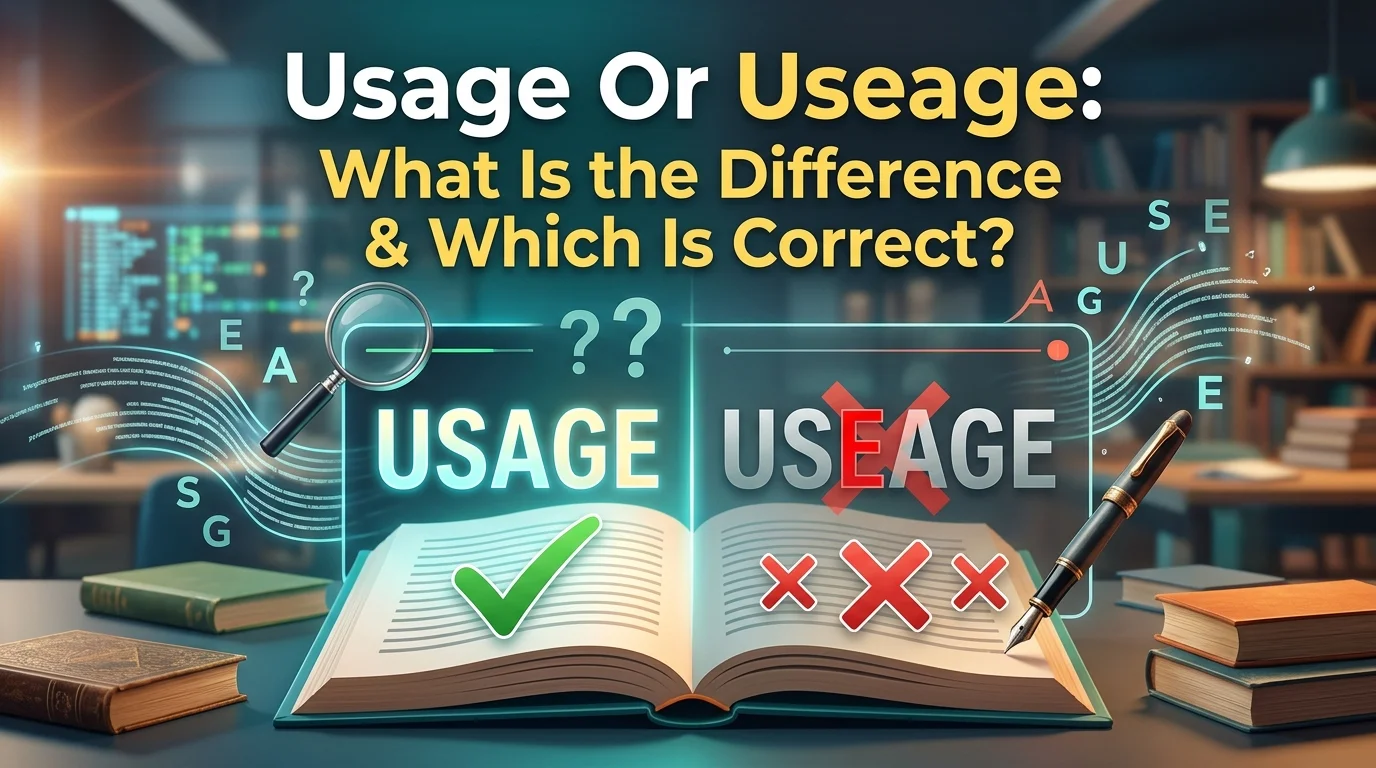
Many English learners get confused between “usage” and “useage” because they look very similar. However, only one of them is correct in standard English. Understanding this difference helps improve your spelling, grammar, and writing accuracy, especially in formal communication, schoolwork, and professional writing.
Comparison Overview
“Usage” and “useage” appear to be alternative spellings of the same word, but they are not equal. “Usage” is the correct English word and is widely accepted in all forms of writing and speech. “Useage” is a misspelling and should be avoided in formal and informal English.
| Term | Correct? | Meaning | Usage |
| Usage | Yes | The way something is used | Standard English |
| Useage | No | No valid meaning | Misspelling |
Definition of Usage
“Usage” is a noun that refers to the way a word, phrase, tool, or object is used. It can also describe customs or accepted practices in language and society.
Examples:
• Word usage in grammar
• Phone usage in daily life
• Energy usage in homes
It is a standard and correct English word.
Definition of Useage
“Useage” is not a correct English word. It is simply a spelling mistake caused by confusion about how “usage” should be written.
People often write “useage” because they assume it follows the pattern of words like “marriage” or “package,” but this is incorrect.
Main Differences Between Usage and Useage
The main difference is very simple: only “usage” is correct.
| Feature | Usage | Useage |
| Valid English word | Yes | No |
| Found in dictionaries | Yes | No |
| Accepted in writing | Yes | No |
| Correct spelling | Yes | No |
| Should you use it? | Yes | Never |
Why do people confuse them?
The confusion happens because the base word “use” ends with “e,” so some writers wrongly keep the “e” and write “useage.” English spelling rules remove the “e” before adding “-age,” creating “usage.”
Spelling Rule Behind Usage
The word comes from “use” + “age.”
Correct formation:
use + age = usage
Incorrect formation:
use + age = useage ✘
The silent “e” is dropped.
Similar examples:
• move → moving
• use → usage
• achieve → achievable
Grammar Guide
“Usage” functions as a noun.
Examples:
• Correct word usage improves writing.
• Internet usage has increased globally.
“Useage” has no grammatical role because it is not a valid word.
How each term is used in sentences
Usage:
• Her grammar usage is excellent.
• Monitor your water usage monthly.
• Proper tool usage prevents accidents.
Useage:
• Incorrect: Your phone useage is too high.
• Correct: Your phone usage is too high.
Common mistakes learners make
- Keeping the silent “e” from “use”
Wrong: useage - Assuming both spellings are accepted
Only “usage” is accepted. - Not spell-checking written work
Spell-check usually flags “useage.”
Simple rules to remember
Rule 1: If you mean “the way something is used,” write “usage.”
Rule 2: Never add an extra “e.”
Rule 3: Think: use becomes usage.
Memory trick:
“Usage uses less letters.”
Quick tips for writing and speaking
• Always spell it “usage.”
• Use grammar tools to catch “useage.”
• Read the word aloud: “yu-sij,” not “yu-see-age.”
• Practice writing it in sentences.
When to Use Each One
Use “usage” when discussing:
• language rules
• how something is used
• consumption of resources
• technology reports
• statistics and data
Examples:
• Electricity usage increased this year.
• Proper word usage matters.
Use “useage” never.
When NOT to Use Each One
Do not use “usage” incorrectly as a verb.
Wrong:
• I usage my laptop daily.
Correct:
• I use my laptop daily.
Do not use “useage” anywhere.
Wrong:
• The internet useage is growing.
Correct:
• The internet usage is growing.
Which One to Use (Decision Guide)
Ask yourself:
Are you referring to the way something is used?
→ Yes = usage
Are you writing “useage”?
→ Stop and correct it to “usage”
Quick decision:
Usage ✔
Useage ✘
Real-World Practical Examples
Usage Examples
- Education: Correct word usage improves essays.
- Daily life: Track your water usage every month.
- Science: Energy usage affects climate change.
- Business: Internet usage data helps marketing teams.
- Technology: App usage increased after the update.
Useage Examples
These examples show incorrect usage:
- Incorrect: Monitor your electricity useage.
- Incorrect: His grammar useage is weak.
- Incorrect: Phone useage reports are useful.
- Incorrect: Water useage should be reduced.
- Incorrect: Check your internet useage.
Correct all of them by replacing “useage” with “usage.”
Self-Assessment (Fill in the Blanks)
- Correct dictionary ______ helps better writing.
- Monthly electricity ______ can be expensive.
- “Useage” is a spelling ______.
- Proper word ______ improves communication.
- Internet ______ increased this year.
- The correct spelling is ______.
- Water ______ should be monitored.
- Grammar ______ matters in essays.
- “Useage” should be ______.
- Smartphone ______ is rising globally.
- Teachers check word ______ in exams.
- Incorrect ______ can confuse readers.
- Office printer ______ is high.
- Energy ______ affects budgets.
- Correct English ______ builds confidence.
- The word “useage” is ______.
- Daily phone ______ can be tracked.
- Language ______ changes over time.
- Proper software ______ prevents errors.
- Always write ______, not useage.
Answers
- usage
- usage
- mistake
- usage
- usage
- usage
- usage
- usage
- avoided
- usage
- usage
- usage
- usage
- usage
- usage
- incorrect
- usage
- usage
- usage
- usage
Final Verdict
The comparison between “usage” and “useage” is easy once you know the rule. “Usage” is the only correct spelling and should be used whenever referring to the way something is used or accepted language practice. “Useage” is simply a misspelling and should never be used. If you remember one thing, remember this: always write “usage.”
Conclusion About Usage Or Useage
Understanding the difference between “usage” and “useage” is a small but important step toward better English writing. The correct form is “usage,” which is widely accepted in grammar, education, business, and everyday communication. “Useage” is simply a spelling mistake that often appears due to confusion with word patterns in English. By learning the correct spelling rule and practicing proper usage in sentences, writers can avoid common errors and improve clarity. Whether you are writing essays, emails, or professional documents, using the right form helps you appear more accurate and confident. In short, always remember that “usage” is the correct choice, while “useage” should be avoided completely.
FAQs
Why is usage the correct spelling and useage is not?
“Usage” is the correct spelling because it follows standard English word formation rules, where the base word “use” drops the silent “e” before adding “age.” This creates a smooth and correct noun form. “Useage” is incorrect because it incorrectly keeps the extra letter, which does not match established spelling conventions or dictionary standards.
Is useage ever accepted in English writing?
No, “useage” is not accepted in standard English writing. It does not appear in dictionaries and is considered a spelling error. Whether in academic, professional, or casual writing, only “usage” should be used. Spell-check tools also typically flag “useage” as incorrect and suggest replacing it with the proper form.
How do you correctly spell the word for correct usage?
The correct spelling is “usage.” It is formed from the word “use” plus the suffix “age,” with the final “e” removed. This spelling is used in grammar, writing analysis, technology reports, and everyday communication to describe how something is used or the amount of something consumed.
What does usage mean in simple terms?
Usage refers to the way something is used or how often it is used. It can apply to language, tools, resources, or behavior. For example, it can describe how people use words in grammar or how much electricity is consumed in a household over time.
Why do people mistakenly write useage instead of usage?
People often write “useage” because they assume the word follows a similar pattern to other English words ending in “age.” Since “use” ends with a silent “e,” writers mistakenly keep it when adding the suffix. This misunderstanding leads to a common but incorrect spelling error.
Can usage be used in both formal and informal writing?
Yes, “usage” is appropriate in both formal and informal contexts. It is commonly used in academic writing, business reports, technical documentation, and everyday conversations. Its flexibility makes it an important vocabulary word for describing how something is applied or utilized in different situations.
What are some common examples of usage in sentences?
Usage can be seen in many contexts such as word usage in grammar, internet usage at home, energy usage in offices, and phone usage in daily life. It helps describe how frequently or in what way something is used, making it useful in both practical and academic discussions.
Is usage only related to grammar rules?
No, “usage” is not limited to grammar. While it is often used in language studies to describe correct word application, it also applies to technology, science, and daily life. For example, it can describe resource consumption, device activity, or general patterns of behavior.
How can I remember the correct spelling easily?
A simple way to remember is to think that “use” becomes “usage” by dropping the final “e.” This small rule helps avoid the mistake of adding an extra letter. Practicing the correct spelling in sentences also strengthens memory and reduces confusion over time.
What happens if I use useage in writing?
If you use “useage” in writing, it will likely be marked as a spelling error and may reduce the quality of your work. In formal settings like exams or professional documents, it can negatively affect your credibility. Always replace it with the correct form “usage” to maintain accuracy.

Sophia Turner is a grammar-focused writer who covers similes, word-versus-word meanings, and correct English usage. Her content is designed for learners who want quick answers, logical explanations, and practical guidance for improving writing accuracy and style.
