
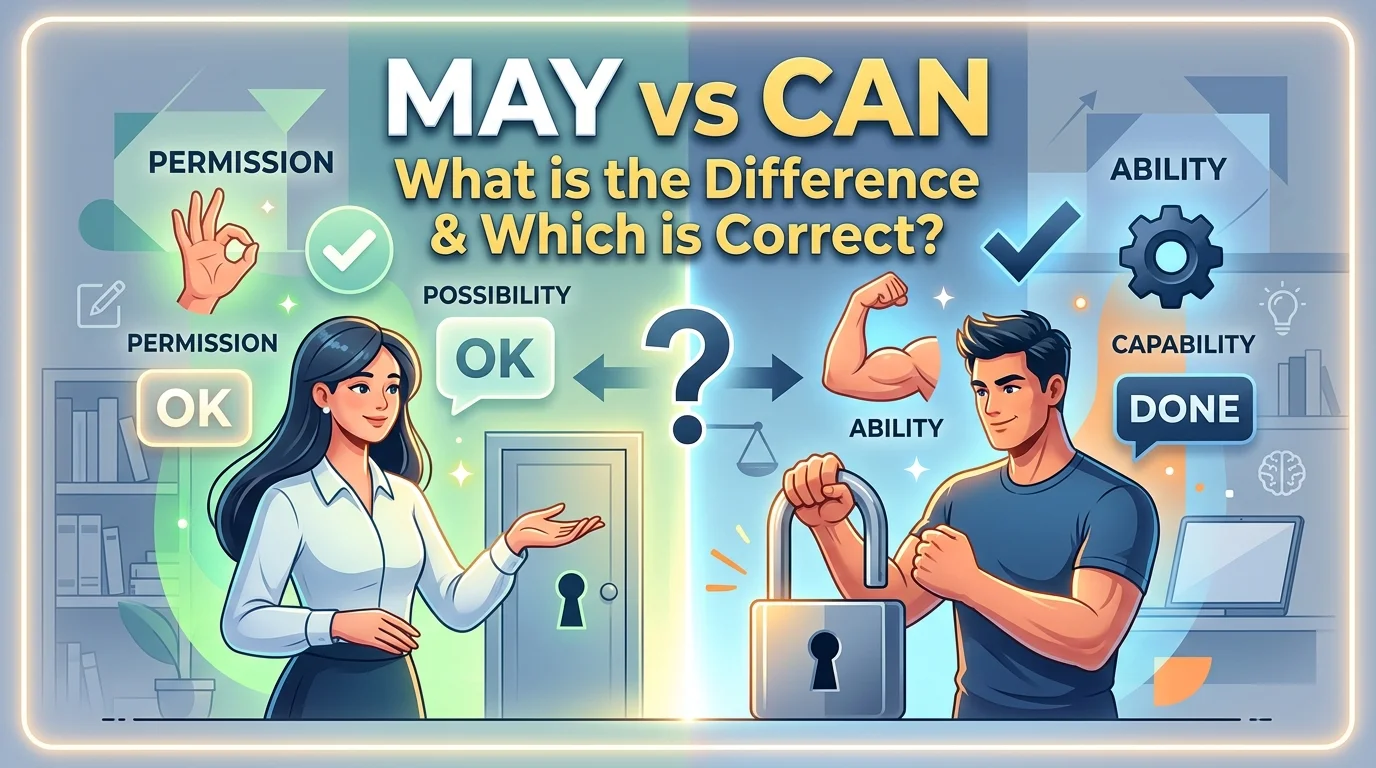
Many English learners confuse may and can because both are often used to talk about permission or possibility. While they may seem similar, they are not always interchangeable. Understanding the difference between may vs can helps you speak and write more accurately, politely, and confidently in everyday English.
Comparison Overview
May and can are both modal verbs in English grammar. They often appear in similar situations, especially when asking for permission or discussing possibility, which causes confusion for learners. However, each word has a different purpose, tone, and grammatical role.
In simple terms:
- May usually expresses permission or possibility, often in formal situations.
- Can usually expresses ability or informal permission.
Learning when to use each one improves both spoken and written English.
Definition of May
May is a modal verb used to express permission, possibility, or sometimes a polite wish.
Core meanings of may:
- Asking for formal permission: May I enter?
- Giving permission: You may leave now.
- Showing possibility: It may rain today.
Purpose:
It adds politeness and formality to communication.
Definition of Can
Can is a modal verb used mainly to express ability, possibility, or informal permission.
Core meanings of can:
- Ability: She can swim.
- Informal permission: Can I borrow your pen?
- Possibility: Accidents can happen.
Purpose:
It shows capability or casual permission in everyday conversation.
Main Differences Between May and Can
| Feature | May | Can |
| Primary meaning | Permission, possibility | Ability, informal permission |
| Tone | Formal and polite | Informal and casual |
| Common use | Formal writing and polite speech | Daily conversation |
| Ability meaning | Not used | Yes |
| Permission meaning | Yes, formal | Yes, informal |
Key difference:
- Use may when politeness or formality matters.
- Use can when talking about ability or casual permission.
Permission: May vs Can
One of the biggest differences appears in permission.
Examples:
- May I leave early? (formal, polite)
- Can I leave early? (casual, common)
Both are correct, but the tone changes.
Possibility: May vs Can
Both can show possibility, but not in exactly the same way.
- It may snow tomorrow. (possible future event)
- Cars can be dangerous. (general possibility)
Rule:
- May = specific possibility
- Can = general possibility
Grammar Guide
Both may and can are modal verbs.
Grammar pattern:
Subject + modal verb + base verb
Examples:
- I may go tomorrow.
- She can drive.
They do not change with subject:
- He can
- They can
- She may
- We may
How each term is used in sentences
May
- May I ask a question?
- It may happen soon.
Can
- I can speak English.
- Can you help me?
Sentence pattern:
- Subject + may + verb
- Subject + can + verb
Common mistakes learners make
- Using may for ability
Incorrect: I may swim well.
Correct: I can swim well. - Using can in formal writing where may sounds better
Less formal: Can I enter, sir?
Better: May I enter, sir? - Confusing possibility meanings
Incorrect: It can rain later tonight. (awkward in prediction)
Better: It may rain later tonight.
Simple rules to remember
- Can = ability
- May = formal permission
- May = specific possibility
- Can = casual permission
Memory trick:
Can means capability. May means manners.
Quick tips for writing and speaking
- In formal emails, use may.
- In daily speech, can sounds more natural.
- For skills and talents, always use can.
- For polite requests, choose may.
When to Use Each One
Use May when:
- Asking politely
- Writing formally
- Talking about uncertain future events
Examples:
- May I sit here?
- It may take time.
Use Can when:
- Talking about ability
- Asking casually
- Discussing general possibilities
Examples:
- I can cook.
- Can you call me later?
When NOT to Use Each One
Do not use May:
- For ability: Wrong: I may run fast.
Do not use Can:
- In very formal permission requests: Less ideal: Can I enter the courtroom?
Avoid confusion:
- Wrong: You may lift 50 kg.
- Correct: You can lift 50 kg.
Which One to Use (Decision Guide)
Ask yourself:
- Am I talking about a skill or ability?
→ Use can - Am I asking formal permission?
→ Use may - Am I speaking casually?
→ Use can - Am I discussing uncertain possibility?
→ Use may
Quick decision:
- Ability? Can
- Formal permission? May
- Casual permission? Can
- Possibility? May
Real-World Practical Examples
May Examples
- Education: May I submit my assignment tomorrow?
- Daily life: You may use my phone charger.
- Science: This chemical may react with water.
- Business: The meeting may be delayed.
- Conversation: It may be true.
Can Examples
- Education: I can solve this math problem.
- Daily life: Can you open the door?
- Science: Water can freeze at 0°C.
- Business: Our team can finish this project.
- Technology: This app can translate languages.
Self-Assessment (Fill in the Blanks)
- I ______ swim very well.
- ______ I use your laptop?
- It ______ rain tonight.
- Birds ______ fly.
- ______ I come in, sir?
- She ______ speak three languages.
- This medicine ______ cause sleepiness.
- ______ you help me with homework?
- Students ______ leave after class.
- He ______ drive a truck.
- It ______ take longer than expected.
- ______ I ask a question?
- Dogs ______ smell better than humans.
- This road ______ be dangerous at night.
- ______ I borrow your notes?
- We ______ finish this today.
- The train ______ arrive late.
- You ______ park here now.
- My brother ______ play piano.
- ______ you pass the salt?
Answers
- can
- can
- may
- can
- may
- can
- may
- can
- may
- can
- may
- may
- can
- can
- may
- can
- may
- may
- can
- can
Final Verdict
Both may and can are correct, but they are used differently. Use can when talking about ability or asking for casual permission. Use may when asking for formal permission or talking about possibility. If you remember that can shows capability and may shows politeness or possibility, choosing the right word becomes much easier.
Conclusion About May vs Can
Understanding the difference between may vs can helps you use English more accurately in both formal and informal situations. While both words can express permission and possibility, their tone and purpose are not the same. “May” brings politeness, respect, and formality, making it ideal for official communication and careful requests. “Can,” on the other hand, focuses on ability and everyday conversation, making it more natural in casual speech. By learning when to use each modal verb, you improve clarity, avoid common grammar mistakes, and sound more confident in English. With regular practice, choosing between “may” and “can” becomes automatic and effortless in real-life communication.
FAQs
What is the main difference between may and can?
The main difference is that “may” is used for formal permission and possibility, while “can” is used for ability and informal permission. “May” sounds more polite and respectful, whereas “can” is more common in everyday conversation and focuses on what someone is able to do.
Can may and can be used interchangeably?
In some casual situations, both can be used for permission, but they are not fully interchangeable. “Can” is informal, while “may” is more polite and formal. In professional or respectful contexts, “may” is preferred to maintain proper tone and clarity in communication.
When should I use may instead of can?
You should use “may” when asking for formal permission or expressing a polite request. It is also used to show possibility in uncertain situations. For example, “May I leave early?” sounds more respectful than “Can I leave early?” in formal settings.
Is can only used for ability?
No, “can” is mainly used for ability, but it can also show informal permission or general possibility. For example, “I can swim” shows ability, while “You can go now” gives casual permission in everyday speech without formality.
Which is more polite may or can?
“May” is more polite and formal than “can.” It is commonly used in respectful requests, official communication, and situations where politeness matters. “Can” is more relaxed and used in casual conversations among friends, family, or informal settings.
Can may be used for future possibility?
Yes, “may” is often used to talk about future possibilities that are uncertain. For example, “It may rain tomorrow” suggests that rain is possible but not guaranteed. It helps express doubt or uncertainty about future events in a natural way.
Why is can used more in spoken English?
“Can” is more common in spoken English because it is simple, direct, and natural in conversation. People use it to talk about abilities or make casual requests without sounding too formal, making it the preferred choice in everyday speech.
Can may express ability?
No, “may” does not express ability. It is used for permission or possibility. Ability is always expressed using “can.” For example, “She can dance well” is correct, while “She may dance well” is incorrect in terms of ability.
Is may used in questions?
Yes, “may” is used in polite questions to ask for permission. For example, “May I come in?” or “May we start the meeting?” These sound formal and respectful, especially in academic, professional, or official environments where politeness is important.
Which is better for exams may or can?
Both are correct depending on context, but “may” is often preferred in formal writing or exams when asking permission or showing possibility. “Can” is suitable for ability-related answers. Choosing correctly depends on understanding the situation and tone required.

Amelia Wright focuses on making figurative language easy to understand. Her writing explains similes, metaphors, and word meanings using relatable examples. She aims to help readers recognize subtle differences in usage and apply them correctly in both academic and casual writing.