
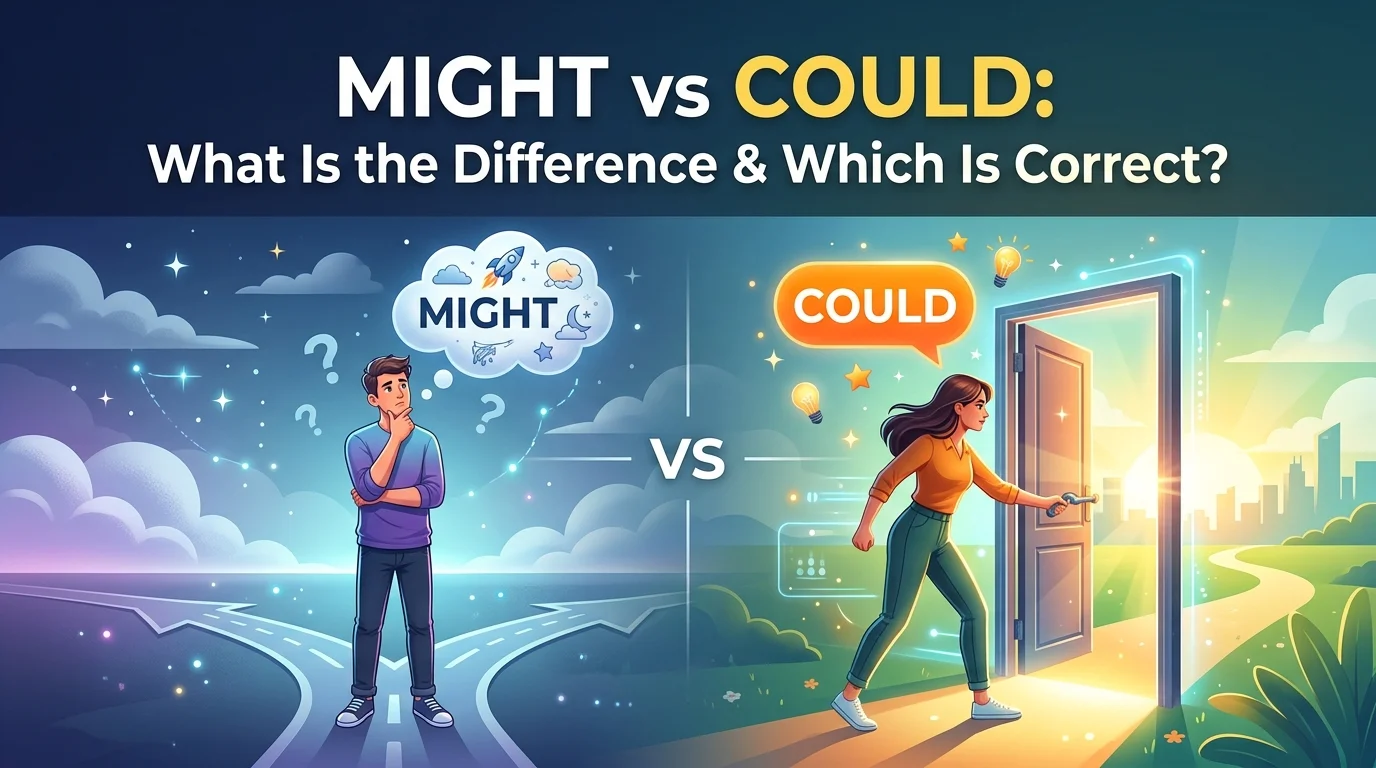
“Might” and “could” are two common English modal verbs that often confuse learners because both can express possibility. However, they are not always interchangeable. Understanding the difference between “might” and “could” helps you choose the right word in speaking and writing, making your English clearer, more accurate, and more natural.
Comparison Overview
“Might” and “could” are both modal verbs used to talk about possibility, permission, and hypothetical situations. While they sometimes overlap, they carry different shades of meaning. “Might” usually shows a weaker possibility or uncertainty, while “could” often shows ability, possibility, or polite suggestions depending on the context.
| Feature | Might | Could |
| Main meaning | Possibility | Ability or possibility |
| Strength | Usually weaker | Often slightly stronger |
| Used for ability | No | Yes |
| Used for suggestions | Rarely | Yes |
| Formality | Neutral | Neutral |
| Common in hypotheticals | Yes | Yes |
Definition of Might
“Might” is a modal verb used mainly to express possibility or uncertainty. It suggests that something is possible, but not certain.
Examples:
• It might rain later.
• She might come to the party.
• I might call you tomorrow.
Core purpose:
To show that something is possible but unsure.
Definition of Could
“Could” is a modal verb used to express ability, possibility, polite requests, or suggestions.
Examples:
• I could swim when I was five.
• It could rain tonight.
• Could you help me?
Core purpose:
To show ability, possibility, or polite intention.
Main Differences Between Might and Could
The biggest difference is in function and meaning.
| Aspect | Might | Could |
| Possibility | Yes | Yes |
| Ability | No | Yes |
| Permission | Rare | Yes |
| Polite request | No | Yes |
| Suggestion | Rare | Yes |
| Certainty level | Less certain | Slightly more practical |
Examples:
• It might snow tomorrow. (possible, uncertain)
• It could snow tomorrow. (possible, maybe based on conditions)
• I might go. (not sure)
• I could go. (it is possible for me)
Probability and Strength of Meaning
“Might” usually sounds less certain than “could.”
Examples:
• She might be at home. (just a guess)
• She could be at home. (possible based on evidence)
Use “might” when uncertainty is higher.
Use “could” when discussing realistic possibility.
Politeness and Social Use
“Could” is much more common in polite requests.
Examples:
• Could you open the window?
• Could I ask a question?
“Might” sounds unusual in these situations.
Incorrect:
• Might you open the window?
Grammar Guide
Both “might” and “could” are modal verbs, so they follow the same grammar pattern:
Subject + modal + base verb
Examples:
• She might leave.
• He could arrive soon.
Never add “to” after them.
Incorrect:
• She might to leave.
• He could to arrive.
How Each Term Is Used in Sentences
“Might” sentence pattern:
Subject + might + base verb
Examples:
• I might travel next year.
• They might agree.
“Could” sentence pattern:
Subject + could + base verb
Examples:
• I could help you.
• They could win.
Common Mistakes Learners Make
Using “could” when talking only about uncertainty:
• Wrong: I could maybe stay home.
• Better: I might stay home.
Using “might” for ability:
• Wrong: I might swim when I was young.
• Correct: I could swim when I was young.
Using “to” after modals:
• Wrong: She could to dance.
• Correct: She could dance.
Simple Rules to Remember
Use “might” for uncertain possibility.
Use “could” for:
• ability
• polite requests
• suggestions
• possibility
Quick memory:
“Might” = maybe
“Could” = can (past or possible)
Quick Tips for Writing and Speaking
In formal writing, use “might” for careful uncertainty.
In conversation, use “could” for polite speaking.
Examples:
• This might affect results. (formal)
• Could you pass the salt? (conversation)
When to Use Each One
Use “might” when:
• you are unsure
• you are guessing
• the chance feels weak
Examples:
• He might call later.
• It might work.
Use “could” when:
• talking about ability
• making polite requests
• giving suggestions
• showing realistic possibility
Examples:
• You could try again.
• Could you wait?
When NOT to Use Each One
Do not use “might”:
• for ability
• for direct requests
Wrong:
• I might drive when I was ten.
Do not use “could”:
• when you want to stress strong uncertainty only
Less natural:
• I could maybe be wrong.
Better:
• I might be wrong.
Which One to Use (Decision Guide)
Ask yourself:
- Am I talking about ability?
→ Use “could” - Am I making a polite request?
→ Use “could” - Am I talking about uncertain possibility?
→ Use “might” - Am I giving a suggestion?
→ Use “could”
Quick guide:
• Maybe = might
• Can/could = could
Real World Practical Examples
Might Examples
Education:
• The teacher might cancel class.
Daily life:
• I might cook dinner tonight.
Science:
• This chemical might react with water.
Business:
• Sales might increase next month.
Conversation:
• She might join us later.
Could Examples
Education:
• Students could use online tools.
Daily life:
• I could visit my parents tomorrow.
Science:
• This method could improve results.
Business:
• We could launch next week.
Conversation:
• Could you call me later?
Self-Assessment (Fill in the Blanks)
- It ______ rain tonight because the sky is dark.
- I ______ swim when I was six years old.
- ______ you help me with this bag?
- She ______ come to dinner, but she is not sure.
- This plan ______ work if we try harder.
- He ______ be at the office right now.
- You ______ try restarting the computer.
- They ______ arrive late because of traffic.
- I ______ read before I started school.
- ______ I ask a question?
- The answer ______ be correct.
- We ______ go to the beach tomorrow.
- She ______ speak three languages when she was young.
- You ______ ask your teacher for help.
- He ______ forget the meeting.
- That idea ______ solve the problem.
- It ______ snow this weekend.
- I ______ help if you need me.
- She ______ not understand the instructions.
- They ______ finish early if they hurry.
Answers
- might
- could
- Could
- might
- could
- might
- could
- might
- could
- Could
- might
- might
- could
- could
- might
- could
- might
- could
- might
- could
Final Verdict
“Might” and “could” both talk about possibility, but they are not identical. Use “might” when you want to express uncertainty or a weaker possibility. Use “could” when talking about ability, polite requests, suggestions, or realistic possibilities. If you remember one simple rule, remember this: “might” means maybe, while “could” often means can or possible.
Conclusion About Might vs Could
Understanding the difference between “might” and “could” helps you speak and write English with greater accuracy and confidence. Both words express possibility, but they are not identical in meaning or usage. “Might” is best for uncertain or weaker possibilities, while “could” is more flexible, covering ability, polite requests, suggestions, and realistic outcomes. Choosing between them depends on context and intent rather than strict rules. Once you grasp their subtle differences, your communication becomes clearer, more natural, and more fluent. Practicing real examples in daily conversation and writing will help you use both modals correctly and effortlessly over time.
FAQs
What is the main difference between might and could?
The main difference is that “might” usually shows a weaker or less certain possibility, while “could” often shows ability, polite requests, suggestions, or realistic possibilities. Both express possibility, but “could” is more versatile and context dependent, whereas “might” is mainly focused on uncertainty or guessing about something.
Can might and could be used interchangeably?
Sometimes they can be used in similar situations, especially when talking about possibility. However, they are not always interchangeable. “Might” is better for uncertainty, while “could” is preferred for ability, politeness, or suggestions. Using the wrong one can slightly change the meaning or tone of a sentence.
When should I use might in a sentence?
Use “might” when you are unsure about something or when the chance of it happening is low. It is commonly used for guesses, predictions, or uncertain events. For example, you might say something might happen, but you are not confident about it.
When should I use could instead of might?
Use “could” when talking about ability, polite requests, or possible situations that are realistic or logical. It is also used for suggestions and hypothetical outcomes. If you want to sound polite or show capability, “could” is usually the better choice.
Is could stronger than might?
In many cases, “could” feels slightly stronger or more practical than “might.” It often suggests a more realistic possibility or capability, while “might” suggests more uncertainty. However, neither is absolutely strong or weak; their meaning depends on context and sentence structure.
Can might be used for past situations?
“Might” can be used in past contexts when combined with have plus a past participle, such as might have done. This expresses speculation about something that possibly happened in the past but is not confirmed. It shows uncertainty about past actions or events.
Is could used for polite requests?
Yes, “could” is commonly used for polite requests in English. It sounds more respectful and formal compared to direct commands. For example, asking someone to help or do something using “could” makes the request softer and more courteous.
Why do learners confuse might and could?
Learners often confuse them because both express possibility and sometimes appear in similar contexts. The subtle difference in meaning, especially regarding certainty, ability, and politeness, makes them tricky. Practice and exposure to real sentences help reduce this confusion over time.
Can might show future possibility?
Yes, “might” is often used to talk about future possibilities that are uncertain. It suggests that something may happen but is not guaranteed. It is commonly used in predictions where the speaker is unsure about the outcome.
Which is more common in everyday English?
Both are common, but “could” is often used more frequently in everyday conversation because it covers more functions like ability and politeness. “Might” is also widely used but tends to appear more in uncertain or speculative statements.

Ethan Clarke is a language writer who specializes in breaking down similes, word meanings, and commonly confused terms. His work focuses on clear explanations, practical examples, and simple comparisons that help readers understand how English