
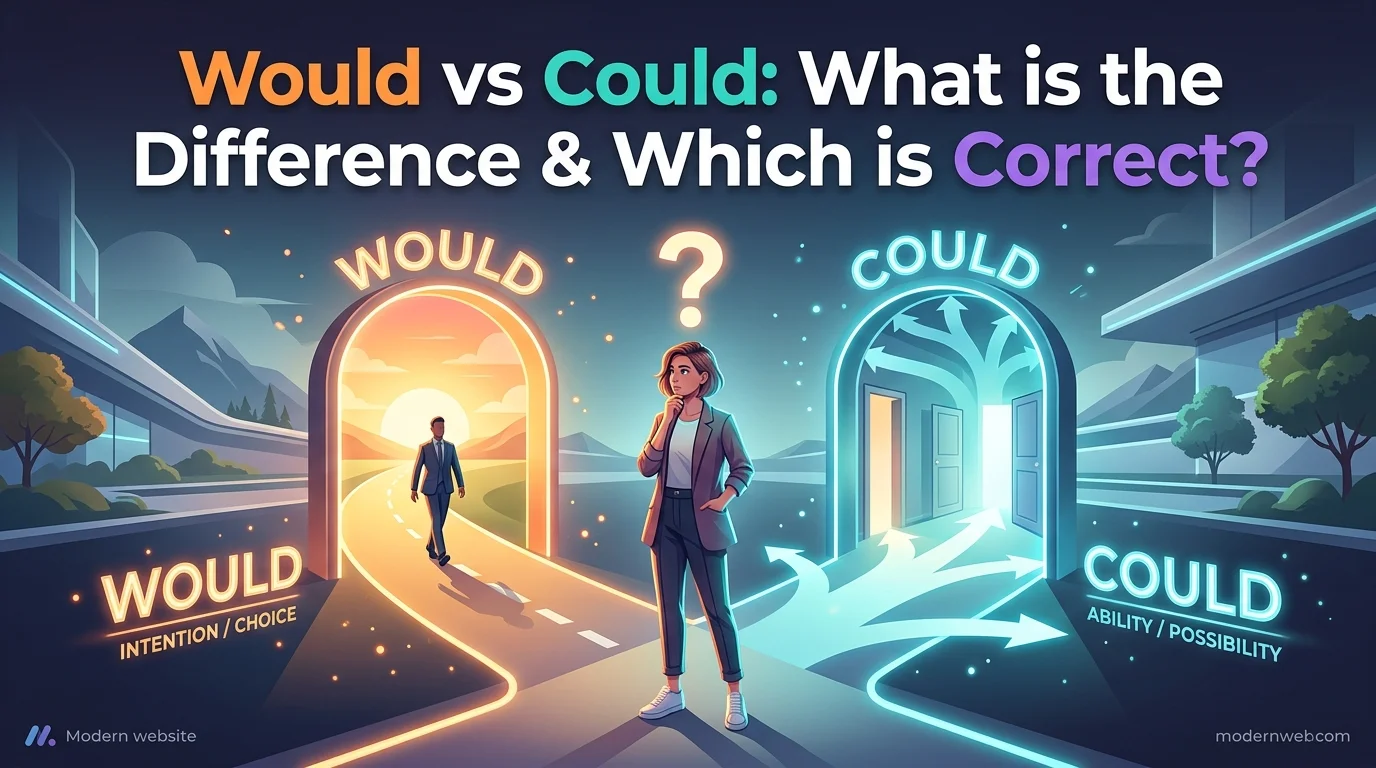
Many English learners confuse would and could because both are common modal verbs used in everyday conversation and writing. While they may look similar, they have different meanings and purposes. Understanding the difference between would vs could helps you speak more naturally, write more accurately, and avoid common grammar mistakes.
Comparison Overview
Would and could are both modal verbs in English grammar. They often appear in polite requests, hypothetical situations, and conditional sentences. However, would usually expresses willingness, preference, or imagined results, while could mainly shows possibility, ability, or polite permission. Knowing when to use each one improves both spoken and written English.
Definition of Would
Would is a modal verb used to talk about:
• imagined or hypothetical situations
• future actions viewed from the past
• polite requests or offers
• preferences and choices
It often answers the idea of “what someone wants or what would happen.”
Examples:
• I would travel more if I had time.
• She would like a cup of tea.
Definition of Could
Could is a modal verb used to talk about:
• past ability
• possibility
• polite requests
• suggestions
It often answers the idea of “what someone is able to do or what is possible.”
Examples:
• I could swim when I was five.
• We could go to the park tomorrow.
Main Differences Between Would and Could
| Feature | Would | Could |
| Main meaning | willingness, choice, hypothetical result | ability, possibility, permission |
| Talks about | what someone wants or what may happen | what someone can do or might happen |
| Common use | preferences and conditionals | abilities and possibilities |
| Example | I would buy it. | I could buy it. |
| Tone | often shows desire | often shows possibility |
Key difference:
Would = choice/result
Could = ability/possibility
Example:
• I would help you if I had time. (willingness)
• I could help you if I had time. (ability)
Uses of Would and Could in Daily English
Both words are extremely common in polite English.
Examples:
• Would you like coffee?
• Could you pass the salt?
Although both sound polite, would focuses on preference, while could focuses on ability.
Grammar Guide
Both would and could are modal verbs.
Grammar pattern:
Subject + would/could + base verb
Examples:
• She would go.
• He could swim.
They never change form:
Not: woulds, coulds, woulded, coulded
How each term is used in sentences
Would
• I would travel more.
• They would help us.
Could
• I could drive at 18.
• She could join later.
Common mistakes learners make
Incorrect: I would swim when I was six.
Correct: I could swim when I was six.
Incorrect: Could you like some tea?
Correct: Would you like some tea?
Incorrect: He would can do it.
Correct: He could do it.
Simple rules to remember
Use would for:
• choice
• desire
• imagined result
Use could for:
• ability
• possibility
• permission
Easy memory trick:
Would = Want
Could = Can
Quick tips for writing and speaking
• Use would for polite offers: “Would you like…”
• Use could for polite requests: “Could you…”
• Use would in conditionals: “I would go…”
• Use could for ability: “I could run…”
When to Use Each One
Use would when:
• expressing preference
• talking about hypothetical situations
• making polite offers
• describing future in the past
Use could when:
• talking about past ability
• expressing possibility
• asking permission politely
• making suggestions
When NOT to Use Each One
Do not use would:
• for physical ability
Wrong: I would swim at age 5.
Correct: I could swim at age 5.
Do not use could:
• for preference
Wrong: Could you like tea?
Correct: Would you like tea?
Which One to Use (Decision Guide)
Ask yourself:
- Is it about ability? → Could
- Is it about possibility? → Could
- Is it about preference? → Would
- Is it about a hypothetical result? → Would
- Is it a polite request? → often Could
- Is it a polite offer? → often Would
Real-World Practical Examples
Would Examples
- Education: I would study harder for better grades.
- Daily life: I would choose pizza tonight.
- Business: We would invest more with better returns.
- Technology: I would upgrade my laptop next year.
- Conversation: I would love to meet you.
Could Examples
- Education: She could solve the math problem.
- Daily life: We could go shopping later.
- Science: This experiment could fail.
- Business: The company could expand globally.
- Technology: This app could improve productivity.
Self-Assessment (Fill in the Blanks)
- I ______ help you if I had time.
- She ______ speak French when she was young.
- ______ you open the window, please?
- I ______ love to visit Japan.
- They ______ finish the project tomorrow.
- He ______ buy the car if he had money.
- We ______ swim well as children.
- ______ you like some tea?
- It ______ rain tonight.
- I ______ choose the blue shirt.
- She ______ solve difficult puzzles at age ten.
- They ______ move next year.
- I ______ join you later.
- He ______ prefer coffee.
- You ______ ask your teacher for help.
- We ______ travel more with extra money.
- She ______ dance very well in school.
- ______ you help me carry this?
- I ______ never do that.
- This idea ______ work.
Answers
- would
- could
- Could
- would
- could
- would
- could
- Would
- could
- would
- could
- could
- could
- would
- could
- would
- could
- Could
- would
- could
Final Verdict
The difference between would and could is simple once you understand their purpose. Use would when talking about choice, willingness, or imagined results. Use could when talking about ability, possibility, or permission. A quick way to remember is: would relates to what someone wants, while could relates to what someone can do. Mastering this difference will make your English clearer and more natural.
Conclusion About Would vs Could
Understanding the difference between would and could makes English much easier and more natural to use in real life. Both words are small but powerful modal verbs that help express ideas clearly in conversation and writing. Would is mainly used for willingness, preferences, and imaginary situations, while could focuses on ability, possibility, and polite requests. Once you learn when to use each one, your sentences become more accurate and confident. Whether you are speaking, writing emails, or preparing for exams, mastering this simple distinction helps you communicate more effectively and sound more fluent in everyday English.
FAQs
What is the main difference between would and could?
Would is used for willingness, preferences, and imagined situations, while could is used for ability, possibility, and polite requests. Both are modal verbs, but they express different meanings depending on context.
Can would and could be used in polite sentences?
Yes, both are used politely in English. Would is often used for offers like “Would you like tea?”, while could is used for requests like “Could you help me?” Both sound respectful.
Is could the past form of can?
Yes, could is the past form of can when talking about ability. For example, “I can swim now” becomes “I could swim when I was young.”
When should I use would in daily conversation?
Use would when expressing preferences, habits, or imaginary situations. For example, “I would travel more if I had time” shows a hypothetical situation or personal choice.
Can could mean possibility?
Yes, could often expresses possibility. For example, “It could rain today” means there is a chance of rain, but it is not certain.
Which is more polite would or could?
Both are polite, but could is generally more polite for requests, while would is more polite for offers or invitations. Both are widely accepted in formal and informal English.
Can would and could be used together?
Yes, they can appear in the same sentence in conditional structures. For example, “I would go if I could drive” shows willingness and ability together.
Is would used for future tense?
Would is not a direct future tense marker. It is used for future in conditional or imagined situations, such as “I would call you tomorrow if I were free.”
What is a simple trick to remember would and could?
Remember: would relates to “want” or choice, while could relates to “can” or ability. This simple link helps you choose the correct word quickly.
Are would and could interchangeable?
No, they are not interchangeable. Using them incorrectly changes meaning. Would shows preference or imagination, while could shows ability or possibility, so context always matters.

Sarah Mitchell is an experienced writer and grammar teacher with over 10 years of expertise in English language education. She helps learners improve their grammar, writing, and communication skills through clear explanations and practical examples. Sarah creates learner-friendly content focused on real-life English, making language learning simple, effective, and confidence-building.