
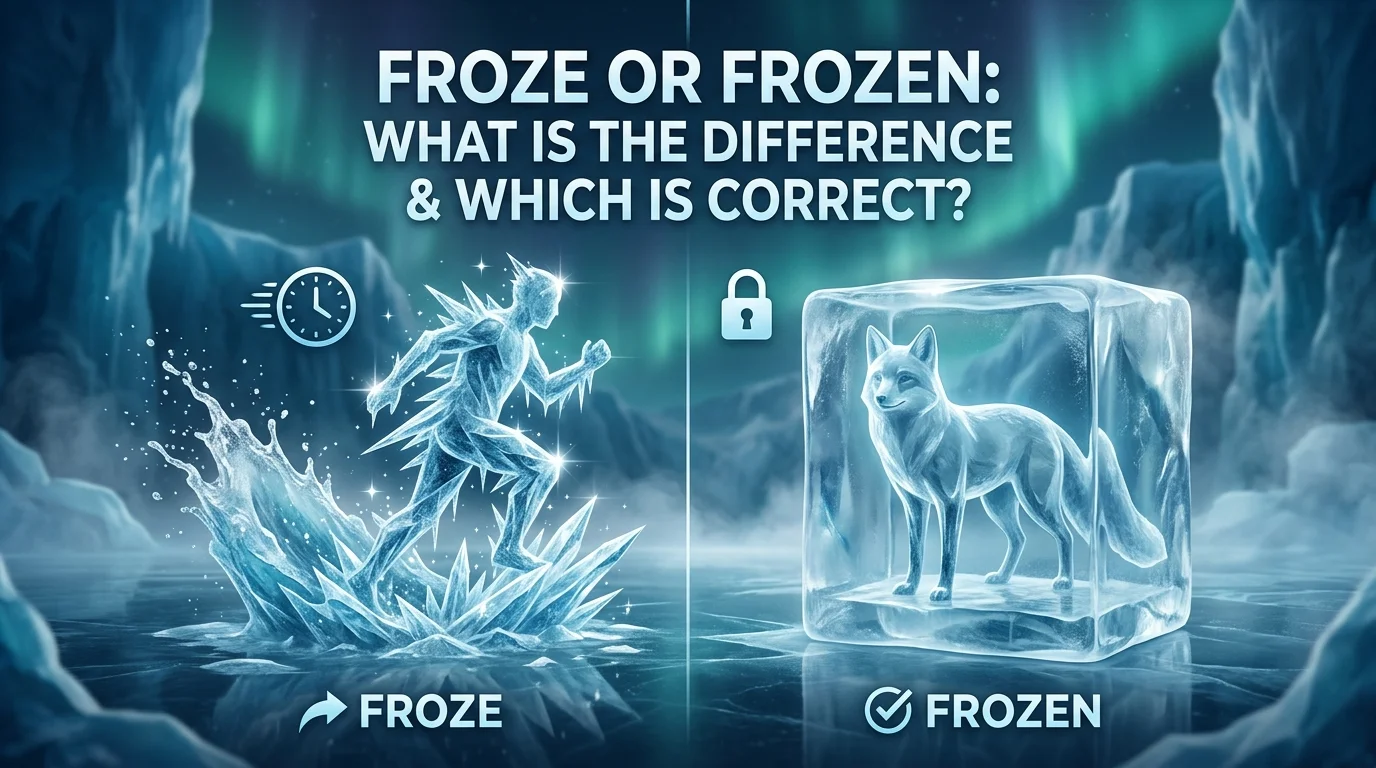
Understanding the difference between “froze” and “frozen” is important for using English correctly in both writing and speaking. These two words come from the same verb but are used in different grammatical situations. This guide will clearly explain their meanings, usage, and differences so you can avoid common mistakes and speak more naturally.
Comparison Overview
“Froze” and “frozen” are both forms of the verb “freeze,” but they are not interchangeable. “Froze” is the past tense form, while “frozen” is the past participle. They appear in different sentence structures depending on whether the action is complete or used with helping verbs like “has,” “have,” or “had.” Understanding their roles helps improve grammar accuracy and fluency.
Definition of Froze
“Froze” is the simple past tense of the verb “freeze.” It describes an action that happened and finished in the past. It does not require helping verbs and is used when you are simply stating what occurred earlier.
Definition of Frozen
“Frozen” is the past participle form of “freeze.” It is used with helping verbs such as “has,” “have,” or “had,” and also functions as an adjective to describe something that is extremely cold or solid due to freezing.
Main Differences Between Froze and Frozen
The key difference lies in grammar and sentence structure. “Froze” is used alone to describe a completed past action. “Frozen” is used in perfect tenses or as an adjective. For example, “The lake froze last night” versus “The lake has frozen completely.”
| Feature | Froze | Frozen |
| Verb form | Simple past | Past participle |
| Usage | Alone in past sentences | With helping verbs or as adjective |
| Example | I froze yesterday | I have frozen food |
| Function | Action completed | Completed action or description |
Grammar Guide
Understanding how “froze” and “frozen” function in grammar helps you use them correctly in different contexts.
How each term is used in sentences
“Froze” is used in simple past structures:
- Subject + froze + object (if any)
“Frozen” is used in perfect tenses or descriptive form:
- Subject + has/have/had + frozen
- Frozen + noun (adjective form)
Common mistakes learners make
Many learners confuse “froze” and “frozen” by using them interchangeably. A common error is saying “I have froze” instead of “I have frozen.” Another mistake is using “frozen” without a helping verb in simple past sentences.
Simple rules to remember
Use “froze” when the sentence is only about the past. Use “frozen” when a helping verb is present or when describing something as cold or solid.
Quick tips for writing and speaking
If you can replace the verb with “did,” use “froze.” If you can use “has” or “have” before it, use “frozen.” Also remember that “frozen” often describes objects like food, water, or conditions.
When to Use Each One
Use “froze” when telling a story or describing a past event. Use “frozen” when forming perfect tenses or describing a state. For example, ice that became solid yesterday “froze,” but ice that is still solid is “frozen.”
When NOT to Use Each One
Do not use “froze” with helping verbs like “has” or “have.” Do not use “frozen” alone in simple past sentences. Avoid saying “I have froze” or “The water frozen yesterday.”
Which One to Use (Decision Guide)
If the sentence is in simple past tense, choose “froze.” If the sentence uses “has,” “have,” or “had,” choose “frozen.” If you are describing something as an adjective, choose “frozen.” This quick decision rule helps eliminate confusion in most cases.
Real-World Practical Examples
Froze Examples
- The lake froze overnight during the cold wave.
- I froze when I heard the loud noise.
- The computer froze while I was working.
- She froze in fear during the performance.
- The pipes froze in winter.
Frozen Examples
- The pond has frozen completely this morning.
- My food has frozen in the refrigerator.
- The lake is frozen during winter months.
- The account had frozen due to inactivity.
- Frozen water covers the road in the morning.
Self-Assessment (Fill in the Blanks)
- The river ______ last night during the storm.
- I have ______ my vegetables for later use.
- She ______ when she saw the surprise.
- The screen has ______ again.
- The lake ______ completely in December.
- My hands ______ in the cold wind.
- The food is ______ and ready to cook.
- They have ______ the documents in storage.
- The water ______ during the night.
- He ______ in place when he heard the sound.
- The pipes have ______ due to freezing temperatures.
- I ______ during the scary moment.
- The pond ______ early this winter.
- She has ______ all the meat.
- The system ______ unexpectedly.
- We ______ when the alarm went off.
- The lake has ______ over the week.
- The driver ______ at the signal.
- The drink ______ solid in the freezer.
- They ______ during the cold night.
Answers
- froze
- frozen
- froze
- frozen
- froze
- froze
- frozen
- frozen
- froze
- froze
- frozen
- froze
- froze
- frozen
- froze
- froze
- frozen
- froze
- frozen
- froze
Final Verdict
“Froze” and “frozen” are closely related but serve different grammatical purposes. “Froze” is used for simple past actions, while “frozen” is used with helping verbs or as an adjective. Mastering this difference improves both writing accuracy and spoken fluency. With practice, choosing between them becomes quick and natural.
Conclusion About Froze or Frozen
Understanding the difference between froze and frozen makes English grammar much easier to use in everyday life. Although both come from the same verb, they serve different roles in sentence structure. Froze is used when describing a completed action in the past, while frozen is used with helping verbs or as a descriptive word. Once you learn this simple distinction, your writing becomes clearer and more natural. Many learners struggle with these forms at first, but with regular practice, the confusion quickly disappears. Whether you are speaking, writing essays, or having conversations, choosing the correct form helps you sound more fluent and confident. Keep in mind the basic rule of past action versus completed state, and you will always know which word fits best in context.
FAQs
What is the main difference between froze and frozen?
The main difference is grammatical use. Froze is the simple past form of freeze and is used for completed actions. Frozen is the past participle used with helping verbs or as an adjective. Understanding this helps avoid common grammar mistakes and improves sentence accuracy in both speaking and writing.
Is it correct to say I have froze?
No, it is incorrect. The correct form is I have frozen because “have” requires the past participle form. Froze is only used in simple past tense without helping verbs. Using frozen with has, have, or had ensures proper grammar structure and clearer communication in English.
When should I use froze in a sentence?
Use froze when describing an action that happened and finished in the past. It does not need helping verbs. For example, The lake froze last night is correct. It is commonly used in storytelling, reports, and daily conversations when referring to completed past events.
When should I use frozen in a sentence?
Use frozen when forming perfect tenses or when describing something as cold or solid. For example, The lake has frozen or frozen food are correct uses. It often works with has, have, or had and can also act as an adjective in descriptions.
Can frozen be used as an adjective?
Yes, frozen is often used as an adjective. It describes something that has become solid due to cold temperatures. For example, frozen water, frozen vegetables, or frozen pipes. In these cases, it does not function as a verb but as a descriptive word.
Why do people confuse froze and frozen?
People confuse them because both come from the same verb freeze. The difference lies in grammar rules that are not always intuitive for learners. Froze is past tense, while frozen is past participle. Without practice, it is easy to mix them up in sentences.
Is it correct to say the water froze yesterday?
Yes, that sentence is correct. Froze is used because it describes a completed action in the past. There is no helping verb like has or have, so the simple past form is appropriate. It clearly shows when the freezing action happened.
What is the rule for using frozen in perfect tense?
The rule is to use frozen with helping verbs like has, have, or had. This forms perfect tenses such as present perfect or past perfect. For example, The lake has frozen or The pipes had frozen before repair. It shows completed actions with relevance to time.
Can I use froze in passive voice sentences?
No, froze is not used in passive voice. Passive structures require the past participle form frozen. For example, The food was frozen is correct, while The food was froze is incorrect. Always use frozen in passive constructions for grammatical accuracy.
How can I remember the difference easily?
A simple way is to remember that froze stands alone for past actions, while frozen needs helpers like has or have. Also, frozen often describes something like food or ice. This quick rule helps you choose the correct form without confusion.

Amelia Wright focuses on making figurative language easy to understand. Her writing explains similes, metaphors, and word meanings using relatable examples. She aims to help readers recognize subtle differences in usage and apply them correctly in both academic and casual writing.