
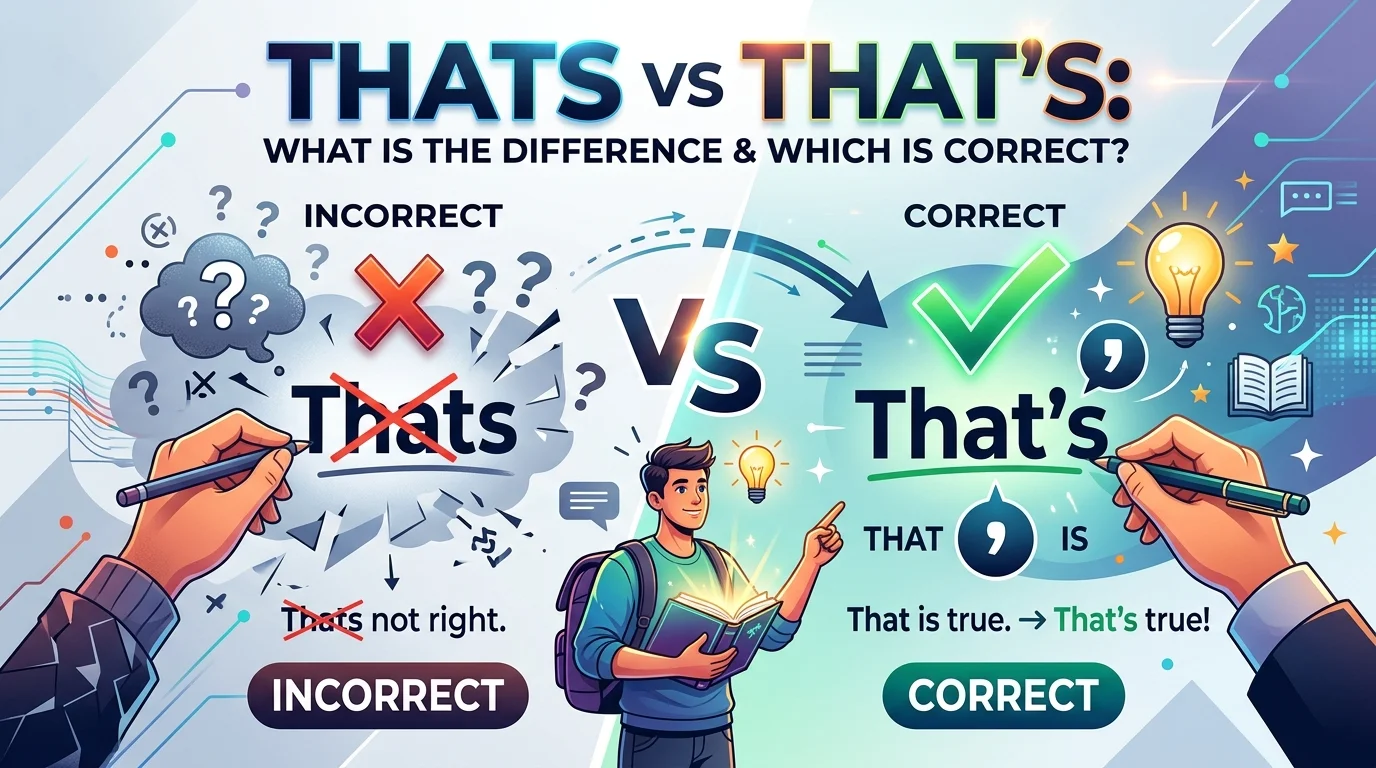
Understanding the difference between “Thats” and “That’s” is important for clear and correct English writing. Many learners get confused because they look similar, but only one is grammatically correct. This comparison will help you understand their meanings, usage, and common mistakes so you can write confidently and accurately.
Comparison Overview
“Thats” and “That’s” may look almost identical, but they are not the same in English grammar. “Thats” is considered incorrect in standard English writing, while “That’s” is a correct contraction of “that is” or “that has.” The difference mainly comes down to apostrophe usage, which changes both meaning and correctness.
Definition of Thats
“Thats” is not a standard English word. It appears when writers forget to add the apostrophe in “That’s.” In formal grammar, it is treated as an error. Although it may sometimes appear in informal typing or mistakes, it does not have a recognized grammatical function or meaning in English.
Definition of That’s
“That’s” is a contraction formed by combining “that” and “is” or “that” and “has.” The apostrophe replaces missing letters, making writing shorter and more natural. It is widely used in everyday speech, writing, conversations, and formal texts when appropriate.
Main Differences Between Thats and That’s
The key difference between “Thats” and “That’s” lies in grammar correctness and meaning. “Thats” has no grammatical validity and is considered a spelling mistake, while “That’s” is a proper contraction used in both spoken and written English.
“That’s” always carries meaning such as “that is” or “that has,” depending on context. For example, “That’s amazing” means “That is amazing.” In contrast, “Thats” does not represent any meaningful structure and should always be corrected in writing.
Grammar Guide
How each term is used in sentences
“That’s” is used when combining “that is” or “that has” in sentences for smoother communication.
Examples:
- That’s a great idea.
- That’s been a long day.
“Thats” should not be used in any formal or informal correct writing.
Common mistakes learners make
Many learners forget the apostrophe and write “Thats” instead of “That’s.” This happens due to fast typing, lack of grammar awareness, or ignoring punctuation rules.
Simple rules to remember
If you can replace the word with “that is” or “that has,” then you must use “That’s.” If there is no apostrophe, the word is incorrect.
Quick tips for writing and speaking
Always double-check contractions in your writing. If you see “Thats,” correct it immediately to “That’s.” In speech, remember that the apostrophe represents missing letters, even though it is not pronounced.
When to Use Each One
“That’s” is used in everyday communication, emails, essays, conversations, and professional writing whenever you need a contraction of “that is” or “that has.”
“Thats” should never be used in correct English writing. If it appears, it should be treated as a spelling error and corrected immediately.
When NOT to Use Each One
You should not use “That’s” when you need the full form in very formal writing where contractions are avoided, such as legal documents or highly formal academic writing. In such cases, write “that is” instead.
“Thats” should never be used in any context because it is not grammatically correct.
Which One to Use (Decision Guide)
If you are writing or speaking and need to express “that is” or “that has,” always choose “That’s.” If you are unsure, try expanding the sentence. If “that is” fits, use “That’s.” Never choose “Thats” because it is always incorrect.
Real-World Practical Examples
Thats Examples
- I will treat “Thats” as a spelling mistake in this essay.
- Typing “Thats” quickly is a common keyboard error.
- Students often write “Thats” instead of correcting it.
- Spell check usually flags “Thats” as incorrect.
- In editing, “Thats” must always be changed.
That’s Examples
- That’s a beautiful sunset.
- That’s exactly what I meant.
- That’s been my favorite movie for years.
- That’s not the right answer.
- That’s a good way to solve the problem.
- That’s interesting to hear.
- That’s what I was looking for.
- That’s his final decision.
- That’s a great opportunity.
- That’s how you fix the issue.
Self-Assessment (Fill in the Blanks)
- I think ______ a good idea to start early.
- The teacher said ______ correct.
- ______ been a long time since we met.
- I believe ______ the best option available.
- She told me ______ not important right now.
- ______ exactly what I wanted to say.
- If it means “that is,” then the correct form is ______.
- ______ a mistake in your sentence.
- He said ______ his final answer.
- ______ really helpful advice.
- I noticed ______ wrong in the report.
- ______ been a great experience so far.
- We all agreed ______ the right decision.
- ______ something you should remember.
- My friend said ______ not necessary.
- ______ the reason I came here.
- ______ what makes this interesting.
- If written without an apostrophe, ______ is incorrect.
- ______ been a productive day.
- The correct contraction is ______.
Answers
- That’s
- That’s
- That’s
- That’s
- That’s
- That’s
- That’s
- That’s
- That’s
- That’s
- That’s
- That’s
- That’s
- That’s
- That’s
- That’s
- That’s
- Thats
- That’s
- That’s
Final Verdict
The difference between “Thats” and “That’s” is simple but important. “That’s” is the correct and grammatically accepted contraction of “that is” or “that has,” while “Thats” is always incorrect and should be avoided in all forms of writing. By remembering the role of the apostrophe, you can easily choose the right form and improve your grammar accuracy in everyday communication.
Conclusion About Thats or That’s
Understanding the difference between “Thats” and “That’s” is essential for writing clear and correct English. While both may look similar at first glance, only “That’s” is grammatically correct and widely accepted in both formal and informal communication. It works as a contraction of “that is” or “that has,” making sentences smoother and more natural. On the other hand, “Thats” is simply a common spelling mistake caused by missing punctuation. By remembering the role of the apostrophe, you can quickly avoid this error and improve your writing accuracy. Whether you are writing emails, essays, or casual messages, using “That’s” correctly helps you sound more confident and professional in English communication.
FAQs
What is the main difference between Thats and That’s?
The main difference is that “That’s” is a correct contraction of “that is” or “that has,” while “Thats” is a spelling error. The apostrophe in “That’s” replaces missing letters, making it grammatically correct. “Thats” has no recognized meaning in English and should always be corrected in writing.
Is Thats a correct English word?
No, “Thats” is not a correct English word. It is considered a spelling mistake in standard grammar. Writers often forget to include the apostrophe, which turns “That’s” into an incorrect form. In all formal and informal writing, it should always be corrected to “That’s.”
When should I use That’s in a sentence?
You should use “That’s” when you mean “that is” or “that has.” It is commonly used in everyday conversation, writing, and professional communication. For example, “That’s a great idea” or “That’s been a long day” are correct uses of this contraction in English sentences.
Why do people write Thats instead of That’s?
People often write “Thats” due to fast typing, lack of attention to punctuation, or misunderstanding apostrophes. Since the apostrophe is small and sometimes overlooked, it gets skipped. However, this results in an incorrect form that should always be corrected during proofreading or editing.
Is That’s formal or informal English?
“That’s” is acceptable in both formal and informal English, depending on context. It is commonly used in everyday writing and speech. However, in very formal documents like legal writing or academic papers, it is better to use the full form “that is” instead of the contraction.
Can Thats change the meaning of a sentence?
“Yes,” using “Thats” can make a sentence incorrect and confusing because it is not a valid English word. It does not carry any grammatical meaning, so the sentence may appear as a spelling error rather than conveying the intended message clearly.
How can I remember to use That’s correctly?
A simple way to remember is to expand the word in your mind. If you can replace it with “that is” or “that has,” then “That’s” is correct. This trick helps you quickly decide when to use the apostrophe form in writing and avoid mistakes.
Is That’s used in spoken English?
Yes, “That’s” is commonly used in spoken English as a natural contraction. People use it in daily conversations to sound more fluent and natural. Although the apostrophe is not spoken, it represents the missing letters in “that is” or “that has.”
What happens if I use Thats in exams?
Using “Thats” in exams is considered a grammatical error and may reduce your writing score. Teachers expect correct punctuation and proper contractions. Always use “That’s” instead to show strong command of English grammar and improve your overall writing quality.
What is the easiest way to avoid this mistake?
The easiest way to avoid this mistake is by proofreading your writing carefully. Look specifically for missing apostrophes in contractions. If you see “Thats,” immediately correct it to “That’s.” Regular reading and writing practice also help reinforce correct grammar habits.

Ethan Clarke is a language writer who specializes in breaking down similes, word meanings, and commonly confused terms. His work focuses on clear explanations, practical examples, and simple comparisons that help readers understand how English