
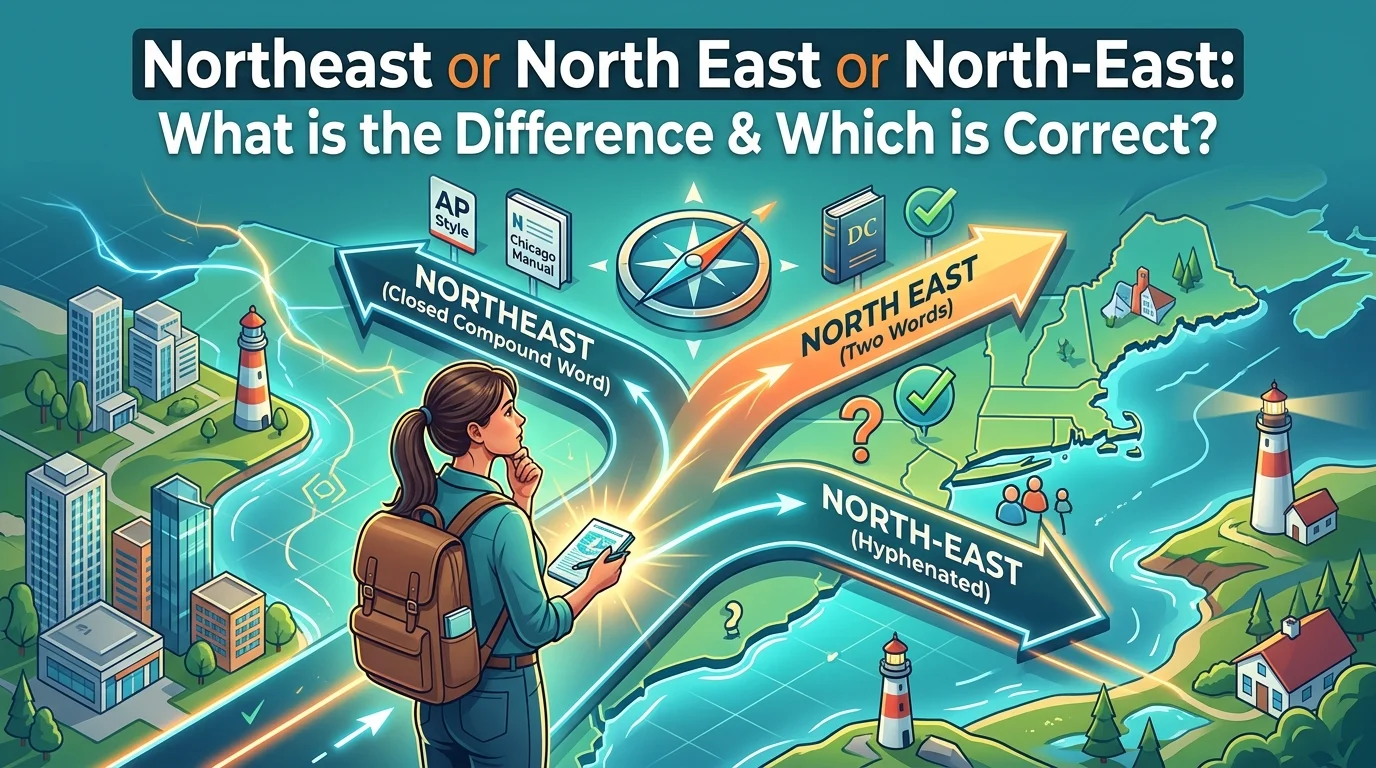
This comparison explains the difference between “Northeast,” “North East,” and “North-East,” three forms that often confuse writers and learners. Although they look similar, each version appears in different contexts such as grammar, geography, and style guides. Understanding the correct usage helps improve writing accuracy, clarity, and professionalism in both academic and everyday communication.
Comparison Overview
All three forms refer to the same general idea of a direction or region located between north and east. However, they differ mainly in spelling style, grammatical acceptance, and regional usage preferences. “Northeast” is the most commonly accepted modern standard in American English, “North-East” is often used in British English or formal writing, and “North East” is less standard but still appears in older texts or informal usage. Choosing the right form depends on context and style conventions.
Definition of Northeast
“Northeast” is a single-word compound noun or adjective used to describe a direction, location, or region that lies between north and east. It is the most widely accepted modern spelling in American English and is commonly used in geography, weather reports, and general writing.
It functions as both a noun (the northeast region) and an adjective (northeast wind). It is considered the standard form in most contemporary style guides.
Definition of North East
“North East” is a two-word version of the same directional term. It is less common in modern standardized writing but may appear in informal contexts, older publications, or certain regional uses. In strict grammar terms, it is generally considered non-standard when referring to a compass direction, but it may still be used when writers intentionally separate the words for emphasis.
Definition of North-East
“North-East” is the hyphenated form of the term. It is often used in British English, formal documents, or older style conventions. The hyphen indicates that the two directional words function together as a single unit. While still valid in some contexts, modern writing increasingly prefers the closed form “Northeast.”
Main Differences Between Northeast, North East, and North-East
The key differences lie in spelling style, formality, and usage preferences. “Northeast” is the most modern and widely accepted form, especially in American English. “North-East” is still found in British English writing and formal geography texts. “North East” is the least standard and often considered outdated or stylistically inconsistent.
From a grammatical perspective, all three refer to the same directional meaning, but consistency matters in writing. Using one form throughout a document is important for clarity and professionalism. In most modern contexts, “Northeast” is the preferred choice.
Comparison Table
| Form | Status | Usage Style | Common Contexts |
| Northeast | Standard | Modern, formal | US English, general writing |
| North-East | Acceptable | Traditional/formal | UK English, geography texts |
| North East | Non-standard | Informal/old usage | Rare or inconsistent usage |
Grammar Guide
How each term is used in sentences
“Northeast” is used as a noun or adjective in modern writing.
Example patterns:
- The northeast region is experiencing rain.
- The wind is blowing from the northeast.
“North-East” is used similarly but is more common in British English style guides.
- The North-East coast is densely populated.
“North East” is rarely used in formal grammar but may appear in informal writing.
- The North East area has many hills.
Common mistakes learners make
A frequent mistake is mixing all three forms within the same document, which reduces consistency. Another common error is using “North East” in formal academic writing where “Northeast” is preferred. Writers also sometimes incorrectly capitalize both words in casual contexts.
Simple rules to remember
- Use “Northeast” for modern American English.
- Use “North-East” if following British or traditional style guides.
- Avoid “North East” unless specifically required by older formatting styles.
Quick tips for writing and speaking
Choose one form and stay consistent throughout your text. If you are unsure, default to “Northeast” because it is the most widely accepted. In professional writing, always check the required style guide before finalizing usage.
When to Use Each One
Use “Northeast” when writing academic papers, articles, weather reports, or general content in American English. Use “North-East” when working with British English conventions or formal geographic references. “North East” should only be used in informal or historical contexts where older spelling styles are preserved.
When NOT to Use Each One
Avoid switching between different forms in the same document. Do not use “North East” in formal writing unless required by a specific guideline. Avoid “North-East” in American English contexts where the standard closed form is expected. Inconsistent usage can make writing appear unpolished.
Which One to Use (Decision Guide)
If your audience is global or American English based, use “Northeast.” If you are writing for British English publications or formal geography material, “North-East” may be acceptable. If you are unsure, choose “Northeast” as it is the most universally recognized and modern form.
Real-World Practical Examples
Northeast Examples
- The northeast region of the country has cold winters.
- Migratory birds travel toward the northeast in summer.
- The northeast direction is marked on the map.
- The company expanded into the northeast market.
- A strong storm is moving from the northeast coast.
North East Examples
- The North East part of the city is under development.
- Tourism is growing in the North East area.
- The North East zone has historical landmarks.
- Farmers in the North East region depend on rainfall.
- The North East boundary is clearly marked.
North-East Examples
- The North-East corridor is important for trade routes.
- The North-East wind brings cool air during winter.
- Several tribes live in the North-East hills.
- The North-East coastline is prone to erosion.
- The North-East division has unique cultural traditions.
Self-Assessment (Fill in the Blanks)
- The ______ direction is commonly used in modern American English.
- The correct word is ______ because it is the standard closed form.
- ______ is often used in British English writing styles.
- The ______ region experiences heavy rainfall during monsoon.
- ______ is less commonly used in modern writing.
- The wind is coming from the ______ side.
- In formal geography, ______ may still appear.
- The ______ coast is known for tourism.
- Writers should avoid mixing ______ forms in one document.
- The ______ area has cultural diversity.
- ______ is the most widely accepted modern spelling.
- The ______ hills are covered with forests.
- The ______ market has expanded rapidly.
- ______ is sometimes seen in older texts.
- The ______ zone includes several states.
- ______ is preferred in US English usage.
- The ______ boundary is marked on official maps.
- The ______ region has a cold climate.
- ______ may appear in informal writing.
- The ______ direction helps with navigation.
Answers
- Northeast
- Northeast
- North-East
- Northeast
- North East
- Northeast
- North-East
- North-East
- Northeast
- North East
- Northeast
- North-East
- Northeast
- North East
- North-East
- Northeast
- North-East
- Northeast
- North East
- Northeast
Final Verdict
All three forms refer to the same directional concept, but they differ in style and acceptance. “Northeast” is the most modern and widely used form, especially in American English and general writing. “North-East” remains acceptable in certain British or formal contexts, while “North East” is less standard and best avoided in professional writing. Choosing “Northeast” ensures clarity, consistency, and correctness in most situations.
Conclusion About Northeast or North East or North-East
In conclusion, understanding the difference between Northeast, North East, and North-East makes writing clearer, more accurate, and more professional. While all three terms describe the same general direction or region between north and east, their usage depends on style conventions and regional preferences. Northeast is the most modern and widely accepted form, especially in American English. North-East is often seen in British or formal geographic writing, while North East is less standard and usually appears in informal or older texts. Choosing the correct form improves readability and ensures consistency in communication across academic, professional, and everyday contexts.
FAQs
What does Northeast mean in simple terms?
Northeast refers to a direction that lies between north and east on a compass. It is also used to describe a region located in that direction. In modern English, it is the most commonly accepted spelling and is widely used in geography, weather reports, and everyday communication to indicate location or movement.
Is North East grammatically correct?
North East is not commonly accepted in modern standard English as a single directional term. While it may appear in informal writing or older texts, it is generally considered non-standard. Most style guides recommend using Northeast or North-East depending on regional writing conventions for clarity and consistency.
When should I use North-East instead of Northeast?
North-East is typically used in British English or formal geographic contexts. It appears more in traditional writing styles or official documents that follow older conventions. However, in modern usage, many writers prefer Northeast for simplicity and consistency, especially in American English content and digital writing.
Why is Northeast more popular than other forms?
Northeast is more popular because it follows modern linguistic trends that favor compound words for directions and locations. It is shorter, clearer, and widely accepted in American English. This makes it the preferred choice in education, media, and professional writing, where consistency and readability are important.
Can I mix all three forms in one document?
It is not recommended to mix Northeast, North East, and North-East within the same document. Doing so can confuse readers and reduce writing quality. It is better to choose one form based on your audience or style guide and use it consistently throughout the entire text.
Is Northeast used in British English?
Yes, Northeast is increasingly used in British English as well, especially in modern writing. However, North-East still appears in some traditional or formal British contexts. Both forms may be acceptable, but consistency within a document is more important than the specific choice.
What is the difference between Northeast and North-East?
The main difference is stylistic. Northeast is a closed compound word commonly used in modern American English. North-East uses a hyphen and is more common in British or formal writing. Both refer to the same direction, but usage depends on regional and stylistic preferences.
Is North East outdated?
North East is generally considered outdated in formal writing. It may still appear in informal contexts or older publications, but it is not recommended for professional or academic use. Writers are encouraged to use Northeast or North-East instead for better clarity and modern correctness.
How do style guides treat these terms?
Most modern style guides prefer Northeast as the standard form in American English. British style guides may allow North-East in certain cases. North East is usually not recommended in any formal style guide due to inconsistency and lack of standardization in modern usage.
Which form is best for academic writing?
For academic writing, Northeast is usually the best choice because it is widely accepted, clear, and consistent with modern English standards. It helps maintain professionalism and avoids confusion, especially in research papers, essays, and formal reports.

Sarah Mitchell is an experienced writer and grammar teacher with over 10 years of expertise in English language education. She helps learners improve their grammar, writing, and communication skills through clear explanations and practical examples. Sarah creates learner-friendly content focused on real-life English, making language learning simple, effective, and confidence-building.