
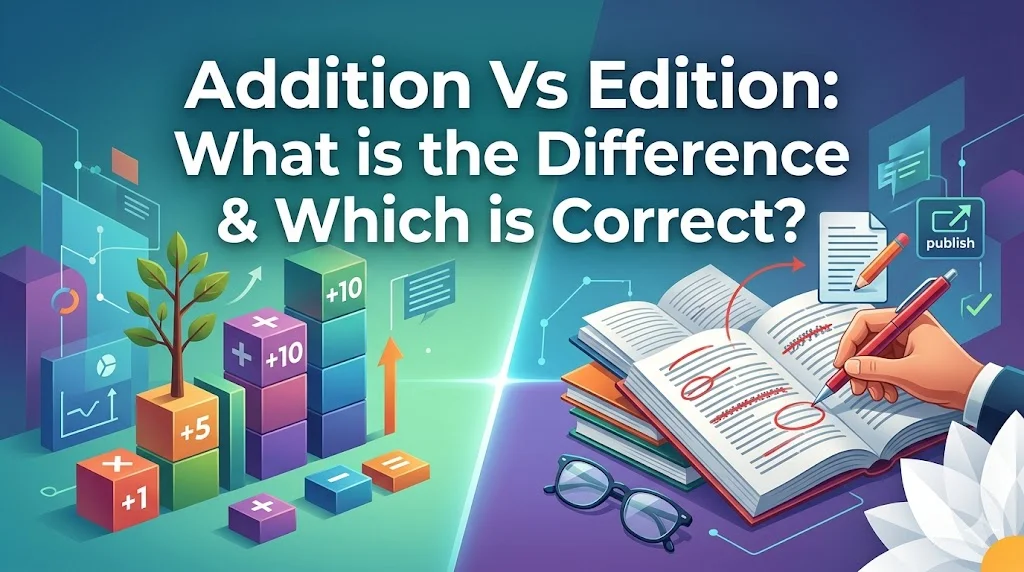
Understanding the difference between “addition” and “edition” is important because these two words sound similar but have completely different meanings. Many learners confuse them in writing and speech. This guide clearly explains what each word means, how to use them correctly, and how to avoid common mistakes in everyday communication.
Comparison Overview
“Addition” and “edition” may look alike, but they belong to different contexts. “Addition” relates to adding or increasing something, often used in math or general situations. “Edition,” on the other hand, refers to a version of something, especially books, newspapers, or products. Knowing this difference helps you communicate more clearly and accurately.
Definition of Addition
“Addition” refers to the act of adding something to something else. It is commonly used in mathematics to describe combining numbers, but it can also mean including or increasing something in general situations. It focuses on growth, increase, or inclusion.
Definition of Edition
“Edition” refers to a particular version or release of a published work, such as a book, magazine, or software. It highlights a specific form that may include updates, revisions, or changes from earlier versions.
Main Differences Between Addition and Edition
The main difference lies in meaning and usage. “Addition” is about increasing or including something new, while “edition” is about a version or release of something. “Addition” is often used in math, daily life, and descriptions of growth. “Edition” is used in publishing, media, and product versions. One focuses on quantity, the other on versions or formats.
Grammar Guide
How each term is used in sentences
“Addition” is used as a noun to describe adding something. Example pattern: Subject + addition + to + noun.
Example: This room is a great addition to the house.
“Edition” is also a noun but refers to versions. Example pattern: Subject + edition + of + noun.
Example: This is the latest edition of the book.
Common mistakes learners make
Many learners confuse “addition” with “edition” because of similar pronunciation. They may write “new addition of a book” instead of “new edition.” Another mistake is using “edition” when talking about adding something rather than referring to a version.
Simple rules to remember
Use “addition” when something is being added.
Use “edition” when talking about versions or releases.
If you can replace it with “increase,” use “addition.”
If you can replace it with “version,” use “edition.”
Quick tips for writing and speaking
Think of “addition” as math or increase.
Think of “edition” as books, updates, or releases.
Check the context before choosing the word.
Read your sentence again to see if “version” or “adding” fits better.
When to Use Each One
Use “addition” when you are talking about adding something, increasing quantity, or including something new in a group. For example, adding a new member to a team.
Use “edition” when referring to a specific version of a book, magazine, software, or product. For example, a revised textbook or updated app version.
When NOT to Use Each One
Do not use “addition” when referring to versions of books or products. Saying “latest addition of the magazine” is incorrect.
Do not use “edition” when talking about adding something. Saying “new edition to the team” is incorrect.
Which One to Use (Decision Guide)
Choose “addition” if your sentence involves adding, increasing, or including something new.
Choose “edition” if your sentence refers to a version, release, or updated form of something.
If unsure, replace the word with “increase” or “version” to check correctness.
Real-World Practical Examples
Addition Examples
The new employee is a great addition to the company.
We made an addition to our house last year.
In math, addition is the process of combining numbers.
The chef added spices as an addition to the recipe.
This feature is a useful addition to the app.
Edition Examples
This is the second edition of the novel.
The newspaper released a special edition today.
I bought the latest edition of the textbook.
This software comes in a premium edition.
Collectors love limited edition products.
Self-Assessment (Fill in the Blanks)
I will use ______ when referring to adding something new.
The correct word is ______ because it means increase.
I will use ______ when referring to a book version.
The correct word is ______ because it means version.
I will use ______ when talking about math operations.
The correct word is ______ because it involves numbers.
I will use ______ when talking about a magazine release.
The correct word is ______ because it refers to a version.
I will use ______ when describing growth in a project.
The correct word is ______ because it shows increase.
I will use ______ when referring to a revised textbook.
The correct word is ______ because it means updated version.
I will use ______ when adding a new feature.
The correct word is ______ because it means inclusion.
I will use ______ when describing a product version.
The correct word is ______ because it means release.
I will use ______ when combining numbers.
The correct word is ______ because it is a math term.
I will use ______ when talking about limited releases.
The correct word is ______ because it means special version.
Answers
- addition
- addition
- edition
- edition
- addition
- addition
- edition
- edition
- addition
- addition
- edition
- edition
- addition
- addition
- edition
- edition
- addition
- addition
- edition
- edition
Final Verdict
“Addition” and “edition” are often confused due to their similar spelling and pronunciation, but their meanings are entirely different. “Addition” is used when something is added or increased, while “edition” refers to a version or release of something. By focusing on context and remembering simple rules, you can easily choose the correct word and improve your clarity in both writing and speaking.
Conclusion About Addition Vs Edition
Understanding the difference between Addition Vs Edition makes your English clearer, more accurate, and more professional in both writing and speaking. “Addition” is always linked to something being added, increased, or included, while “edition” refers to a specific version or release of a book, magazine, software, or product. Although they look similar, their meanings belong to completely different contexts. Once you remember that “addition” is about quantity and “edition” is about versions, you can avoid common mistakes easily. This simple clarity helps improve grammar confidence, especially in academic, professional, and everyday communication.
FAQs About Addition Vs Edition
What is the main difference between addition and edition
The main difference is meaning. “Addition” refers to something being added or included, often increasing quantity. “Edition” refers to a version of something, such as a book or software. One focuses on increase, while the other focuses on versions or releases. Understanding context helps choose the correct word easily.
Can addition and edition be used interchangeably
No, they cannot be used interchangeably. “Addition” is used for adding or increasing something, while “edition” is used for versions of published or released materials. Using them interchangeably leads to incorrect grammar and confusion. Each word has a specific purpose based on context and meaning.
Is addition only used in mathematics
No, addition is not only used in mathematics. While it is commonly associated with numbers, it is also used in everyday language to describe including or adding something new. For example, a new feature can be an addition to a product or service.
What does edition mean in books
In books, “edition” refers to a specific version of a book. Each edition may include updates, corrections, or revisions from previous versions. For example, a second edition means the book has been updated or reprinted with changes made by the author or publisher.
Why do people confuse addition and edition
People often confuse them because they sound and look similar. However, their meanings are very different. “Addition” relates to adding or increasing something, while “edition” relates to versions or releases. This similarity in spelling leads to frequent mistakes in writing and speech.
Can edition be used for software
Yes, “edition” is commonly used for software. Different versions of software are called editions, such as basic edition, premium edition, or professional edition. Each edition may include different features or updates, helping users choose based on their needs.
How can I remember the difference easily
A simple way to remember is to link “addition” with “add” and “increase,” and “edition” with “edit” and “version.” If something is being added, use addition. If something is a version or release, use edition. This mental trick helps avoid confusion in writing.
Is addition used in daily conversation
Yes, addition is frequently used in daily conversation. People use it when talking about adding something new, such as a person, feature, or item. For example, “This is a great addition to the team” is a common and natural way to use the word.
What are examples of edition in real life
Examples of edition include book editions, newspaper editions, and software editions. For instance, a revised textbook is a new edition, or a special newspaper release is a special edition. These examples show how edition always refers to versions or releases.
Which is more commonly used addition or edition
Both are commonly used but in different contexts. “Addition” is widely used in general language, mathematics, and daily communication. “Edition” is mainly used in publishing, media, and product versions. Their usage depends entirely on the situation and meaning needed.

Daniel Brooks is an English educator with a passion for explaining similes and word comparisons in plain language. He covers topics like versus meanings, correct usage, and figurative language to help writers avoid common mistakes and improve clarity in everyday writing.
