
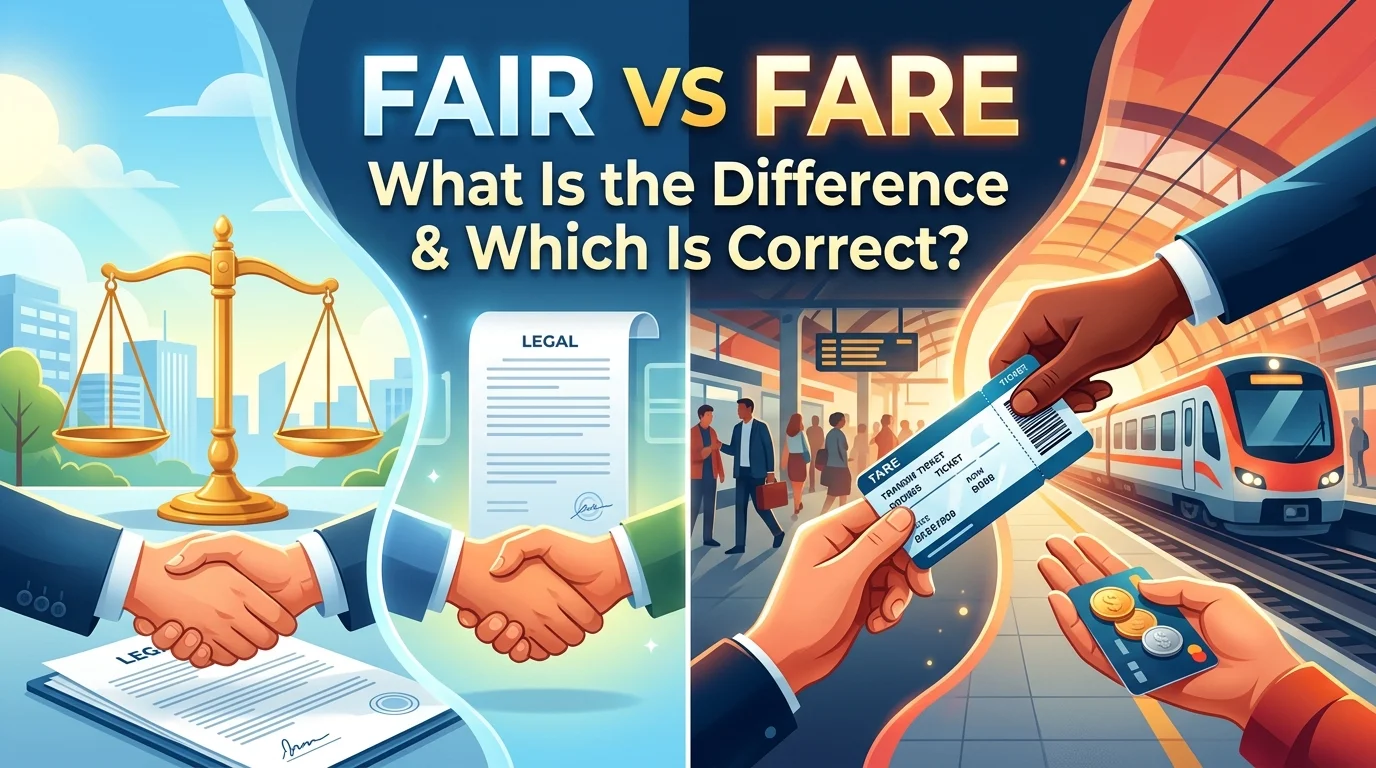
Many English learners confuse fair and fare because they sound exactly the same, but they have very different meanings and uses. These words are homophones, which means they are pronounced alike but spelled differently. Understanding Fair vs Fare helps you avoid writing mistakes and improves your grammar, speaking, and everyday English confidence.
Comparison Overview
Fair and fare may sound identical, but they serve completely different purposes in English.
Fair is mostly used as an adjective or noun and relates to ideas like justice, equality, beauty, or public events.
Fare is usually a noun or verb connected to travel costs, food, or how someone performs in a situation.
Knowing the difference between fair vs fare is important because using the wrong word can completely change your sentence’s meaning.
Definition of Fair
The word fair generally means something that is just, equal, reasonable, or acceptable.
It can also describe physical appearance, such as light skin or hair, or refer to a public event or exhibition.
Examples:
- The teacher made a fair decision.
- She has fair skin.
- We visited the book fair yesterday.
Main meanings of fair:
- Just or unbiased
- Reasonable
- Attractive/light-colored
- Public event or exhibition
Definition of Fare
The word fare usually relates to travel cost, food, or performance.
It often appears when discussing transportation tickets or how someone is doing in a situation.
Examples:
- The bus fare increased this year.
- Traditional village fare was served.
- How did you fare in the exam?
Main meanings of fare:
- Cost of transport
- Food or meals
- To perform or progress
Main Differences Between Fair and Fare
| Feature | Fair | Fare |
| Meaning | Just, equal, event, attractive | Travel cost, food, performance |
| Part of Speech | Adjective, noun | Noun, verb |
| Common Context | Rules, treatment, events | Transport, restaurants, outcomes |
| Example | That was a fair choice. | The taxi fare was expensive. |
Key difference:
Use fair when talking about justice, appearance, or events.
Use fare when talking about travel cost, food, or performance.
Why People Confuse Fair and Fare
These words are often confused because:
- They sound exactly the same.
- Both are common in everyday English.
- Spell-check may not catch the mistake because both are real words.
Example confusion:
- Wrong: The bus fair is too high.
- Correct: The bus fare is too high.
Grammar Guide
How Each Term Is Used in Sentences
Fair patterns:
- fair + noun → fair decision
- be + fair → This is fair.
- noun form → county fair
Examples:
- That rule is fair.
- We attended the science fair.
Fare patterns:
- fare + noun → bus fare
- verb form → fare well
Examples:
- The train fare doubled.
- Students fared well in the test.
Common Mistakes Learners Make
Common mistakes include:
❌ The taxi fair was expensive.
✔ The taxi fare was expensive.
❌ That is not fare treatment.
✔ That is not fair treatment.
❌ We went to the summer fare.
✔ We went to the summer fair.
Simple Rules to Remember
Remember this:
- Fair = fairness (both start with F)
- Fare = fee for travel (both relate to money/travel)
Easy memory trick:
“You pay a fare, but you want fair treatment.”
Quick Tips for Writing and Speaking
- If discussing money for transport, choose fare.
- If discussing justice or equality, choose fair.
- If discussing an event, choose fair.
- If discussing food style, choose fare.
When to Use Each One
Use Fair when:
- discussing equality
- describing appearance
- talking about public exhibitions
- judging something as reasonable
Examples:
- The judge was fair.
- The weather was fair today.
Use Fare when:
- paying for transport
- discussing food styles
- asking how someone performed
Examples:
- Airplane fare is expensive.
- How did you fare in the interview?
When NOT to Use Each One
Do not use fair for:
- transportation prices
- food descriptions
- performance results
Wrong:
- The flight fair was cheap.
Do not use fare for:
- justice
- equality
- events
Wrong:
- The school hosted a science fare.
Which One to Use (Decision Guide)
Ask yourself:
Are you talking about justice, equality, weather, or an event?
→ Use Fair
Are you talking about transport cost, food, or performance?
→ Use Fare
Quick decision:
- fair treatment ✔
- fair skin ✔
- county fair ✔
- bus fare ✔
- airline fare ✔
- fare well ✔
Real-World Practical Examples
Fair Examples
- The referee made a fair decision in the football match.
- Everyone deserves fair treatment at work.
- The weather remained fair all weekend.
- Our school organized a science fair.
- She has fair hair and blue eyes.
Fare Examples
- The bus fare increased by 10%.
- Airline fare changes daily.
- The restaurant serves Italian fare.
- How did your team fare in the competition?
- Students fared well in the final exam.
Self-Assessment (Fill in the Blanks)
- The taxi ______ was too expensive.
- Everyone deserves ______ treatment.
- We visited the county ______ yesterday.
- Airline ______ often changes.
- The teacher was very ______ to all students.
- How did you ______ in your interview?
- The science ______ starts tomorrow.
- The train ______ doubled this year.
- That was a ______ decision.
- Traditional village ______ was served at dinner.
- The weather stayed ______ all afternoon.
- She has ______ skin.
- The bus ______ is affordable.
- The rules seem ______.
- Students ______ well in the exam.
- We attended a job ______.
- The taxi ______ was paid online.
- Judges should be ______.
- Festival ______ included local dishes.
- How did your business ______ this year?
Answers
- fare
- fair
- fair
- fare
- fair
- fare
- fair
- fare
- fair
- fare
- fair
- fair
- fare
- fair
- fare
- fair
- fare
- fair
- fare
- fare
Final Verdict
The difference between Fair vs Fare is simple once you know their meanings. Fair relates to justice, equality, appearance, and events, while fare relates to travel costs, food, and performance. Even though they sound identical, their meanings are completely different. A simple memory trick is: “Fair means equal, fare means payment or progress.” Mastering this pair helps you write more accurately, speak more confidently, and avoid one of the most common English homophone mistakes.
Conclusion About Fair vs Fare
Understanding Fair vs Fare helps clear one of the most common English language confusions caused by identical pronunciation but different meanings. While fair is linked with justice, equality, appearance, and events, fare is related to travel costs, food, and performance outcomes. Knowing the context of each word makes it much easier to choose the right one in writing and conversation. These differences may seem small, but they play a big role in making communication clear and professional. Whether you are talking about a bus fare, a school fair, or how someone fared in an exam, using the correct term ensures your message is accurate and easy to understand. With simple practice and memory tricks, you can confidently avoid mistakes and strengthen your English grammar skills in everyday life.
FAQs
What is difference between fair and fare?
Fair and fare are homophones that sound the same but have different meanings. Fair refers to justice, equality, appearance, or events like exhibitions. Fare refers to travel costs, food types, or performance outcomes. The main difference lies in context, where fair is about fairness and fare is about payment or results.
When should I use fair?
Use fair when describing something that is just, equal, or reasonable. It is also used for physical appearance like fair skin or for events like a school fair. In sentences, fair expresses balance, honesty, and proper treatment, making it common in both formal and everyday English communication.
When is fare used?
Fare is used when talking about transportation costs such as bus or train tickets. It also refers to food styles or how someone performs in a situation, such as how they fared in an exam. It always relates to money, food, or outcomes in practical situations.
Is fair and fare homophones?
Yes, fair and fare are homophones because they are pronounced the same but have different spellings and meanings. This often confuses learners in writing. Understanding their definitions and contexts helps avoid mistakes and improves accuracy in both spoken and written English.
Can fair mean event?
Yes, fair can refer to a public event where goods, food, or entertainment are presented, such as a book fair or trade fair. These events are usually organized for exhibitions, sales, or community gatherings and are common in schools, cities, and cultural activities.
What does fare mean in travel?
In travel, fare refers to the cost of transportation like buses, trains, taxis, or flights. It is the price paid for a journey and can vary depending on distance, time, and transport type. Fare is always connected to payment for travel services.
Common mistakes between fair and fare?
A common mistake is using fair instead of fare for transport costs or using fare instead of fair for justice or events. Since both words sound the same, learners often mix them up. Understanding their meanings and practicing examples helps avoid these errors.
How to remember fair vs fare?
A simple trick is that fair relates to fairness, justice, and events, while fare relates to fees and payments. Another easy memory tip is that you pay a fare for travel, but you expect fair treatment in life. This helps keep both words clear in memory.
Is fair used for skin tone?
Yes, fair is often used to describe light skin tone, hair, or eyes. It is commonly used in descriptions of physical appearance in English. This usage is separate from its meaning of justice or events but is widely accepted in everyday language.
What does fare well mean?
Fare well means to perform or progress successfully in a situation. For example, a student may fare well in exams or a business may fare well in the market. It describes outcomes and success, showing how someone or something performs over time.

Daniel Brooks is an English educator with a passion for explaining similes and word comparisons in plain language. He covers topics like versus meanings, correct usage, and figurative language to help writers avoid common mistakes and improve clarity in everyday writing.