
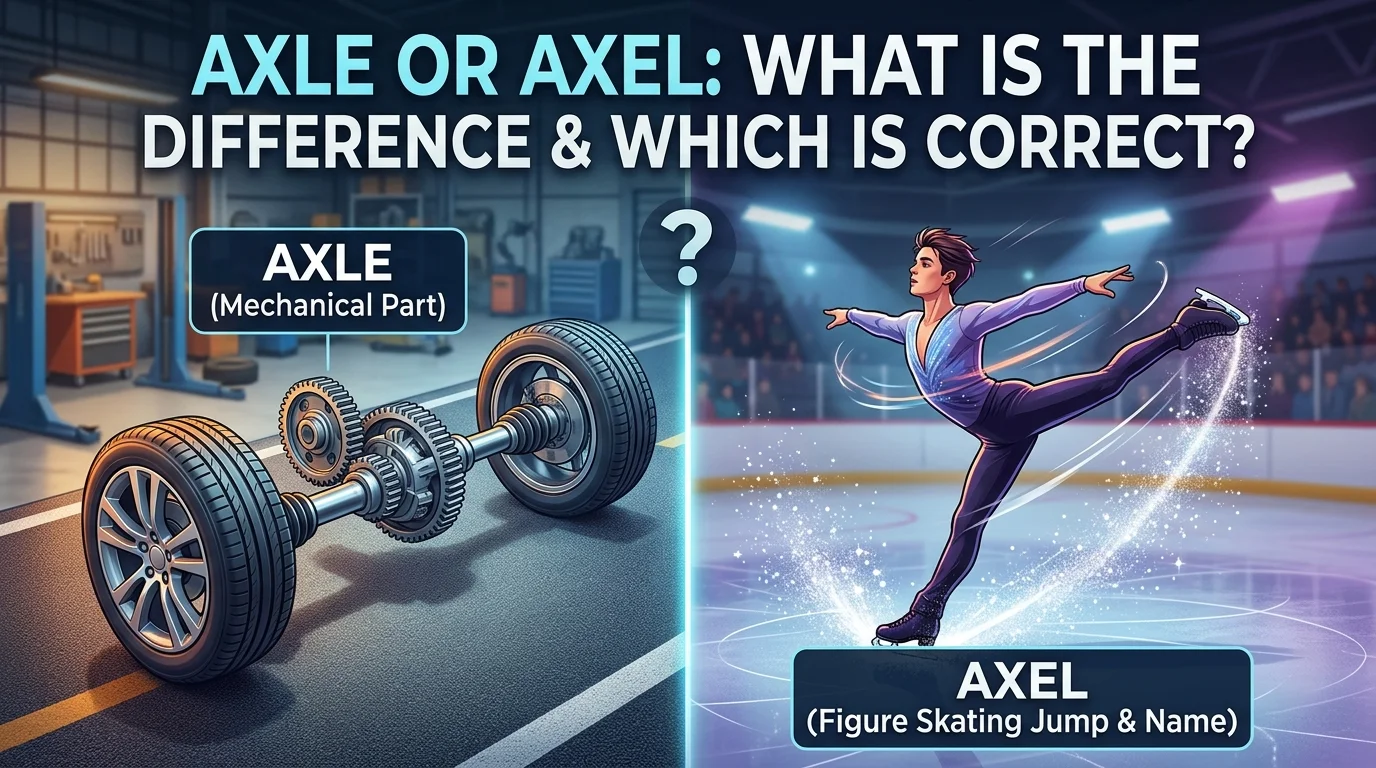
Many English words look or sound similar but mean completely different things, and axle and Axel are a perfect example. These two terms are often confused because of their spelling and pronunciation. However, their meanings, uses, and contexts are entirely different. Understanding the difference helps you write and speak more accurately.
Comparison Overview
The words axle and Axel may sound almost identical, but they belong to completely different categories.
Axle is a common noun mostly used in mechanics and transportation. It refers to a rod or shaft that connects and supports wheels.
Axel, on the other hand, is usually a proper noun or a specialized term. It can be a person’s name or a figure skating jump.
Although they sound alike, they should never be used interchangeably.
| Feature | Axle | Axel |
| Part of Speech | Common noun | Proper noun / noun |
| Main Meaning | Mechanical shaft for wheels | Name or skating jump |
| Common Context | Cars, bikes, machinery | Names, sports |
| Capitalization | Usually lowercase | Often capitalized |
| Interchangeable? | No | No |
Definition of Axle
An axle is a central rod or shaft that connects two wheels and allows them to rotate properly. It is an important mechanical component found in vehicles and machines.
Examples of where an axle is used:
- cars
- trucks
- bicycles
- trains
- carts
Its main purpose is to support weight and enable movement.
Definition of Axel
Axel has two common meanings.
First, it is a personal name used in many countries.
Example: Axel is a popular male name in parts of Europe and America.
Second, in figure skating, an Axel is a jump where the skater takes off facing forward and rotates in the air.
Example: She landed a double Axel during the competition.
Main Differences Between Axle and Axel
The main differences are based on meaning, usage, and context.
| Category | Axle | Axel |
| Meaning | A wheel-supporting rod | A name or skating jump |
| Field | Engineering, mechanics | Names, sports |
| Usage | Technical/mechanical | Personal or athletic |
| Example | The axle broke | Axel won the race |
| Capitalization | Lowercase | Usually uppercase |
The easiest way to remember it is this:
Axle belongs to vehicles.
Axel belongs to people or skating.
Origins and Word History
The word axle comes from Old English and has been connected to transportation and wheels for centuries.
The word Axel originates from Scandinavian languages and is a common given name. In skating, the jump was named after Axel Paulsen, who first performed it.
Grammar Guide
How each term is used in sentences
Axle usually appears as a common noun.
Examples:
- The axle needs repair.
- This truck has a strong rear axle.
Axel is usually a proper noun or specialized noun.
Examples:
- Axel called me yesterday.
- She completed a triple Axel.
Common mistakes learners make
Using Axel when talking about cars:
- Incorrect: The car’s Axel is broken.
- Correct: The car’s axle is broken.
Using axle as a person’s name:
- Incorrect: axle is my friend.
- Correct: Axel is my friend.
Forgetting capitalization:
- Axel as a name must be capitalized.
- axle usually stays lowercase.
Simple rules to remember
If it has wheels, use axle.
If it is a person or skating move, use Axel.
Vehicle = axle
Name/skating = Axel
Quick tips for writing and speaking
Check the topic first.
If discussing mechanics, choose axle.
If discussing a person or figure skating, choose Axel.
Pay attention to capitalization.
When to Use Each One
Use axle when:
- talking about vehicles
- discussing machine parts
- writing about engineering
- explaining transportation mechanics
Use Axel when:
- referring to someone named Axel
- discussing figure skating
- writing about sports competitions
When NOT to Use Each One
Do not use axle:
- for personal names
- for skating jumps
Do not use Axel:
- for vehicle parts
- in engineering descriptions
Wrong: Replace the Axel on your car.
Correct: Replace the axle on your car.
Which One to Use (Decision Guide)
Ask yourself this question:
Is it related to a vehicle or machine?
Yes → use axle
No → continue.
Is it a person’s name or a skating move?
Yes → use Axel
This simple check prevents most mistakes.
Real-World Practical Examples
Axle Examples
- The truck’s rear axle snapped during transport.
- A bicycle axle helps the wheels rotate smoothly.
- Engineers tested the axle strength in the lab.
- The mechanic replaced the damaged axle.
- Railway systems rely on strong axles for safety.
Axel Examples
- Axel joined our class this semester.
- The skater performed a perfect double Axel.
- Axel submitted the business report early.
- During the Olympics, she attempted a triple Axel.
- Axel called customer support this morning.
Self-Assessment (Fill in the Blanks)
- The car needs a new ______ because the wheels are unstable.
- The correct word is ______ because it refers to a vehicle part.
- My friend ______ plays football every weekend.
- The correct word is ______ because it is a person’s name.
- The bicycle’s front ______ is bent.
- She landed a perfect double ______ in the skating final.
- The mechanic inspected the rear ______.
- ______ sent me an email yesterday.
- Trucks need strong ______ to carry heavy loads.
- The skater attempted a triple ______.
- The broken ______ caused the wheel to fall off.
- ______ won first place in the ice competition.
- The engineer designed a stronger ______.
- The athlete trained to improve her ______ jump.
- Replace the damaged ______ immediately.
- ______ is visiting from Sweden next week.
- The cart’s ______ supports both wheels.
- He failed his first ______ jump attempt.
- A train uses multiple ______ systems.
- ______ introduced himself during class.
Answers
- axle
- axle
- Axel
- Axel
- axle
- Axel
- axle
- Axel
- axle
- Axel
- axle
- Axel
- axle
- Axel
- axle
- Axel
- axle
- Axel
- axle
- Axel
Final Verdict
Axle and Axel may sound alike, but they mean very different things. Use axle when talking about wheels, vehicles, and machinery. Use Axel when referring to a person’s name or a figure skating jump linked to Axel Paulsen. Remember this simple rule: if it rolls, it is axle; if it skates or has a name, it is Axel.
Conclusion About Axle Or Axel
Understanding the difference between axle and Axel helps avoid one of the most common spelling and meaning confusions in English. While they sound similar, their uses are completely unrelated. Axle refers to a mechanical component found in vehicles that supports and rotates wheels, making it essential in transportation and engineering. Axel, however, is either a personal name or a term used in figure skating for a specific jump. Recognizing the context is the key to using each word correctly. If you are talking about cars, bicycles, or machinery, axle is the right choice. If you are referring to a person or a skating move, Axel is correct. Mastering this distinction improves both writing accuracy and communication clarity in everyday and professional use.
FAQs
What is the main difference between axle and Axel?
The main difference is meaning and usage. Axle is a mechanical part in vehicles that connects wheels and allows movement. Axel is usually a proper name or a figure skating jump. Both words sound similar but belong to completely different contexts, so they should never be used interchangeably in writing or speech.
Is axle related to cars and vehicles?
Yes, axle is an important part of vehicles like cars, trucks, bicycles, and trains. It is a rod that connects wheels and supports weight while allowing rotation. Without axles, vehicles cannot move properly. It plays a key role in transportation systems and mechanical engineering design and performance.
What does Axel mean in figure skating?
In figure skating, Axel is a jump where the skater takes off facing forward and rotates in the air before landing. It is considered one of the most challenging jumps because of its extra half rotation. It is commonly used in competitive skating routines and judged in international competitions.
Can Axel be used as a person’s name?
Yes, Axel is a common male first name in many countries, especially in Europe. It is used as a personal name and has no relation to mechanical parts. Many athletes, professionals, and public figures are named Axel, so context is important when interpreting the word in sentences.
Why do people confuse axle and Axel?
People confuse these words because they sound almost identical when spoken. However, their meanings are completely different. Axle is used in technical and mechanical contexts, while Axel is used for names or skating. The confusion mainly happens in writing and pronunciation without context awareness.
How do I remember the difference easily?
A simple trick is to connect axle with wheels and vehicles, since both contain the letter combination related to movement. For Axel, think of a person or a skating jump. This mental association helps you quickly choose the correct word depending on the situation.
Is axle a technical term?
Yes, axle is a technical term used in engineering and mechanics. It describes a component that connects wheels and supports loads in machines and vehicles. It is essential for movement and stability, making it a key concept in automotive and mechanical studies.
Is Axel always capitalized?
Yes, Axel is usually capitalized because it is a proper noun when used as a name. In figure skating, it is also often capitalized when referring to the jump. Axle, however, is a common noun and is typically written in lowercase unless it begins a sentence.
Are axle and Axel pronounced the same way?
Yes, both words are generally pronounced the same, which is one reason for confusion. However, their meanings differ greatly depending on context. Listening carefully to surrounding words in a sentence helps determine whether it refers to a vehicle part or a name.
Can axle and Axel ever be used interchangeably?
No, they should never be used interchangeably. Axle refers to a mechanical component, while Axel refers to a name or skating move. Using them incorrectly can change the meaning of a sentence completely, so understanding their distinct contexts is very important for correct communication.

Amelia Wright focuses on making figurative language easy to understand. Her writing explains similes, metaphors, and word meanings using relatable examples. She aims to help readers recognize subtle differences in usage and apply them correctly in both academic and casual writing.