
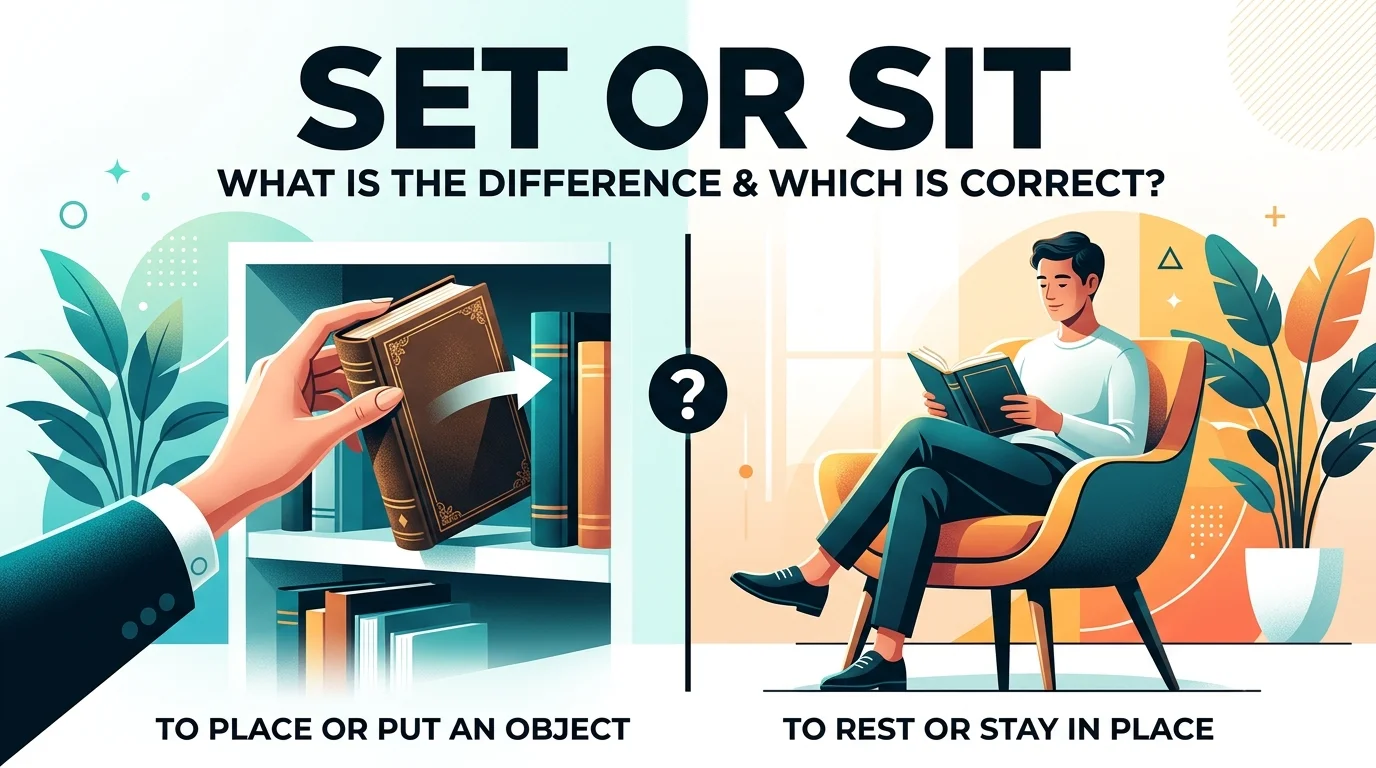
“Set” and “sit” are two common English verbs that often confuse learners because both relate to placing or being in a position. However, they are used differently in grammar and meaning. Understanding when to use “set” versus “sit” helps improve your speaking and writing accuracy in everyday English.
Comparison Overview
“Set” and “sit” are both action verbs, but they describe different kinds of actions. “Set” usually means to place something somewhere, while “sit” means to rest in a seated position or remain placed somewhere naturally. The key difference is often whether an object is involved.
| Feature | Set | Sit |
| Meaning | To place something | To rest in a seated position |
| Type of verb | Usually transitive | Usually intransitive |
| Needs an object? | Yes, often | No, usually |
| Example | Set the book on the table | Sit on the chair |
Definition of Set
“Set” means to put or place something in a particular position or location. It usually involves moving an object from one place to another.
Examples:
• Please set the cup on the table.
• She set her phone beside the bed.
“Set” often requires an object because you are setting something.
Definition of Sit
“Sit” means to rest your body on a seat or surface, usually by bending your knees. It can also mean to remain positioned somewhere.
Examples:
• Please sit on the chair.
• The book sits on the shelf.
“Sit” often does not require an object because the subject performs the action itself.
Main Differences Between Set and Sit
The biggest difference between “set” and “sit” is action direction.
“Set” involves placing something:
• I set the vase on the shelf.
“Sit” involves being placed or resting:
• The vase sits on the shelf.
Other key differences:
- Object usage
• Set needs an object: Set the plate down.
• Sit usually does not: Sit down. - Action type
• Set = active placement
• Sit = passive position - Grammar role
• Set is usually transitive.
• Sit is usually intransitive.
Verb Forms of Set and Sit
Understanding verb forms helps avoid mistakes.
| Verb | Present | Past | Past Participle | Present Participle |
| Set | set | set | set | setting |
| Sit | sit | sat | sat | sitting |
Examples:
• Yesterday, I set the alarm.
• Yesterday, I sat near the window.
Common Phrases with Set and Sit
Common phrases with “set”:
• set the table
• set a goal
• set an alarm
• set a date
Common phrases with “sit”:
• sit down
• sit still
• sit quietly
• sit in the corner
Grammar Guide
How each term is used in sentences
Set pattern:
Subject + set + object + place
Examples:
• She set the keys on the desk.
• They set the food on the counter.
Sit pattern:
Subject + sit + place
Examples:
• She sits by the window.
• They sit in the classroom.
Common mistakes learners make
Mistake 1:
❌ Sit the book on the desk.
✅ Set the book on the desk.
Mistake 2:
❌ Set on the chair.
✅ Sit on the chair.
Mistake 3:
❌ I have sit there before.
✅ I have sat there before.
Simple rules to remember
Use “set” when you place something.
Use “sit” when a person or thing rests naturally.
Easy memory trick:
“Set” = something is being moved.
“Sit” = something stays still.
Quick tips for writing and speaking
Check if there is an object.
If yes, use “set.”
If someone is resting or positioned, use “sit.”
Remember:
Set the cup.
Sit on the chair.
When to Use Each One
Use “set” when:
• placing an object
• arranging something
• creating a schedule or rule
• adjusting a device
Examples:
• Set the timer.
• Set the books neatly.
Use “sit” when:
• talking about sitting down
• describing position
• describing rest
Examples:
• Sit here.
• The house sits on a hill.
When NOT to Use Each One
Do not use “set”:
• when talking about your own seated position
❌ Set on the sofa.
✅ Sit on the sofa.
Do not use “sit”:
• when placing objects
❌ Sit the bag here.
✅ Set the bag here.
Which One to Use (Decision Guide)
Ask yourself:
- Am I placing something somewhere?
→ Use “set.” - Am I talking about someone or something resting?
→ Use “sit.”
Quick guide:
• Set = place
• Sit = rest
Real-World Practical Examples
Set Examples
- Education: Set your notebook on the desk.
- Daily life: Set the groceries on the counter.
- Science: Set the microscope carefully.
- Business: Set a meeting for Monday.
- Technology: Set your password today.
Sit Examples
- Education: Sit in the front row.
- Daily life: Sit beside your friend.
- Science: The sample sits in the container.
- Business: Sit in the conference room.
- Conversation: Please sit here.
Self-Assessment (Fill in the Blanks)
- I will use ______ when placing a glass on the table.
- The correct word is ______ because it describes sitting on a bench.
- Please ______ the books on the shelf.
- Please ______ beside me.
- The cat likes to ______ near the window.
- ______ the plate on the counter.
- I usually ______ in the back row.
- She ______ the bag on the chair.
- The house ______ on a hill.
- ______ down and relax.
- He ______ the alarm for 6 AM.
- The bird ______ on the branch.
- Please ______ your phone here.
- Students must ______ quietly.
- The lamp ______ on the desk.
- They ______ the chairs in a circle.
- The baby can ______ alone now.
- ______ the folder on my desk.
- The temple ______ at the top of the mountain.
- Please ______ near the door.
Answers
- set
- sit
- set
- sit
- sit
- set
- sit
- set
- sits
- sit
- set
- sits
- set
- sit
- sits
- set
- sit
- set
- sits
- sit
Final Verdict
“Set” and “sit” may seem similar, but their difference is simple once you understand the action. Use “set” when placing something somewhere, because it usually needs an object. Use “sit” when a person or thing is resting or positioned naturally. Remember this simple rule: if you place it, “set” it; if it rests, it “sits.”
Conclusion About Set Or Sit
Understanding the difference between “set” and “sit” makes English grammar much clearer and easier to use in daily communication. While both words may seem similar at first, they serve completely different purposes in sentences. “Set” is mainly used when placing or arranging something, while “sit” describes a resting position or something naturally positioned. Once you learn this simple distinction, your speaking and writing become more accurate and confident. With regular practice and real-life examples, you can easily avoid common mistakes and use both words correctly in conversations, academic writing, and professional communication. Mastering these small but important differences helps build a stronger foundation in English grammar overall.
FAQs About Set Or Sit
What is the main difference between set and sit?
The main difference is that “set” is used when placing something somewhere, while “sit” is used when a person or object rests in a seated or fixed position. “Set” usually needs an object, but “sit” often does not. This makes their usage clearly different in grammar and meaning.
Can I use sit for objects?
Yes, “sit” can be used for objects when describing their position or location. For example, “The book sits on the table.” In this case, it shows where something rests naturally without being actively placed. However, it is not used when you are actively putting something somewhere.
Why is set considered a transitive verb?
“Set” is considered a transitive verb because it usually requires a direct object to complete its meaning. You set something, such as a book, plate, or item. Without an object, the sentence feels incomplete, which is why it always connects to something being placed.
Is sit always intransitive?
Mostly yes, “sit” is an intransitive verb because it does not require a direct object. The subject performs the action itself, such as “She sits.” However, it can sometimes describe objects metaphorically, like “The house sits on a hill,” but still without a direct object.
What is the past tense of set and sit?
The past tense of “set” remains “set,” which can confuse learners. The past tense of “sit” is “sat.” For example, “I set the table yesterday” and “I sat on the chair yesterday.” These forms are important for correct grammar usage.
Can set and sit be used in passive sentences?
“Set” can often appear in passive structures like “The table is set.” “Sit” is less commonly used in passive voice but can describe states, such as “The statue is sitting in the park.” However, active forms are more natural in everyday English.
Which word is more commonly used in daily English?
Both are common, but “sit” is used more frequently in everyday speech because it relates to human actions and positions. “Set” is often used in specific contexts like arranging, scheduling, or placing objects, making it slightly more task-oriented.
How do I remember when to use set or sit?
A simple trick is to remember that “set” means “place something,” while “sit” means “rest yourself or something in a position.” If an object is involved, use “set.” If it is about position or resting, use “sit.”
Can set and sit change meaning in different contexts?
Yes, both words can change slightly based on context. “Set” can also mean establishing something, like rules or goals. “Sit” can describe location, like “The city sits near the river.” Context always helps determine the correct meaning.
Are set and sit interchangeable in any situation?
No, they are not interchangeable. Each word has a specific grammatical role and meaning. Using one in place of the other can change the meaning of a sentence or make it incorrect, so understanding their difference is essential.

Sarah Mitchell is an experienced writer and grammar teacher with over 10 years of expertise in English language education. She helps learners improve their grammar, writing, and communication skills through clear explanations and practical examples. Sarah creates learner-friendly content focused on real-life English, making language learning simple, effective, and confidence-building.