
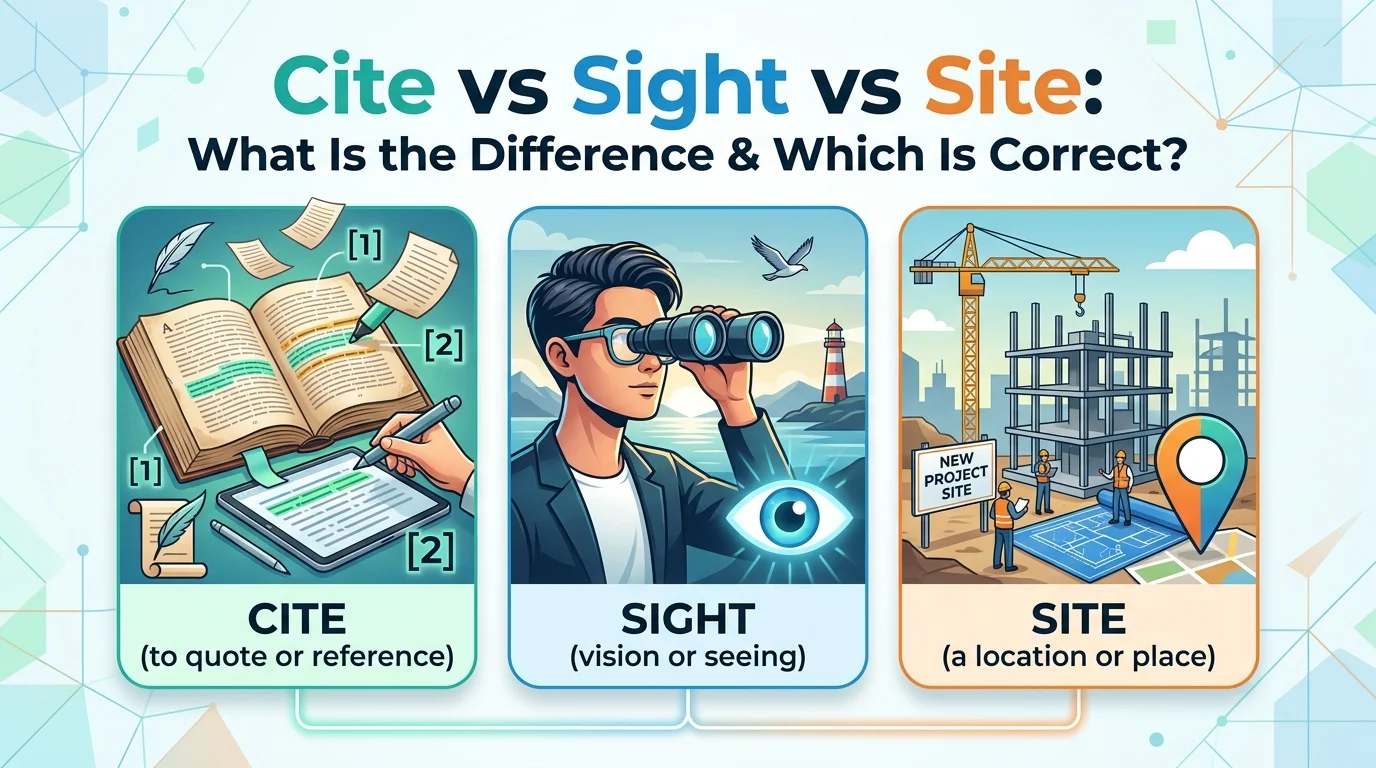
Many English learners confuse cite, sight, and site because they sound exactly the same. These words are homophones, meaning they share the same pronunciation but have completely different meanings and uses. Understanding the difference between cite, sight, and site is important for writing, speaking, academics, business communication, and everyday conversations.
Comparison Overview
Cite, sight, and site are commonly confused words in English. Although they are pronounced the same way, they serve different grammatical and practical purposes.
| Word | Part of Speech | Meaning | Common Context |
| Cite | Verb | To quote, mention, or refer to a source | Academic writing, research, legal documents |
| Sight | Noun, Verb | The ability to see or something that is seen | Vision, travel, observation |
| Site | Noun | A place or location | Construction, websites, geography |
Understanding these distinctions helps avoid common writing and speaking mistakes.
Definition of Cite
Cite is a verb that means to mention, quote, reference, or acknowledge a source of information.
People commonly use cite in academic, legal, scientific, and professional writing.
Examples:
- Researchers cite previous studies.
- Students cite sources in essays.
- Lawyers cite legal cases.
- Journalists cite experts.
The main purpose of cite is to give credit or provide evidence.
Definition of Sight
Sight primarily refers to vision or the ability to see. It can also describe something visible or worth seeing.
Sight can function as both a noun and a verb.
Examples:
- The eagle has excellent sight.
- The mountains were an amazing sight.
- We sighted a whale during the trip.
Sight is closely related to seeing and visual perception.
Definition of Site
Site is a noun that refers to a specific place, location, or position.
It may refer to physical locations or digital locations such as websites.
Examples:
- The construction site was busy.
- The archaeological site revealed ancient artifacts.
- Visit our company website site.
Site is always connected to a location or place.
Main Differences Between Cite, Sight, and Site
The biggest difference lies in their meanings and usage.
| Feature | Cite | Sight | Site |
| Meaning | Reference or quote a source | Vision or something seen | A location or place |
| Part of Speech | Verb | Noun, Verb | Noun |
| Related To | Information and evidence | Seeing and observation | Physical or digital locations |
| Common Contexts | Research, law, academics | Travel, vision, nature | Construction, geography, technology |
| Example | Please cite your sources. | What a beautiful sight! | The building site is closed. |
Meaning Comparison
- Cite = Reference information.
- Sight = See or vision.
- Site = Place or location.
Usage Comparison
- Use cite when talking about sources.
- Use sight when talking about seeing.
- Use site when talking about locations.
Academic Usage of Cite
In academic writing, citing sources is essential because it:
- Gives credit to original authors.
- Prevents plagiarism.
- Supports arguments.
- Improves credibility.
- Helps readers verify information.
Common citation styles include:
- APA
- MLA
- Chicago
- Harvard
Sight vs Site: Why They Are Often Confused
Sight and site are often confused because they share identical pronunciation.
Compare:
- The Grand Canyon is an incredible sight.
- The Grand Canyon is a famous tourist site.
The first refers to something beautiful to see, while the second refers to a location.
Grammar Guide
How Each Term Is Used in Sentences
Cite
Pattern:
- Cite + source
- Cite + evidence
- Cite + author
Examples:
- Please cite your references.
- The article cites several experts.
- Researchers cited recent findings.
Sight
Pattern:
- A sight
- In sight
- Out of sight
- Sight + object
Examples:
- The castle came into sight.
- The sunset was a beautiful sight.
- We sighted dolphins offshore.
Site
Pattern:
- Site + noun
- Construction site
- Website site
- Site location
Examples:
- The site is under development.
- Workers inspected the site.
- The company launched a new site.
Common Mistakes Learners Make
Many learners accidentally substitute one word for another.
Incorrect:
- Please sight your sources.
- Please site your references.
- The construction sight is closed.
Correct:
- Please cite your sources.
- The construction site is closed.
- The waterfall is a beautiful sight.
Simple Rules to Remember
- Cite contains “cit” like citation.
- Sight relates to eyesight and seeing.
- Site refers to a location or place.
Memory trick:
- Citation = Cite
- Eyesight = Sight
- Location Site = Site
Quick Tips for Writing and Speaking
- Writing research papers? Use cite.
- Talking about vision? Use sight.
- Discussing locations? Use site.
- Double-check homophones before publishing content.
- Read sentences aloud and verify meaning from context.
When to Use Each One
Use Cite When
- Referencing books.
- Quoting authors.
- Supporting arguments.
- Writing academic papers.
- Mentioning evidence.
Use Sight When
- Talking about vision.
- Describing scenery.
- Discussing observation.
- Referring to visible objects.
- Mentioning things worth seeing.
Use Site When
- Referring to a place.
- Talking about construction projects.
- Discussing web pages.
- Describing geographic locations.
- Mentioning archaeological areas.
When NOT to Use Each One
Do Not Use Cite When
- Referring to locations.
- Discussing vision.
- Describing scenery.
Do Not Use Sight When
- Referring to references.
- Discussing websites.
- Talking about physical locations.
Do Not Use Site When
- Referring to eyesight.
- Quoting information sources.
- Mentioning visual observations.
Which One to Use (Decision Guide)
Ask yourself the following question:
Are you talking about a source or reference?
→ Use Cite
Are you talking about seeing or vision?
→ Use Sight
Are you talking about a place or location?
→ Use Site
Quick decision chart:
| If You Mean… | Use |
| Reference a source | Cite |
| Something visible | Sight |
| A location | Site |
| Academic evidence | Cite |
| Eyesight | Sight |
| Construction area | Site |
Real-World Practical Examples
Cite Examples
- The professor asked students to cite all references.
- Researchers cite previous studies in scientific papers.
- Lawyers often cite court decisions.
- Journalists cite expert opinions.
- The report cited government statistics.
Sight Examples
- The waterfall was an unforgettable sight.
- The ship disappeared from sight.
- Eagles have exceptional sight.
- We sighted rare birds during the expedition.
- The northern lights are a spectacular sight.
Site Examples
- Workers arrived early at the construction site.
- The archaeological site attracted tourists.
- The company redesigned its website site.
- Engineers inspected the project site.
- The hospital site was chosen carefully.
Self-Assessment (Fill in the Blanks)
- I will use ______ when referring to academic references. The correct word is ______ because it involves source acknowledgment.
- I will use ______ when referring to vision. The correct word is ______ because it relates to seeing.
- I will use ______ when referring to a building location. The correct word is ______ because it means a place.
- I will use ______ when quoting a researcher. The correct word is ______ because sources are being referenced.
- I will use ______ when describing a beautiful sunset. The correct word is ______ because it is something seen.
- I will use ______ when discussing a construction area. The correct word is ______ because it refers to a location.
- I will use ______ when mentioning evidence in a paper. The correct word is ______ because evidence must be referenced.
- I will use ______ when talking about eyesight. The correct word is ______ because it relates to vision.
- I will use ______ when discussing an archaeological location. The correct word is ______ because it is a place.
- I will use ______ when giving credit to an author. The correct word is ______ because the author is being referenced.
- I will use ______ when seeing whales from a boat. The correct word is ______ because it relates to observation.
- I will use ______ when discussing a company webpage location. The correct word is ______ because it refers to a digital place.
- I will use ______ when writing a bibliography. The correct word is ______ because sources are included.
- I will use ______ when talking about a landmark worth seeing. The correct word is ______ because it describes something visible.
- I will use ______ when referring to a project location. The correct word is ______ because it identifies a place.
- I will use ______ when supporting an argument with evidence. The correct word is ______ because references are needed.
- I will use ______ when describing visual perception. The correct word is ______ because it concerns seeing.
- I will use ______ when discussing where a building will be constructed. The correct word is ______ because it is a location.
- I will use ______ when referencing a scientific journal. The correct word is ______ because a source is being acknowledged.
- I will use ______ when describing an amazing view. The correct word is ______ because it refers to something seen.
Answers
- Cite, Cite
- Sight, Sight
- Site, Site
- Cite, Cite
- Sight, Sight
- Site, Site
- Cite, Cite
- Sight, Sight
- Site, Site
- Cite, Cite
- Sight, Sight
- Site, Site
- Cite, Cite
- Sight, Sight
- Site, Site
- Cite, Cite
- Sight, Sight
- Site, Site
- Cite, Cite
- Sight, Sight
Final Verdict
Cite, sight, and site may sound identical, but they have entirely different meanings. Cite is used when referring to sources, references, or evidence. Sight relates to vision, observation, and things that can be seen. Site refers to a physical or digital location. The easiest way to remember them is to connect cite with citation, sight with eyesight, and site with location. Once you understand these simple distinctions, choosing the correct word becomes straightforward in academic writing, professional communication, and everyday conversations.
Conclusion About Cite vs Sight vs Site
Understanding the difference between cite, sight, and site is essential for clear and accurate communication. Although these three words sound exactly alike, they serve completely different purposes in English. Cite is used when referring to sources, references, or evidence, especially in academic and professional writing. Sight relates to vision, observation, or something that can be seen, while site refers to a physical or digital location. Because they are homophones, they are often confused in writing, but recognizing the context of a sentence makes choosing the correct word much easier. Whether you are writing a research paper, describing a beautiful view, or talking about a location, selecting the right term improves clarity and professionalism. By remembering the simple connections of citation for cite, eyesight for sight, and location for site, you can confidently use each word correctly in everyday conversations, education, business communication, and formal writing.
FAQs
What is the difference between cite, sight, and site?
Cite means to reference or quote a source, sight relates to vision or something seen, and site refers to a place or location. Although they sound the same, their meanings and uses are completely different.
Is cite a verb or a noun?
Cite is primarily used as a verb. It means to mention, quote, or reference a source of information. It is commonly used in academic writing, legal documents, and research papers.
What does sight mean in English?
Sight refers to the ability to see or something that is visible. It can describe vision, observation, or an impressive thing worth looking at, such as a famous landmark or natural wonder.
What is a site?
A site is a location or place. It may refer to a construction site, archaeological site, event location, or a website on the internet. The word always relates to a specific place.
Why are cite, sight, and site confusing?
These words are confusing because they are homophones. They have the same pronunciation but different spellings and meanings. Many writers accidentally choose the wrong word when relying only on sound.
How do I remember the meaning of cite?
A simple trick is to connect cite with citation. If you are mentioning a source, reference, or evidence, cite is the correct word to use in the sentence.
Can sight be used as a verb?
Yes, sight can be used as a verb. In this form, it means to see or observe something, especially something unusual or distant, such as spotting a whale from a boat.
Is website related to site?
Yes, the word site is commonly used as a shortened form of website. In technology, a site refers to a collection of web pages that people access through the internet.
Which word should I use in academic writing?
In academic writing, cite is usually the correct choice when referring to sources and references. Proper citation helps support arguments and gives credit to original authors.
How can I avoid mixing up cite, sight, and site?
Focus on the meaning rather than the pronunciation. If the sentence involves references, use cite. If it involves seeing, use sight. If it involves a location, use site.

Amelia Wright focuses on making figurative language easy to understand. Her writing explains similes, metaphors, and word meanings using relatable examples. She aims to help readers recognize subtle differences in usage and apply them correctly in both academic and casual writing.