
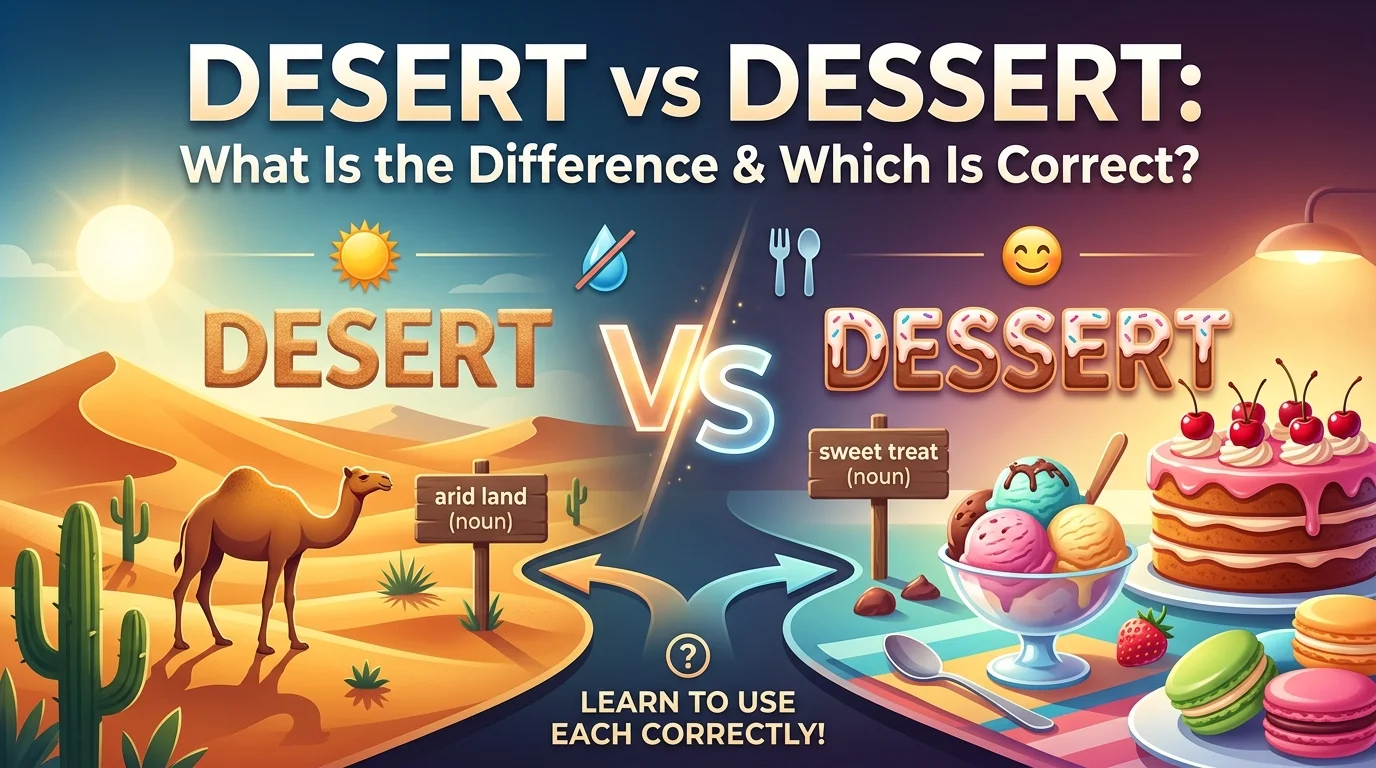
Many English learners confuse desert and dessert because they look very similar and differ by only one letter. However, these two words have completely different meanings and uses. Understanding the difference between desert and dessert will help you avoid common spelling mistakes and communicate more clearly in both writing and speaking.
Comparison Overview
Desert and dessert are often mixed up because they are nearly identical in spelling and pronunciation. A desert is usually a dry geographical region with very little rainfall, while a dessert is a sweet food served after a meal. Although they look alike, their meanings, contexts, and uses are entirely different.
| Feature | Desert | Dessert |
| Meaning | Dry, arid land | Sweet food after a meal |
| Part of Speech | Noun (sometimes verb) | Noun |
| Context | Geography, environment | Food, dining |
| Example | The Sahara is a desert. | Ice cream is my favorite dessert. |
| Common Confusion | Missing an extra “s” | Adding an extra “s” |
Definition of Desert
A desert is a large, dry area of land that receives very little rainfall throughout the year. Deserts often have extreme temperatures and limited vegetation.
As a noun, desert refers to a geographical region.
Examples:
- The Sahara Desert is one of the largest deserts in the world.
- Many animals have adapted to life in the desert.
- The desert receives very little rain.
Desert can also function as a verb meaning to abandon or leave someone behind.
Examples:
- The soldiers did not desert their post.
- He felt his friends had deserted him.
Definition of Dessert
A dessert is a sweet course typically served at the end of a meal. Desserts can include cakes, cookies, ice cream, puddings, pastries, and many other sweet foods.
Examples:
- Chocolate cake was the dessert.
- We ordered ice cream for dessert.
- Fruit salad is a healthy dessert option.
Unlike desert, dessert is only used as a noun.
Main Differences Between Desert and Dessert
The primary difference lies in their meanings and usage.
| Aspect | Desert | Dessert |
| Meaning | Dry land or abandon | Sweet food after a meal |
| Usage | Geography or verb meaning abandon | Food-related situations |
| Part of Speech | Noun and verb | Noun only |
| Example | We crossed the desert. | We ate dessert after dinner. |
Another easy way to distinguish them is their spelling:
- Desert contains one “s.”
- Dessert contains two “s” letters.
Why Are They Commonly Confused?
The words look very similar and are pronounced somewhat alike. Many writers accidentally omit or add an extra “s” when typing quickly.
Memory Trick
Remember:
Dessert has two S’s because everyone wants a second serving of dessert.
Desert vs Dessert Pronunciation
Although they are similar, pronunciation can help distinguish them.
- Desert (dry land): DEZ-ert
- Dessert (sweet food): dih-ZURT
Listening carefully can often reveal which word is intended.
Grammar Guide
How Each Term Is Used in Sentences
Desert
Pattern:
- The + desert + verb
- A desert + noun
Examples:
- The desert stretches for miles.
- We explored the desert during summer.
As a verb:
- Subject + desert + object
Examples:
- They did not desert their team.
- Never desert your responsibilities.
Dessert
Pattern:
- Dessert + verb
- Dessert after + meal
Examples:
- Dessert was delicious.
- We enjoyed dessert after dinner.
Common Mistakes Learners Make
- Writing dessert when referring to dry land.
- Writing desert when referring to cake or ice cream.
- Forgetting that dessert contains two S’s.
- Assuming both words have the same meaning.
- Misusing desert as a food-related word.
Incorrect:
- We walked across the dessert.
Correct:
- We walked across the desert.
Incorrect:
- Chocolate cake is my favorite desert.
Correct:
- Chocolate cake is my favorite dessert.
Simple Rules to Remember
- Desert = dry land.
- Dessert = sweet food.
- Dessert has two S’s.
- Desert may also be a verb meaning abandon.
- Dessert is always a noun.
Quick Tips for Writing and Speaking
- Think about the topic first: geography or food.
- If discussing sweets, choose dessert.
- If discussing dry regions, choose desert.
- Check the number of S letters.
- Proofread carefully before publishing.
When to Use Each One
Use Desert When:
- Talking about dry geographical regions.
- Discussing climate and ecosystems.
- Referring to abandonment as a verb.
- Writing about environmental science.
- Discussing travel through arid regions.
Examples:
- The camel crossed the desert.
- Some soldiers deserted their positions.
Use Dessert When:
- Talking about food.
- Ordering in restaurants.
- Writing recipes.
- Discussing meals.
- Talking about sweets and treats.
Examples:
- We shared a dessert.
- Dessert will be served at eight o’clock.
When NOT to Use Each One
Do Not Use Desert When:
- Referring to cakes, ice cream, or sweets.
- Discussing meal courses.
- Talking about food menus.
Incorrect:
- The restaurant served a delicious desert.
Do Not Use Dessert When:
- Referring to dry landscapes.
- Discussing geography.
- Talking about abandonment.
Incorrect:
- The Sahara is the largest dessert in Africa.
Which One to Use (Decision Guide)
Ask yourself a simple question:
Are you talking about a sweet food after a meal?
- Yes → Use dessert
- No → Continue
Are you talking about a dry region of land?
- Yes → Use desert
- No → Continue
Do you mean to abandon someone or something?
- Yes → Use desert as a verb
This simple decision process helps eliminate confusion.
Real-World Practical Examples
Desert Examples
- The Sahara Desert covers much of North Africa.
- Scientists study plants that survive in the desert.
- We drove across the desert during our trip.
- The desert ecosystem supports unique wildlife.
- Travelers carried extra water into the desert.
Dessert Examples
- We ordered cheesecake for dessert.
- Ice cream is a popular summer dessert.
- The restaurant offered several dessert choices.
- Fruit parfait is a healthy dessert.
- She baked brownies for dessert.
Self-Assessment (Fill in the Blanks)
- I will use ______ when referring to a dry region of land.
- The correct word is ______ because it refers to sweet food after dinner.
- We crossed the ______ during our vacation.
- Chocolate pudding is a delicious ______.
- Scientists studied animals living in the ______.
- I ordered apple pie for ______.
- The camel traveled through the ______.
- The correct word is ______ because it refers to cake.
- Rain rarely falls in the ______.
- Ice cream is a common ______.
- The hikers explored the ______.
- We enjoyed a tasty ______ after lunch.
- The Sahara is a famous ______.
- The bakery sells many types of ______.
- Many reptiles survive in the ______.
- Cookies can be served as ______.
- The climate of the ______ is very dry.
- The correct word is ______ because it refers to a sweet course.
- Some plants thrive in the ______.
- Brownies are a popular ______.
Answers
- Desert
- Dessert
- Desert
- Dessert
- Desert
- Dessert
- Desert
- Dessert
- Desert
- Dessert
- Desert
- Dessert
- Desert
- Dessert
- Desert
- Dessert
- Desert
- Dessert
- Desert
- Dessert
Final Verdict
Desert and dessert may look almost identical, but their meanings are completely different. A desert is a dry region of land and can also function as a verb meaning to abandon. A dessert is a sweet food served at the end of a meal. The easiest way to remember the difference is that dessert has two S’s, just like many people want a second serving of dessert. Whenever you encounter these words, think about the context. If the topic is geography or abandonment, use desert. If the topic is food, sweets, or dining, use dessert. Understanding this simple distinction will help you write more accurately, speak more confidently, and avoid one of the most common English spelling mistakes.
Conclusion About Desert vs Dessert
Understanding the difference between desert and dessert is easier once you focus on their meanings and contexts. A desert refers to a dry, arid region with little rainfall, while a dessert is a sweet dish typically enjoyed at the end of a meal. Although the words look very similar, they serve completely different purposes in the English language. This confusion is common among learners because only one extra letter separates them, but remembering that dessert has an extra “s” for something sweet can make the distinction much easier. Whether you are writing an academic paper, having a casual conversation, ordering food at a restaurant, or discussing geography, choosing the correct word helps improve clarity and accuracy. By understanding their definitions, grammar, and real-world usage, you can confidently use desert and dessert correctly in any situation.
FAQs
What is the difference between desert and dessert?
A desert is a dry geographical area that receives very little rainfall, while a dessert is a sweet food served after a meal. Despite their similar spelling, they have completely different meanings and are used in different contexts.
Why do people confuse desert and dessert?
People often confuse these words because they are spelled similarly and sound somewhat alike. The difference is only one extra letter “s,” making them one of the most commonly mixed-up word pairs in English.
Is dessert always related to food?
Yes, dessert is always a noun that refers to a sweet course served after a meal. Common desserts include cakes, cookies, ice cream, pies, puddings, and pastries enjoyed as treats.
Can desert be used as a verb?
Yes, desert can function as a verb meaning to abandon, leave, or forsake someone or something. For example, a person might desert a responsibility, a location, or a group.
How can I remember the spelling of dessert?
A popular memory trick is that dessert has two “s” letters because many people want a second serving of dessert. This simple reminder helps distinguish it from desert.
Which word should I use when talking about the Sahara?
You should use desert because the Sahara is a large dry region located in Africa. It is one of the world’s most famous deserts and has very little annual rainfall.
Is ice cream a dessert?
Yes, ice cream is considered a dessert because it is commonly served after meals as a sweet treat. It is one of the most popular desserts worldwide.
Are deserts always hot?
No, not all deserts are hot. Some deserts, such as polar deserts, can be extremely cold. A desert is defined by low precipitation rather than temperature alone.
Can dessert be used as a verb?
No, dessert is only used as a noun. It refers exclusively to sweet foods served after a meal and does not function as a verb in standard English grammar.
What is the easiest way to choose between desert and dessert?
Think about the topic being discussed. If the conversation is about food, sweets, or dining, use dessert. If it is about dry land, climate, geography, or abandonment, use desert.