
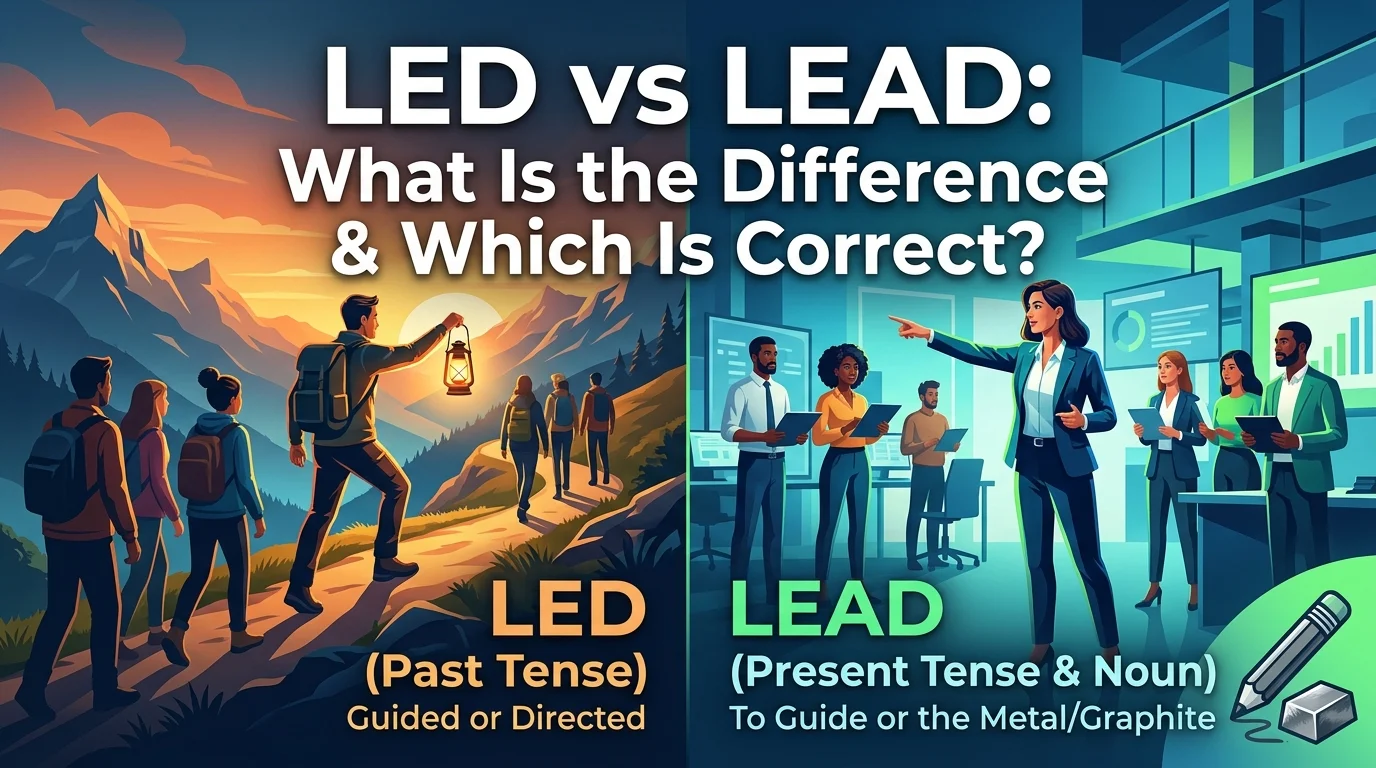
Many English learners and even native speakers get confused by led vs lead. The two words are closely related and can sound similar. The confusion becomes even greater because lead can be both a verb and a noun. Understanding the difference between led and lead helps you write and speak more clearly. It is useful in school, at work, and in daily life.
Comparison Overview
Led and lead are forms of the same verb, but they are used in different grammatical situations.
| Term | Part of Speech | Meaning | Example |
| Lead | Verb (present tense) | To guide, direct, or be in charge | I lead the team. |
| Led | Verb (past tense) | Guided or directed in the past | She led the project. |
| Lead | Noun | A clue, position of advantage, or a metal | The detective found a lead. |
The key difference is that lead is usually used for the present or future. Led is used for actions that happened in the past.
Definition of Led
Led is the past tense and past participle form of the verb lead.
It means someone guided, directed, influenced, or controlled something in the past.
Examples:
- She led the discussion yesterday.
- The manager led the meeting successfully.
- They led the company through difficult times.
Whenever the action already happened, led is usually the correct choice.
Definition of Lead
Lead is the present tense form of the verb meaning to guide, direct, or be in charge.
It can also function as a noun with several meanings.
Examples as a verb:
- I lead the marketing department.
- They lead the competition.
- Who will lead the project?
Examples as a noun:
- The detective followed a promising lead.
- Our team has a ten-point lead.
- Lead pipes were once commonly used.
Main Differences Between Led and Lead
| Feature | Led | Lead |
| Tense | Past tense | Present tense |
| Time Reference | Action already happened | Action happening now or in future |
| Part of Speech | Verb only | Verb and noun |
| Example | She led the team. | She will lead the team. |
| Grammar Role | Past action | Present or future action |
Key Difference in Meaning
The meaning remains largely the same when used as a verb. The major difference is the time of the action.
- Lead = present or future guidance
- Led = past guidance
Pronunciation Difference
When used as a verb:
- Lead = “leed”
- Led = “led”
When used as the metal:
- Lead = “led”
This pronunciation overlap causes much of the confusion.
Why People Confuse Led and Lead
Several factors contribute to confusion:
- Lead and led are forms of the same verb.
- The spelling pattern is unusual.
- The noun “lead” (metal) is pronounced like “led.”
- English learners often expect the past tense of lead to be “leaded,” which is incorrect.
Comparison Table: Led vs Lead
| Category | Led | Lead |
| Verb Form | Past | Present |
| Indicates Time | Yesterday, last week, earlier | Today, now, tomorrow |
| Common Use | Historical events | Current leadership |
| Example | He led the march. | He leads the march. |
| Grammar Function | Completed action | Ongoing action |
Grammar Guide
How Each Term Is Used in Sentences
Lead Patterns
- Subject + lead/leads + object
- Subject + will lead + object
Examples:
- I lead the class.
- She leads the department.
- They will lead the campaign.
Led Patterns
- Subject + led + object
Examples:
- I led the class yesterday.
- She led the department last year.
- They led the campaign successfully.
Common Mistakes Learners Make
Mistake 1
❌ She lead the team yesterday.
✅ She led the team yesterday.
Mistake 2
❌ He has lead the project for years.
✅ He has led the project for years.
Mistake 3
❌ They led the company now.
✅ They lead the company now.
Simple Rules to Remember
- If the action happened in the past, use led.
- If the action is happening now, use lead.
- After “has,” “have,” or “had,” use led.
- Never use “leaded” as the past tense of the verb lead.
Quick Tips for Writing and Speaking
- Look for time clues such as yesterday, last year, or previously. These often require led.
- Look for present-time clues such as today, currently, or now. These often require lead.
- Remember that “have led” is correct, not “have lead.”
- Double-check professional and academic writing for this common error.
When to Use Each One
Use Lead When:
- Talking about present actions.
- Referring to future guidance or direction.
- Describing leadership roles.
- Using lead as a noun.
Examples:
- I lead a research team.
- She will lead the discussion.
- The detective found a lead.
Use Led When:
- Describing completed actions.
- Talking about past leadership.
- Referring to historical events.
Examples:
- She led the expedition.
- They led the company through a crisis.
- He led the group safely home.
When NOT to Use Each One
Do Not Use Lead When:
- Referring to completed past actions.
- Following helping verbs such as has, have, or had.
Incorrect:
- She lead the meeting yesterday.
- They have lead the project.
Do Not Use Led When:
- Referring to present actions.
- Talking about future leadership.
Incorrect:
- I led the team today and still do.
- She will led the conference.
Which One to Use (Decision Guide)
Ask yourself these questions:
- Did the action happen in the past?
- Yes → Use led.
- Is the action happening now?
- Yes → Use lead.
- Is the action planned for the future?
- Yes → Use lead.
- Are you using has, have, or had?
- Use led.
- Are you referring to a clue, advantage, or metal?
- Use lead.
Real-World Practical Examples
Led Examples
- The teacher led the students through the experiment.
- The CEO led the company during a recession.
- The scientist led an important research project.
- The coach led the team to victory.
- The guide led tourists through the museum.
Lead Examples
- I lead a weekly study group.
- She will lead the software development team.
- They lead the industry in innovation.
- The detective followed a strong lead.
- Our team has a comfortable lead in the tournament.
Self-Assessment (Fill in the Blanks)
- I will use ______ when referring to present leadership.
- The correct word is ______ because the action happened yesterday.
- She ______ the meeting last week.
- They ______ the organization today.
- The correct word is ______ because the event occurred in the past.
- We ______ the discussion every Monday.
- He has ______ several successful projects.
- The detective found a useful ______.
- She ______ the team through the crisis.
- They will ______ the workshop tomorrow.
- The correct word is ______ because it follows “have.”
- Our company continues to ______ the market.
- The guide ______ visitors around the castle yesterday.
- The correct word is ______ because the action is ongoing.
- The manager ______ the staff meeting last month.
- Scientists ______ current research efforts.
- The police followed a promising ______.
- She had ______ the department for years.
- The correct word is ______ because the action was completed.
- Who will ______ the new initiative?
Answers
- lead
- led
- led
- lead
- led
- lead
- led
- lead
- led
- lead
- led
- lead
- led
- lead
- led
- lead
- lead
- led
- led
- lead
Final Verdict
The difference between led and lead is primarily a matter of grammar and time. Lead is the present tense form of the verb and is used when someone guides, directs, or controls something now or in the future. Led is the past tense and past participle form, used when the action has already happened. While lead can also function as a noun meaning a clue, an advantage, or a type of metal, led is strictly a verb form. If you remember that lead = present/future and led = past, choosing the correct word becomes much easier. Mastering this distinction will improve your writing, speaking, and overall confidence in English communication.
Conclusion About Led vs Lead
Understanding the difference between led vs lead is essential for clear and correct communication. Although these words are closely connected, they serve different grammatical purposes. Lead is usually the present tense verb that means to guide or direct. Led is the past tense and past participle used for actions that already happened. The confusion often comes from the unusual spelling and the fact that the noun lead sounds different based on its meaning.
By focusing on the time of the action, you can quickly decide which word is appropriate. If someone is guiding others now or in the future, use lead. If the action happened in the past, use led. Mastering this distinction will strengthen your writing, improve your grammar accuracy, and help you communicate with confidence in academic, professional, and everyday situations.
FAQs
What is the difference between led and lead?
The main difference is tense. Lead is the present tense form of the verb meaning to guide or direct, while led is the past tense and past participle form. If the action is happening now, use lead. If it already happened, use led.
Is led the past tense of lead?
Yes, led is the correct past tense and past participle of the verb lead. For example, “She led the team to success” describes an action that happened in the past.
Why do people confuse led and lead?
People often confuse these words because they are forms of the same verb. Additionally, the noun lead referring to a metal is pronounced like led, making the distinction less obvious for learners.
How do I know when to use lead?
Use lead when discussing present or future actions. For example, “I lead the department” or “She will lead the meeting.” It indicates guidance, direction, or leadership happening now or later.
How do I know when to use led?
Use led when referring to actions that already happened. For example, “The teacher led the class yesterday.” It shows that the guiding or directing occurred in the past.
Can lead be used as a noun?
Yes, lead can function as a noun. It may refer to a clue in an investigation, an advantage in a competition, or a type of metal. The meaning depends on the context.
Is “have lead” correct grammar?
No, have lead is generally incorrect when using the verb. The correct form is have led because led is the past participle. Example: “They have led the organization successfully.”
What is the pronunciation of lead and led?
As a verb, lead is pronounced like “leed.” Led is pronounced “led.” However, the noun lead meaning a metal is also pronounced “led,” which often causes confusion.
Are led and lead interchangeable?
No, they are not interchangeable. The correct choice depends on grammar and time reference. Using the wrong form can make a sentence grammatically incorrect or confusing.
What is the easiest way to remember led vs lead?
A simple rule is to associate lead with present or future actions and led with past actions. If the action happened yesterday, last year, or earlier, led is usually the correct choice.

Daniel Brooks is an English educator with a passion for explaining similes and word comparisons in plain language. He covers topics like versus meanings, correct usage, and figurative language to help writers avoid common mistakes and improve clarity in everyday writing.
