
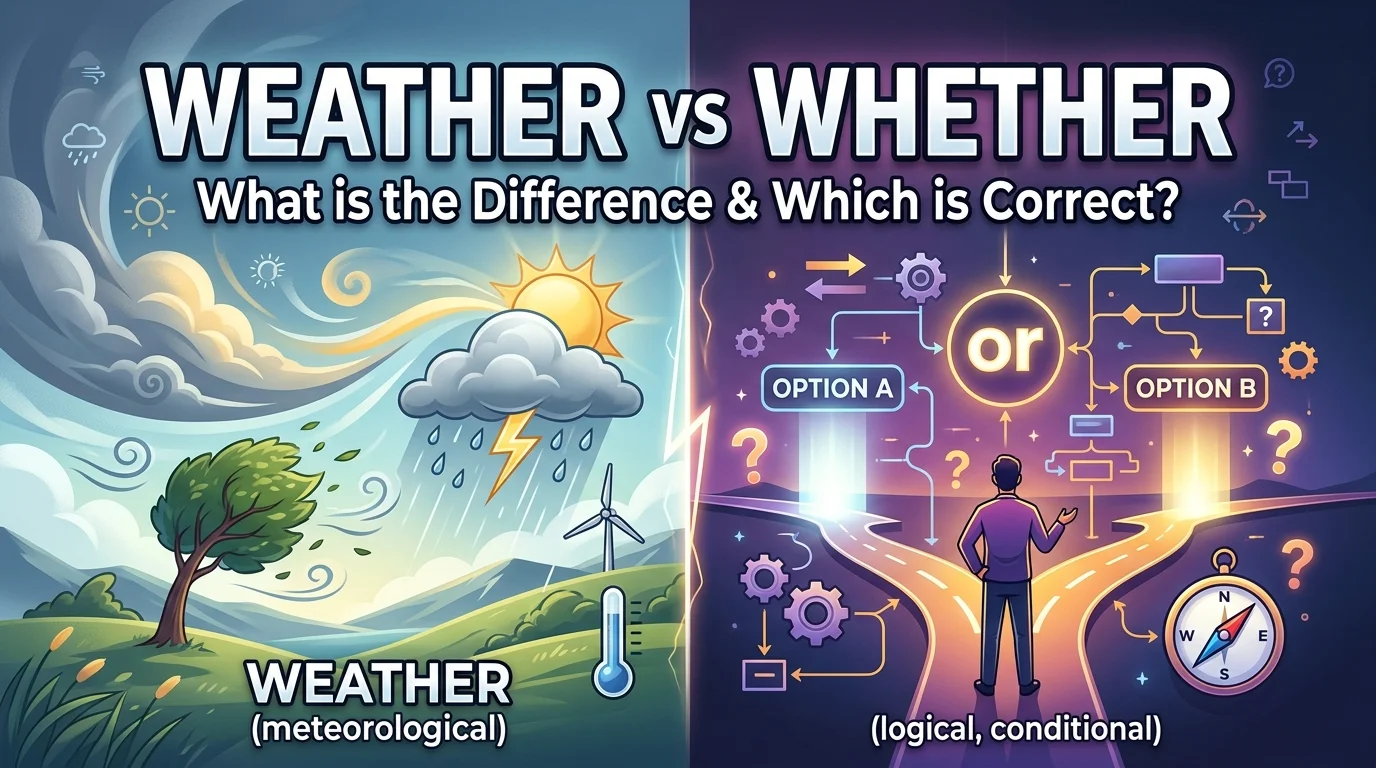
Understanding the difference between “weather” and “whether” is important because they are commonly confused in writing and speaking. Even though they sound similar, their meanings are completely different. One relates to atmospheric conditions, while the other is used for expressing choices or possibilities in sentences.
Comparison Overview
“Weather” and “whether” are homophones, meaning they sound the same but have different meanings and spellings. “Weather” is mainly a noun and sometimes a verb related to climate conditions. “Whether” is a conjunction used to introduce alternatives or possibilities. Knowing their roles helps avoid spelling and grammar mistakes in everyday communication.
Definition of Weather
“Weather” refers to the state of the atmosphere at a particular time and place. It includes conditions such as sunshine, rain, wind, humidity, and temperature. It can also be used as a verb meaning to endure or withstand something difficult.
Definition of Whether
“Whether” is a conjunction used to express a choice between two or more possibilities. It is often used in sentences where uncertainty or alternatives are being discussed. It helps connect ideas when comparing options or outcomes.
Main Differences Between Weather and Whether
The key difference between “weather” and “whether” lies in meaning and usage.
“Weather” is related to climate and environmental conditions, while “whether” is used in grammar to show alternatives or decisions.
“Weather” can function as a noun or verb, but “whether” only functions as a conjunction.
Another important difference is context. “Weather” appears in discussions about nature, travel, and daily conditions, while “whether” appears in decision-making, reporting speech, and logical expressions.
| Feature | Weather | Whether |
| Part of speech | Noun, verb | Conjunction |
| Meaning | Atmospheric conditions | Choice or possibility |
| Usage context | Climate, environment | Decisions, alternatives |
| Example use | The weather is hot today | I do not know whether he will come |
Grammar Guide
How each term is used in sentences
“Weather” is used as a noun when describing conditions like rain or sunshine. It can also be used as a verb meaning to survive or endure something.
Examples:
- The weather is very cold today.
- They had to weather the storm during the hike.
“Whether” is used to introduce options or uncertainty.
Examples:
- I do not know whether he will attend the meeting.
- She is deciding whether to study abroad or stay home.
Common mistakes learners make
Many learners confuse “weather” with “whether” because they sound identical. A common mistake is using “weather” when talking about choices, which is incorrect.
Incorrect:
- I am not sure weather I should go.
Correct:
- I am not sure whether I should go.
Another mistake is using “whether” when talking about climate.
Incorrect:
- The whether is cold today.
Correct:
- The weather is cold today.
Simple rules to remember
- Use “weather” when talking about nature or climate.
- Use “whether” when talking about choices or uncertainty.
- If you can replace the word with “climate,” use “weather.”
- If you can replace it with “if or not,” use “whether.”
Quick tips for writing and speaking
- Think of rain, sun, and wind for “weather.”
- Think of decisions and options for “whether.”
- Read the sentence aloud to check meaning clarity.
- Focus on context instead of pronunciation.
When to Use Each One
Use “weather” when describing environmental conditions such as temperature, storms, or forecasts. It is commonly used in daily conversations, news reports, and travel planning.
Use “whether” when expressing doubt, choices, or alternatives. It is commonly used in formal writing, conversations, and academic discussions where decisions are involved.
When NOT to Use Each One
Do not use “weather” when discussing choices or uncertainty. It does not fit logical or decision-based sentences.
Do not use “whether” when talking about climate or environmental conditions. It cannot describe physical atmospheric states.
Which One to Use (Decision Guide)
If your sentence is about rain, sunshine, or temperature, choose “weather.” If your sentence involves options, decisions, or uncertainty, choose “whether.” A simple way to decide is to check if the sentence is about nature or choice. Nature means weather, choice means whether.
Real-World Practical Examples
Weather Examples
- The weather today is perfect for a picnic.
- Bad weather delayed the flight schedule.
- We check the weather before planning outdoor events.
- The weather changed suddenly in the evening.
- Cold weather can affect travel plans.
Whether Examples
- I am unsure whether I should accept the job offer.
- She asked whether the store is still open.
- They will decide whether to continue the project.
- I cannot tell whether he is serious or joking.
- He is thinking about whether to move to another city.
Self-Assessment (Fill in the Blanks)
- The ______ is very hot today.
- I do not know ______ I should go or stay.
- The ______ report says it will rain tomorrow.
- She is unsure ______ to accept the invitation.
- We checked the ______ before traveling.
- He asked ______ the train has left.
- Cold ______ can cause delays.
- I wonder ______ she likes the gift.
- The ______ changed quickly in the evening.
- They are deciding ______ to continue or stop.
- Sunny ______ makes people happy.
- I cannot decide ______ to study abroad.
- The ______ forecast was accurate.
- Tell me ______ you are coming.
- Bad ______ affected the match.
- I am not sure ______ he is right.
- The ______ became stormy at night.
- She asked ______ it is true.
- We enjoyed the good ______ at the beach.
- He is thinking about ______ to join the team.
Answers
- weather
- whether
- weather
- whether
- weather
- whether
- weather
- whether
- weather
- whether
- weather
- whether
- weather
- whether
- weather
- whether
- weather
- whether
- weather
- whether
Final Verdict
“Weather” and “whether” are often confused but serve completely different purposes in English. “Weather” describes atmospheric conditions like rain and sunshine, while “whether” is used to show choices or uncertainty. Understanding their roles in context makes it easy to choose the correct word and avoid common grammar mistakes in writing and speaking.
Conclusion About Weather vs Whether
Understanding the difference between weather and whether helps improve both writing accuracy and spoken clarity. These two words may sound identical, but their meanings are completely unrelated. Weather refers to atmospheric conditions like rain, sunshine, or storms, while whether is used to express choices, possibilities, or uncertainty. Once you recognize the context in which each word is used, it becomes much easier to choose the correct one without hesitation. Practicing examples and paying attention to sentence meaning can quickly eliminate confusion. Over time, using these words correctly becomes natural and effortless, helping you communicate more confidently in everyday conversations, academic writing, and professional communication.
FAQs
What is the main difference between weather and whether?
Weather refers to atmospheric conditions such as rain, wind, or sunshine. Whether is used to express choices or uncertainty between options. The main difference lies in meaning and usage. One describes nature, while the other is used in grammar for decision-making or alternative possibilities in sentences.
Why do people confuse weather and whether?
People confuse them because they are homophones, meaning they sound exactly the same when spoken. However, their spelling and meanings are completely different. Without context, it becomes easy to mix them up, especially in fast writing or speech where attention to detail may be reduced.
Can weather be used as a verb?
Yes, weather can be used as a verb. In this case, it means to endure or survive difficult conditions. For example, a ship can weather a storm. This usage is less common than the noun form but still important in formal and descriptive writing.
How is whether used in a sentence?
Whether is used to introduce alternatives or uncertainty. It often appears in sentences where a decision or choice is involved. For example, “I do not know whether I should go” shows doubt between two possibilities, making it a key word in expressing conditions or options.
Is weather only related to climate?
Primarily, weather refers to atmospheric conditions like temperature, rain, and wind. However, it can also be used figuratively to describe enduring difficulties. Still, its main and most common usage is related to climate and environmental conditions in everyday communication and reporting.
Can whether be replaced with if?
In some cases, whether can be replaced with if, especially in informal speech. However, whether is preferred in formal writing, especially when presenting alternatives or multiple choices. Using whether ensures clarity and grammatical accuracy in professional and academic contexts.
What are common mistakes with weather and whether?
A common mistake is using weather when talking about choices or uncertainty. Another error is spelling whether incorrectly when discussing climate. These mistakes happen because the words sound the same, but careful attention to meaning helps avoid confusion in writing.
How can I remember weather vs whether easily?
A simple trick is to link weather with nature words like rain, sun, and storms. For whether, think of choice words like option or decision. If the sentence involves climate, use weather. If it involves choice or uncertainty, use whether.
Where is weather commonly used?
Weather is commonly used in news reports, travel discussions, and daily conversations about climate conditions. It helps describe temperature, rainfall, storms, and other atmospheric situations that affect daily life, outdoor activities, and environmental conditions in specific regions.
Where is whether commonly used?
Whether is commonly used in decision-making situations, formal writing, and discussions involving choices. It often appears in questions, reported speech, and academic writing where alternatives or uncertainty need to be clearly expressed between two or more options.

Sophia Turner is a grammar-focused writer who covers similes, word-versus-word meanings, and correct English usage. Her content is designed for learners who want quick answers, logical explanations, and practical guidance for improving writing accuracy and style.