
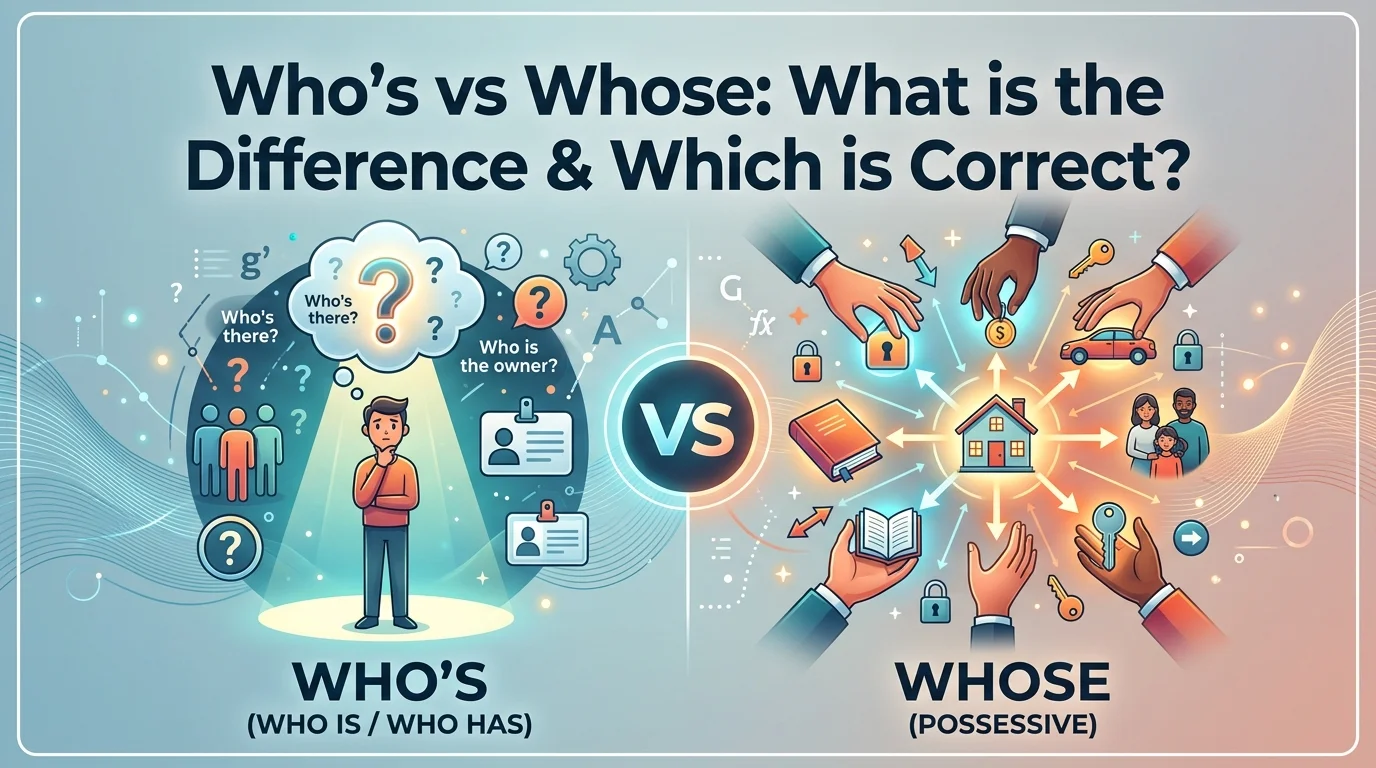
Understanding the difference between “who’s” and “whose” is essential for clear and correct English writing. These two words look similar but have completely different meanings and functions. Confusing them can change the meaning of a sentence or make your writing unclear, especially in formal communication, exams, and professional contexts.
Comparison Overview
“Who’s” and “whose” are both commonly used in English, but they serve very different grammatical roles. “Who’s” is a contraction, while “whose” is a possessive word used to show ownership or relation. Despite sounding similar, they are not interchangeable and must be used based on context and meaning.
Definition of Who’s
“Who’s” is a contraction of two possible phrases: “who is” or “who has.” It is used in informal and spoken English to shorten sentences and make communication more natural. The apostrophe replaces missing letters, making it important to recognize that it is not a possessive form.
Definition of Whose
“Whose” is a possessive pronoun used to ask or explain ownership or association. It shows that something belongs to someone or is connected to a person or thing. It does not contain an apostrophe and should never be confused with “who’s.”
Main Differences Between Who’s and Whose
The main difference lies in grammar and meaning. “Who’s” always expands to “who is” or “who has,” while “whose” expresses possession. One is a contraction, and the other is a possessive pronoun. Misusing them can change the meaning of a sentence entirely.
| Feature | Who’s | Whose |
| Type | Contraction | Possessive pronoun |
| Meaning | Who is / Who has | Belonging to whom |
| Apostrophe | Yes | No |
| Usage | Informal speech, questions | Questions and statements of ownership |
| Example | Who’s coming today? | Whose book is this? |
Grammar Guide
How each term is used in sentences
“Who’s” is used when you can replace it with “who is” or “who has.” For example, “Who’s ready?” means “Who is ready?” On the other hand, “whose” is used to ask about ownership, such as “Whose phone is ringing?”
Common mistakes learners make
A frequent mistake is using “who’s” when showing possession, such as writing “Who’s bag is this?” instead of “Whose bag is this?” Another common error is forgetting that “whose” never contains an apostrophe.
Simple rules to remember
If you can expand the word to “who is” or “who has,” use “who’s.” If you are talking about ownership or belonging, use “whose.” This simple test works in almost all situations.
Quick tips for writing and speaking
Always pause and expand “who’s” in your mind before writing it. If the sentence still makes sense, it is correct. If not, switch to “whose.” This habit helps avoid mistakes in exams and professional writing.
When to Use Each One
Use “who’s” in questions or statements where you mean “who is” or “who has,” especially in casual conversation. Use “whose” when asking about possession or identifying ownership in both formal and informal writing.
When NOT to Use Each One
Do not use “who’s” when you are talking about possession. It should never replace “whose.” Similarly, do not use “whose” as a contraction for “who is” or “who has,” as it will make the sentence grammatically incorrect.
Which One to Use (Decision Guide)
If the sentence can be expanded to “who is” or “who has,” choose “who’s.” If the sentence is asking about ownership or relationship, choose “whose.” This decision rule helps quickly identify the correct form without confusion.
Real-World Practical Examples
Who’s Examples
- Who’s going to the meeting today?
- Who’s finished their homework already?
- Who’s been calling me all morning?
- Who’s responsible for this project?
- Who’s arriving late again?
Whose Examples
- Whose jacket is hanging on the chair?
- Whose idea was this proposal?
- Whose car is parked outside?
- Whose phone keeps ringing?
- Whose responsibility is this task?
Self-Assessment (Fill in the Blanks)
- I wonder ______ coming to the party tonight.
- ______ backpack is left in the classroom?
- Do you know ______ going to win the match?
- ______ keys are these on the table?
- She asked ______ finished the assignment.
- ______ turn is it to present today?
- I don’t know ______ calling me right now.
- ______ idea was used in the presentation?
- Tell me ______ ready for the trip.
- ______ phone is ringing in the hall?
- He asked ______ responsible for the mistake.
- ______ laptop is this on the desk?
- I want to know ______ coming for dinner.
- ______ bag was left in the bus?
- Do you know ______ speaking in the video?
- ______ decision changed the outcome?
- She asked ______ going to help her.
- ______ shoes are placed near the door?
- I am not sure ______ attending the event.
- ______ idea inspired the project?
Answers
- who’s
- whose
- who’s
- whose
- who’s
- whose
- who’s
- whose
- who’s
- whose
- who’s
- whose
- who’s
- whose
- who’s
- whose
- who’s
- whose
- who’s
- whose
Final Verdict
“Who’s” and “whose” may look similar, but they serve completely different purposes in English. “Who’s” is a contraction meaning “who is” or “who has,” while “whose” is used to show possession. The easiest way to choose correctly is to test whether the sentence refers to action or ownership. With practice, using the right form becomes quick and automatic.
Conclusion About Who’s vs Whose
The difference between “who’s” and “whose” is small in spelling but huge in meaning. “Who’s” is simply a shortened form of “who is” or “who has,” while “whose” shows possession or belonging. Many writers confuse the two because they sound identical in speech, but their grammatical roles are completely different. Once you understand the contraction rule for “who’s” and the ownership rule for “whose,” choosing the correct form becomes much easier. Practicing with real sentences helps reinforce the distinction in everyday writing and conversation. Mastering this simple difference improves clarity, avoids common mistakes, and strengthens overall English communication skills.
FAQs
What is the main difference between who’s and whose?
“Who’s” is a contraction of “who is” or “who has,” while “whose” is used to show possession or belonging. The two words sound alike but serve different grammatical purposes in sentences.
Can who’s ever be used for possession?
No, “who’s” should never be used for possession. It always represents “who is” or “who has.” For ownership or belonging, the correct word is “whose.”
Why do people confuse who’s and whose?
People often confuse them because they are pronounced the same in spoken English. The difference becomes clearer only in writing, where apostrophe usage and meaning must be carefully checked.
How can I quickly remember the difference?
A simple trick is to expand the word. If it becomes “who is” or “who has,” use “who’s.” If it shows ownership, use “whose.” This quick test helps avoid mistakes.
Is whose always used for questions?
No, “whose” can be used in both questions and statements. It is commonly used to ask about ownership but can also describe possession in indirect sentences.
Is who’s formal or informal English?
“Who’s” is more common in informal and spoken English. In formal writing, it is still correct but should be used carefully depending on tone and context.
Can whose refer to things or only people?
“Whose” can refer to both people and things. It is used to show possession or relationship, even when the subject is not a person.
What is the biggest mistake with who’s and whose?
The most common mistake is using “who’s” instead of “whose” in possessive sentences, which changes the meaning and makes the sentence grammatically incorrect.
Are who’s and whose pronounced differently?
No, both words are pronounced the same way. This is why learners often confuse them in writing even though their meanings are different.
Why is learning who’s vs whose important?
Understanding the difference improves grammar accuracy, reduces writing errors, and helps communicate ideas more clearly in both academic and professional English.

Amelia Wright focuses on making figurative language easy to understand. Her writing explains similes, metaphors, and word meanings using relatable examples. She aims to help readers recognize subtle differences in usage and apply them correctly in both academic and casual writing.