
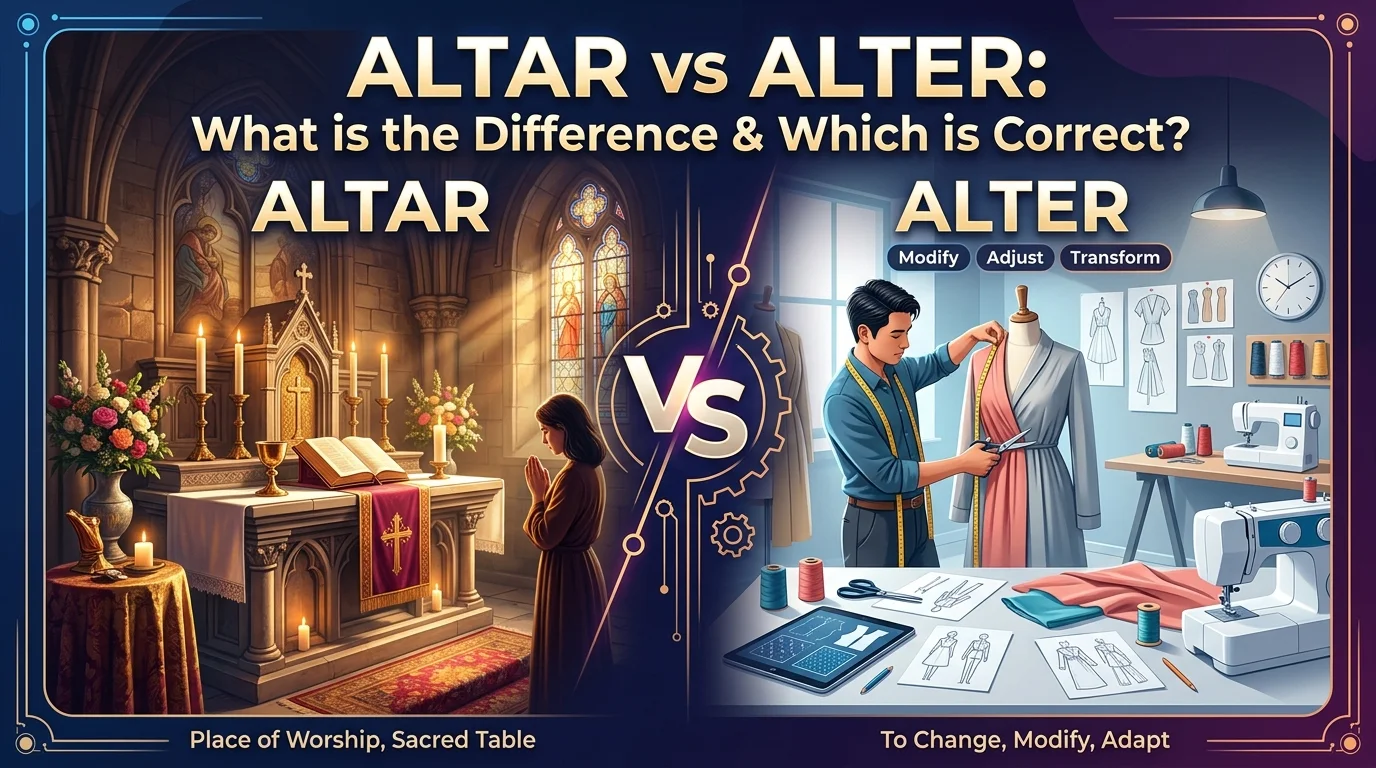
Many English learners and native speakers alike confuse altar and alter because they sound exactly the same. However, these two words have completely different meanings and uses. Understanding the difference between altar vs alter is important for correct writing, speaking, and grammar. This guide explains each term in simple language, highlights their differences, and shows when to use each one correctly.
Comparison Overview
The words altar and alter are homophones, meaning they are pronounced the same but have different spellings and meanings.
| Word | Part of Speech | Meaning | Common Context |
| Altar | Noun | A sacred table or structure used in religious ceremonies | Religion, weddings, churches |
| Alter | Verb | To change or modify something | Daily life, business, science, writing |
Although they sound identical, one refers to a physical object, while the other describes an action.
Definition of Altar
An altar is a noun that refers to a sacred table, platform, or structure used for religious ceremonies, worship, sacrifices, or prayers.
Altars are commonly found in churches, temples, shrines, and other places of worship. The word is often associated with weddings, religious services, and spiritual rituals.
Key Characteristics of Altar
- Always a noun
- Refers to a physical object
- Commonly used in religious settings
- Associated with worship and ceremonies
Example
“The couple stood before the altar during the wedding ceremony.”
Definition of Alter
Alter is a verb that means to change, modify, adjust, or make something different.
It can refer to changing plans, documents, clothing, behavior, designs, or almost anything else.
Key Characteristics of Alter
- Always used as a verb
- Describes an action
- Means to change or modify
- Common in everyday communication
Example
“You should alter the report before submitting it.”
Main Differences Between Altar and Alter
Although the words sound alike, their meanings and functions are completely different.
| Feature | Altar | Alter |
| Part of Speech | Noun | Verb |
| Meaning | Sacred religious structure | To change or modify |
| Function | Names an object | Describes an action |
| Context | Religion, ceremonies | General communication |
| Physical Object? | Yes | No |
| Action Word? | No | Yes |
Simple Comparison
- Altar = a place used for worship.
- Alter = to make changes.
Example Pair
Correct: “Flowers decorated the altar.”
Correct: “They decided to alter the design.”
Incorrect: “Flowers decorated the alter.”
Incorrect: “They decided to altar the design.”
Religious vs Everyday Usage
One easy way to distinguish these words is by context.
Altar in Religious Contexts
An altar is usually connected to:
- Churches
- Temples
- Weddings
- Religious ceremonies
- Prayer services
Alter in Everyday Contexts
Alter is commonly used in:
- Business
- Education
- Technology
- Science
- Writing
- Personal decisions
Common Memory Trick
A simple memory trick can help.
Altar contains “tar.”
Think of a church floor leading to the altar.
Alter contains “ter.”
Think of “ter” as part of the word “change” in your memory system. When something changes, it is altered.
Grammar Guide
How Each Term Is Used in Sentences
Altar
Pattern:
- The altar + verb
- At the altar
- Before the altar
Examples:
- The priest stood beside the altar.
- The candles were placed on the altar.
- They exchanged vows at the altar.
Alter
Pattern:
- Alter + object
- Alter + plan
- Alter + document
Examples:
- We need to alter the schedule.
- She altered her dress.
- Scientists altered the experiment.
Common Mistakes Learners Make
Mistake 1
Incorrect: “The bride walked toward the alter.”
Correct: “The bride walked toward the altar.”
Mistake 2
Incorrect: “Please altar the document.”
Correct: “Please alter the document.”
Mistake 3
Using altar as a verb.
Incorrect: “They altar the plans.”
Correct: “They alter the plans.”
Simple Rules to Remember
- Altar is always a noun.
- Alter is always a verb.
- If worship is involved, use altar.
- If change is involved, use alter.
- Ask whether the word names something or does something.
Quick Tips for Writing and Speaking
- Think “church” when you see altar.
- Think “change” when you see alter.
- Check whether the sentence needs a noun or a verb.
- Read the sentence aloud and identify the context.
- Proofread carefully because spell-check may miss homophones.
When to Use Each One
Use Altar When
- Discussing religion
- Talking about weddings
- Referring to a sacred structure
- Describing ceremonies
- Mentioning worship practices
Examples:
- The flowers surrounded the altar.
- The congregation faced the altar.
Use Alter When
- Talking about changes
- Modifying plans
- Revising documents
- Adjusting designs
- Changing behavior
Examples:
- We must alter the budget.
- The tailor will alter the jacket.
When NOT to Use Each One
Do Not Use Altar When
- Referring to changes
- Talking about revisions
- Describing modifications
- Discussing adjustments
Incorrect:
- Please altar the contract.
Do Not Use Alter When
- Referring to church furniture
- Discussing wedding ceremonies
- Describing sacred structures
Incorrect:
- The candles sat on the alter.
Which One to Use (Decision Guide)
Use this quick decision guide:
- Are you talking about a sacred table, church structure, or wedding setting?
- Yes → Altar
- No → Continue
- Are you talking about changing, modifying, adjusting, or revising something?
- Yes → Alter
- No → Recheck the sentence.
Quick Formula
- Religious object = Altar
- Change something = Alter
Real-World Practical Examples
Altar Examples
- The bride and groom met at the altar during the ceremony.
- The priest placed the candle on the altar.
- Visitors admired the ancient altar inside the temple.
- The church decorated the altar for Easter.
- The worshippers gathered near the altar for prayer.
Alter Examples
- The teacher asked students to alter their essays.
- Scientists altered the testing procedure.
- The company altered its marketing strategy.
- The tailor altered the suit to fit perfectly.
- New evidence may alter the final decision.
Self-Assessment (Fill in the Blanks)
- The couple exchanged vows at the ______.
- We need to ______ the project schedule.
- Candles were placed on the ______.
- The editor decided to ______ the article.
- The church restored its historic ______.
- New information could ______ the results.
- The flowers surrounded the ______.
- The manager wants to ______ the budget.
- Guests gathered near the ______ during the ceremony.
- The tailor will ______ the jacket.
- The priest stood beside the ______.
- The company may ______ its policies.
- The wedding photographs featured the ______.
- Scientists had to ______ the experiment.
- Worshippers approached the ______ quietly.
- We should ______ the design before production.
- The ancient ______ was made of stone.
- The author decided to ______ several chapters.
- Everyone faced the ______ during prayer.
- The new law may ______ business operations.
Answers
- Altar
- Alter
- Altar
- Alter
- Altar
- Alter
- Altar
- Alter
- Altar
- Alter
- Altar
- Alter
- Altar
- Alter
- Altar
- Alter
- Altar
- Alter
- Altar
- Alter
Final Verdict
The difference between altar and alter is straightforward once you understand their roles. Altar is a noun that refers to a sacred structure used in religious ceremonies, worship, and weddings. Alter is a verb that means to change, modify, or adjust something. Since they are homophones, they are often confused in writing, but their meanings are entirely unrelated. Whenever you encounter these words, ask yourself whether the sentence is talking about a religious object or a change being made. If it refers to worship, ceremonies, or a sacred place, choose altar. If it refers to modifying, revising, or changing something, choose alter. Keeping this simple distinction in mind will help you use both words correctly and confidently in everyday writing and conversation.
Conclusion About Altar vs Alter
Understanding the difference between altar vs alter becomes much easier once you focus on their meanings and grammatical roles. Although these words sound exactly alike, they serve completely different purposes in English. Altar is a noun that refers to a sacred structure used in religious ceremonies, worship, and weddings, while alter is a verb that means to change, modify, or adjust something. Because they are homophones, writers often confuse them, especially when typing quickly. The good news is that a simple context check can prevent mistakes. If the sentence relates to religion or a ceremonial setting, use altar. If it involves making changes, use alter. Mastering this distinction will improve your writing accuracy, strengthen your grammar skills, and help you communicate more clearly. With regular practice and exposure, choosing between altar and alter will soon become second nature.
FAQs
What is the main difference between altar and alter?
The main difference is that altar is a noun referring to a sacred structure used in religious ceremonies, while alter is a verb meaning to change or modify something. Even though they sound the same, they have completely different meanings and grammatical functions.
Is altar a noun or a verb?
Altar is always a noun. It refers to a physical object, usually found in churches, temples, or other places of worship. It is never used as an action word and should not be confused with the verb alter.
Is alter a noun or a verb?
Alter is primarily used as a verb. It means to change, revise, adjust, or modify something. It describes an action rather than an object, making it different from altar, which is a noun.
Why do people confuse altar and alter?
People often confuse these words because they are homophones. Homophones have the same pronunciation but different spellings and meanings. Since altar and alter sound identical, writers sometimes choose the wrong spelling when relying only on sound.
How do I remember the difference between altar and alter?
A helpful trick is to associate altar with religion and ceremonies, while alter relates to change. If the sentence involves a church, wedding, or worship setting, use altar. If something is being modified, use alter.
Can altar and alter ever be used interchangeably?
No, they cannot be used interchangeably. Since they have different meanings and grammatical roles, replacing one with the other creates incorrect sentences and may confuse readers about the intended meaning.
What is an example sentence using altar?
A simple example is: “The bride and groom stood before the altar during the wedding ceremony.” In this sentence, altar refers to the sacred place where the ceremony takes place.
What is an example sentence using alter?
An example is: “The manager decided to alter the project timeline.” Here, alter means to change or adjust the schedule based on new circumstances or requirements.
Is altar commonly used outside religious contexts?
Most of the time, altar appears in religious, ceremonial, or historical contexts. While it may occasionally be used figuratively, its primary meaning remains connected to worship, rituals, and sacred spaces.
Which word should I use when talking about making changes?
Whenever you mean to change, revise, modify, or adjust something, the correct word is alter. This applies to documents, plans, clothing, designs, policies, and many other situations involving change.

Daniel Brooks is an English educator with a passion for explaining similes and word comparisons in plain language. He covers topics like versus meanings, correct usage, and figurative language to help writers avoid common mistakes and improve clarity in everyday writing.
