
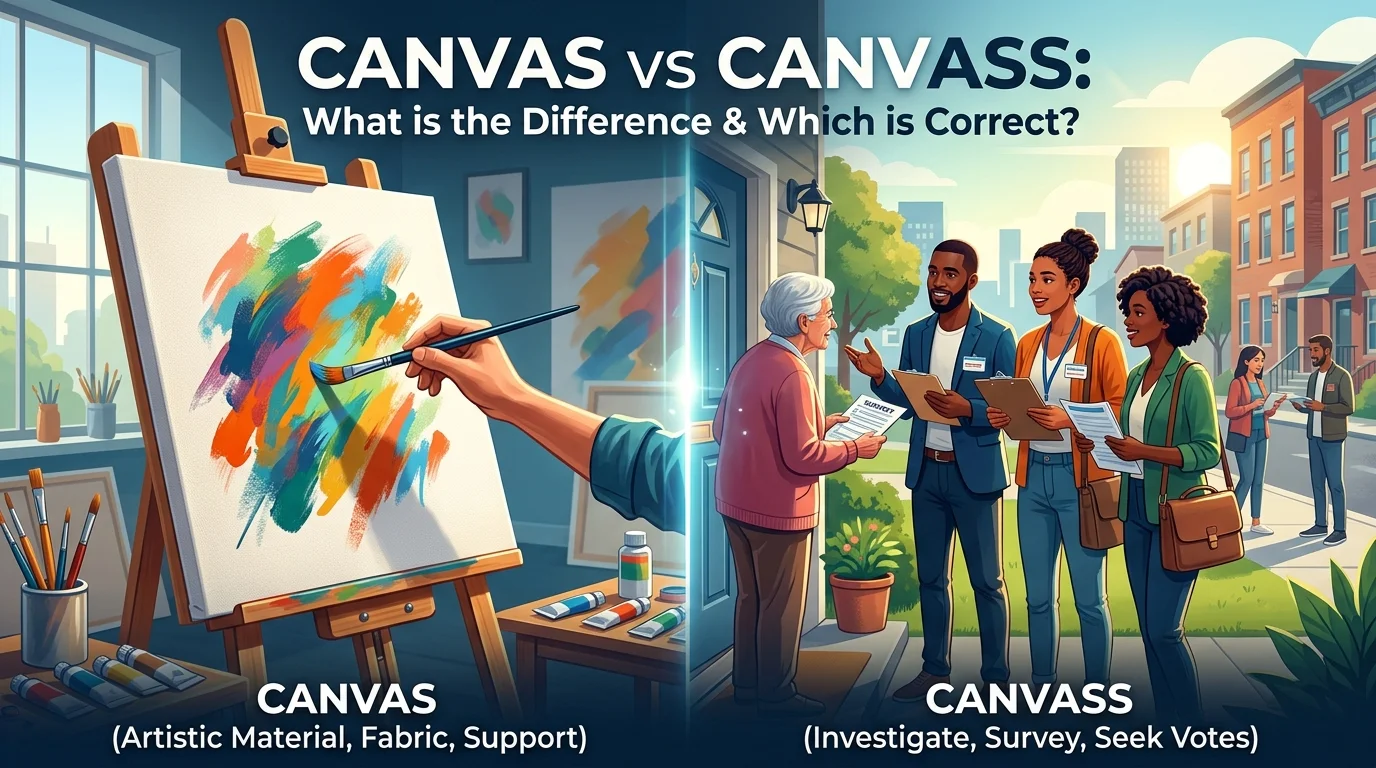
Many English learners confuse canvas and canvass because the words look and sound similar. However, they have completely different meanings and uses. Understanding the difference between these two terms helps improve writing accuracy, grammar, and communication. This guide explains their meanings, grammar rules, examples, and practical usage in a simple and beginner-friendly way.
Comparison Overview
Although canvas and canvass differ by only one letter, they belong to different parts of speech and serve different purposes.
| Feature | Canvas | Canvass |
| Main Meaning | A strong fabric or a painting surface | To seek opinions, votes, or support |
| Part of Speech | Noun (mainly) | Verb (mainly) |
| Common Contexts | Art, tents, sails, bags | Politics, surveys, marketing |
| Related To | Material or artwork | Gathering information or support |
| Example | The artist painted on a canvas. | Volunteers canvassed the neighborhood. |
Definition of Canvas
Canvas is a strong, durable fabric traditionally made from hemp, cotton, or linen. It is commonly used for painting, tents, sails, shoes, bags, and other heavy-duty products.
The word can also refer to the surface on which artists paint.
Key Meaning of Canvas
- A heavy-duty fabric
- A painting surface
- Something made from strong cloth
Examples
- The artist stretched a canvas before painting.
- The tent was made from waterproof canvas.
- She bought a canvas backpack for travel.
Definition of Canvass
Canvass is primarily a verb that means to seek opinions, support, votes, or information from people. It is often used in politics, surveys, business research, and community campaigns.
Key Meaning of Canvass
- To ask people for opinions
- To gather support or votes
- To investigate or discuss thoroughly
Examples
- Volunteers canvassed residents before the election.
- The company canvassed customers for feedback.
- Researchers canvassed local communities.
Main Differences Between Canvas and Canvass
The biggest difference is that canvas refers to a material or surface, while canvass refers to an action involving gathering opinions or support.
| Aspect | Canvas | Canvass |
| Meaning | Strong fabric or painting surface | Seek support, votes, or opinions |
| Function | Object or material | Action |
| Part of Speech | Noun | Verb |
| Used In | Art, construction, outdoor equipment | Politics, marketing, surveys |
| Example | The painting hangs on a canvas. | They canvassed voters. |
Canvas in Art and Everyday Life
Canvas plays an important role in both creative and practical settings.
Common Uses of Canvas
- Painting and artwork
- Shoes and bags
- Tents and camping equipment
- Boat sails
- Home decoration
Canvass in Politics and Research
Canvassing is commonly used when organizations need information or support from people.
Common Uses of Canvass
- Election campaigns
- Customer surveys
- Market research
- Community outreach
- Public opinion studies
Grammar Guide
How Each Term Is Used in Sentences
Canvas (Noun)
Pattern:
Subject + Verb + Canvas
Examples:
- The painter bought a canvas.
- We carried a canvas tent.
- The artwork was displayed on a large canvas.
Canvass (Verb)
Pattern:
Subject + Canvass + Object
Examples:
- Volunteers canvassed voters.
- The team canvassed local businesses.
- Researchers canvassed residents.
Common Mistakes Learners Make
Mistake 1: Using Canvas Instead of Canvass
❌ The campaign workers canvas voters every weekend.
✅ The campaign workers canvass voters every weekend.
Mistake 2: Using Canvass Instead of Canvas
❌ The artist painted on a canvass.
✅ The artist painted on a canvas.
Mistake 3: Confusing the Meanings
Many learners assume both words relate to art because they look similar.
Simple Rules to Remember
- Canvas = Cloth or painting surface
- Canvass = Collect opinions or votes
- If discussing artwork, use canvas.
- If discussing surveys or elections, use canvass.
Quick Tips for Writing and Speaking
- Think of canvas when talking about paintings.
- Think of canvass when talking about asking people questions.
- Double-check spelling because one extra “s” changes the meaning completely.
- Remember that canvass usually involves people and communication.
When to Use Each One
Use Canvas When
- Talking about painting surfaces
- Describing durable fabric
- Discussing tents, bags, or sails
- Referring to artwork
Examples:
- The canvas was stretched tightly.
- The bag is made of canvas.
- She painted a landscape on canvas.
Use Canvass When
- Seeking votes
- Conducting surveys
- Gathering opinions
- Researching public attitudes
Examples:
- The volunteers canvassed every street.
- We canvassed customers for suggestions.
- Researchers canvassed local residents.
When NOT to Use Each One
Do Not Use Canvas When
- Discussing elections
- Collecting opinions
- Asking for votes
- Conducting surveys
Incorrect:
- The candidate canvased voters.
Correct:
- The candidate canvassed voters.
Do Not Use Canvass When
- Referring to paintings
- Discussing fabric
- Talking about tents or bags
Incorrect:
- The artist bought a canvass.
Correct:
- The artist bought a canvas.
Which One to Use (Decision Guide)
Use this simple guide:
| Situation | Correct Word |
| Painting surface | Canvas |
| Fabric material | Canvas |
| Tent or bag material | Canvas |
| Seeking votes | Canvass |
| Conducting surveys | Canvass |
| Gathering opinions | Canvass |
Ask yourself:
Am I talking about a physical object or fabric? → Use Canvas
Am I talking about asking people for information, support, or votes? → Use Canvass
Real-World Practical Examples
Canvas Examples
- The artist displayed her work on a large canvas.
- Our camping tent is made from durable canvas.
- He carried a canvas backpack to school.
- The sailboat used a canvas sail.
- The museum preserved the historic canvas painting.
Canvass Examples
- Election volunteers canvassed voters across the city.
- The company canvassed customers about product improvements.
- Researchers canvassed residents regarding traffic concerns.
- Community leaders canvassed local businesses for support.
- The organization canvassed public opinion before launching the campaign.
Self-Assessment (Fill in the Blanks)
- The artist painted on a ______.
- Campaign workers will ______ voters before the election.
- The backpack is made from strong ______ material.
- Researchers will ______ residents for feedback.
- The painting hangs on a large ______.
- Volunteers ______ neighborhoods every weekend.
- The tent was made of waterproof ______.
- The marketing team will ______ customers.
- She purchased a blank ______ for painting.
- Political parties often ______ voters.
- The sail was made from ______ fabric.
- We need to ______ community members for opinions.
- The artwork was displayed on ______.
- Survey teams ______ hundreds of people.
- The bag uses durable ______.
- Election workers ______ households.
- The painter stretched a new ______.
- Researchers ______ participants before publishing results.
- The museum restored an old ______.
- Volunteers ______ residents to gather support.
Answers
- Canvas
- Canvass
- Canvas
- Canvass
- Canvas
- Canvass
- Canvas
- Canvass
- Canvas
- Canvass
- Canvas
- Canvass
- Canvas
- Canvass
- Canvas
- Canvass
- Canvas
- Canvass
- Canvas
- Canvass
Final Verdict
Canvas and canvass may look similar, but their meanings are entirely different. Canvas is a noun that refers to a strong fabric or a surface used for painting. Canvass is a verb that means to seek opinions, votes, support, or information from people. If you are discussing art, tents, bags, or fabric, choose canvas. If you are talking about elections, surveys, research, or gathering public opinions, choose canvass. Remembering that canvas is a thing and canvass is an action makes it much easier to use the correct word every time.
Conclusion About Canvas vs Canvass
Understanding the difference between canvas vs canvass is essential for clear and accurate communication. While these words look similar and are often confused because of their spelling, they have completely different meanings and uses. Canvas refers to a strong fabric or the surface artists use for painting, whereas canvass means to seek opinions, support, votes, or information from people. Knowing this distinction can help you avoid common writing mistakes and improve your grammar skills.
Whether you are discussing artwork, camping equipment, surveys, research, or political campaigns, choosing the correct word ensures your message is easy to understand. A simple way to remember the difference is that canvas is a thing, while canvass is an action. By practicing their meanings and reviewing real-world examples, you can confidently use both words in everyday writing and conversation without confusion.
FAQs
What is the main difference between canvas and canvass?
The main difference is that canvas is a noun that usually refers to a strong fabric or a painting surface, while canvass is a verb that means to gather opinions, votes, support, or information from people. They may look similar, but their meanings and uses are completely different.
Is canvas a noun or a verb?
Canvas is primarily used as a noun. It commonly refers to a durable cloth material used for tents, bags, sails, and paintings. In most everyday situations, you will encounter canvas as the name of an object or material rather than an action.
Is canvass a noun or a verb?
Canvass is mainly used as a verb. It describes the action of asking people for opinions, support, votes, or feedback. It is frequently used in political campaigns, surveys, community outreach programs, and market research projects.
Can I use canvas when talking about elections?
No, canvas should not be used when discussing elections or voter outreach. In those situations, the correct word is canvass because it refers to the act of contacting people to gain support, gather opinions, or encourage voting participation.
Why do people confuse canvas and canvass?
People often confuse these words because they are spelled almost the same and sound very similar when spoken. However, they belong to different grammatical categories and have unrelated meanings, which makes understanding their definitions especially important.
What does canvas mean in art?
In art, canvas refers to the fabric surface on which artists create paintings. It is usually stretched over a wooden frame and prepared for painting. Many professional and amateur artists use canvas because it is durable and suitable for different painting techniques.
What does canvass mean in politics?
In politics, canvass means to contact voters to gather support, discuss issues, or learn public opinions. Campaign volunteers often canvass neighborhoods by visiting homes, making phone calls, or speaking directly with community members before elections.
How can I remember the difference between canvas and canvass?
A simple memory trick is to think of canvas as a thing and canvass as an action. If you are referring to fabric, artwork, or a physical object, use canvas. If you are talking about asking people questions or seeking support, use canvass.
Are canvas and canvass interchangeable?
No, they are not interchangeable. Replacing one with the other changes the meaning of a sentence and creates a grammatical error. Each word has its own specific definition, context, and purpose, so choosing the correct one is important.
Which word is more common in everyday English?
Canvas is generally more common in everyday conversations because people often discuss art supplies, bags, shoes, and outdoor equipment. Canvass is used less frequently and usually appears in specific contexts such as politics, research, surveys, and community campaigns.

Sarah Mitchell is an experienced writer and grammar teacher with over 10 years of expertise in English language education. She helps learners improve their grammar, writing, and communication skills through clear explanations and practical examples. Sarah creates learner-friendly content focused on real-life English, making language learning simple, effective, and confidence-building.