
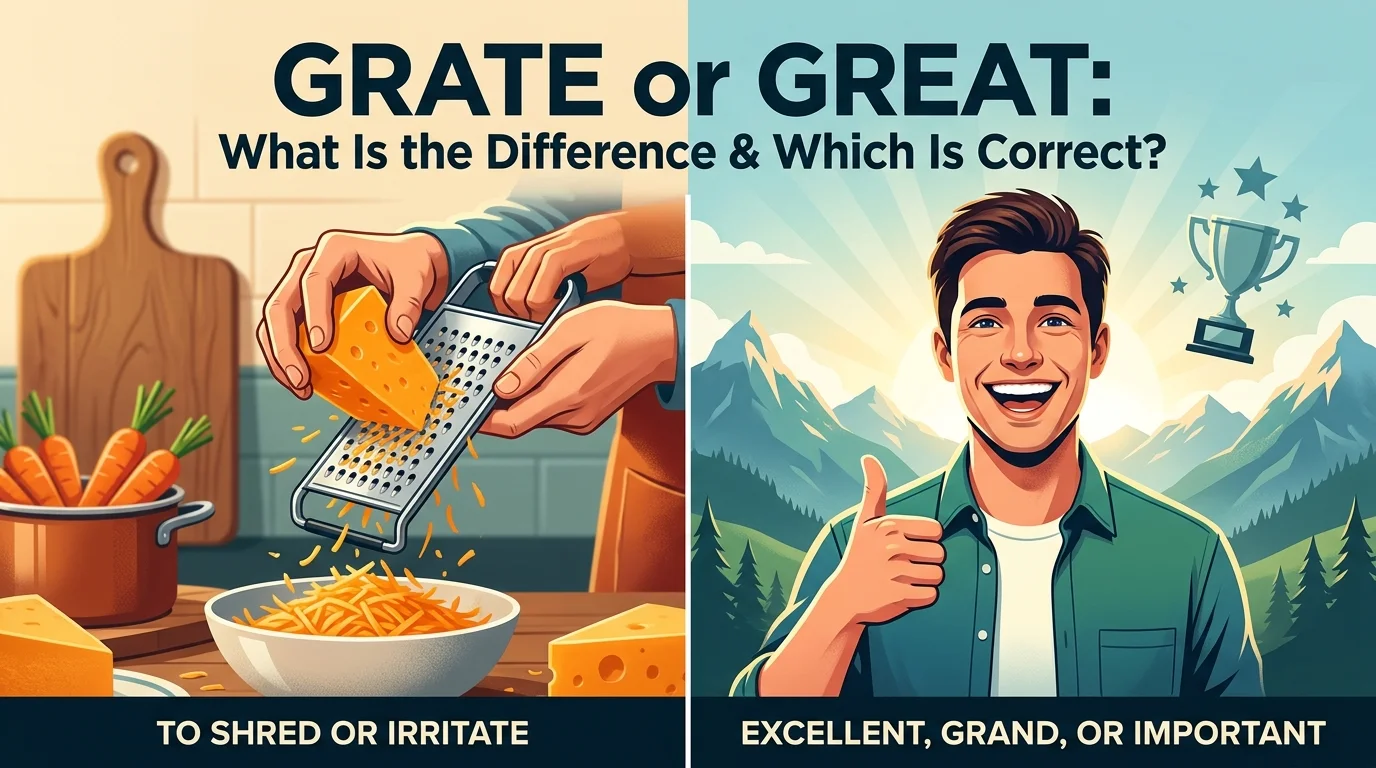
Many English learners and even native speakers sometimes confuse grate and great because they sound exactly alike. Although their pronunciation is the same, their meanings are completely different. Understanding when to use grate and when to use great can help you avoid common writing mistakes and communicate more clearly in both spoken and written English.
Comparison Overview
The words grate and great are homophones, which means they sound the same but have different meanings and spellings.
| Word | Part of Speech | Main Meaning |
| Grate | Verb / Noun | To shred food into small pieces or a metal framework |
| Great | Adjective | Excellent, large, important, or impressive |
While grate is often related to cooking or physical objects, great is commonly used to describe quality, size, achievement, or importance.
Definition of Grate
The word grate is primarily used as a verb meaning to reduce food into small pieces by rubbing it against a rough surface.
Examples:
- Grate the cheese before adding it to the pasta.
- She grated carrots for the salad.
As a noun, grate refers to a metal framework or covering.
Examples:
- The drain grate was blocked.
- Leaves collected under the grate.
Definition of Great
The word great is an adjective that describes something excellent, important, large, impressive, or highly skilled.
Examples:
- She is a great teacher.
- We had a great vacation.
- The company achieved great success.
It is one of the most commonly used positive adjectives in English.
Main Differences Between Grate and Great
| Feature | Grate | Great |
| Meaning | To shred food or a metal framework | Excellent, impressive, important |
| Part of Speech | Verb or Noun | Adjective |
| Common Context | Cooking, construction | Quality, praise, achievements |
| Example | Grate the cheese. | That was a great idea. |
| Positive Description | No | Yes |
The easiest way to distinguish them is that great expresses excellence or importance, while grate usually refers to shredding food or a metal structure.
Why Are Grate and Great Confused?
The main reason these words are confused is that they are pronounced exactly the same.
Examples:
- Great job! ✓
- Grate job! ✗
- Please grate the cheese. ✓
- Please great the cheese. ✗
Because English contains many homophones, understanding the context is essential.
Comparison Table
| Situation | Correct Word |
| Praising someone | Great |
| Talking about success | Great |
| Describing something excellent | Great |
| Shredding vegetables | Grate |
| Shredding cheese | Grate |
| Referring to a drain cover | Grate |
Grammar Guide
How Each Term Is Used in Sentences
Grate
Pattern:
- Grate + object
Examples:
- Grate the cheese.
- Grate the carrots.
- Grate some chocolate over the cake.
Great
Pattern:
- Great + noun
Examples:
- Great opportunity
- Great performance
- Great achievement
Common Mistakes Learners Make
- Writing “grate” when they mean “great.”
- Using “great” in cooking instructions.
- Assuming both words can replace each other.
- Ignoring context clues.
- Relying only on pronunciation.
Incorrect:
- That was a grate movie.
Correct:
- That was a great movie.
Simple Rules to Remember
- If you mean excellent or impressive, use great.
- If you mean shred food, use grate.
- Great describes things.
- Grate usually describes an action.
Memory trick:
Great = Excellent
Grate = Grater in the kitchen
Quick Tips for Writing and Speaking
- Think about whether you’re describing quality or performing an action.
- If praise is involved, choose great.
- If cooking is involved, choose grate.
- Check whether the word functions as an adjective or a verb.
- Proofread homophones carefully.
When to Use Each One
Use Grate When
- Preparing food.
- Following recipes.
- Referring to shredding ingredients.
- Talking about metal covers or frameworks.
Examples:
- Grate the cheese finely.
- Grate the zucchini into a bowl.
Use Great When
- Giving compliments.
- Describing success.
- Talking about quality.
- Referring to something large or important.
Examples:
- She did a great job.
- It was a great experience.
When NOT to Use Each One
Do Not Use Grate
- To describe excellence.
- To compliment someone.
- To describe achievements.
- To express approval.
Incorrect:
- You did a grate job.
Do Not Use Great
- In cooking instructions involving shredding.
- To refer to drain covers.
- To describe the act of shredding food.
Incorrect:
- Great the cheese before serving.
Which One to Use (Decision Guide)
Ask yourself these questions:
- Am I talking about something excellent, impressive, successful, or important?
- Use great.
- Am I talking about shredding food into smaller pieces?
- Use grate.
- Am I referring to a metal framework or drain cover?
- Use grate.
- Am I complimenting a person, thing, or achievement?
- Use great.
In most everyday conversations, great is used far more frequently than grate.
Real-World Practical Examples
Grate Examples
- Grate the cheese before making pizza.
- The recipe says to grate fresh ginger.
- She grated carrots for the soup.
- Workers repaired the street grate.
- Grate chocolate over the dessert for decoration.
Great Examples
- The student received great grades this semester.
- We had a great family dinner.
- The scientist made a great discovery.
- The company reported great profits.
- That was a great presentation during the meeting.
Self-Assessment (Fill in the Blanks)
- I will use ______ when referring to shredding cheese.
- The correct word is ______ because it means excellent.
- I will use ______ when complimenting someone’s work.
- The correct word is ______ because it refers to shredding vegetables.
- We had a ______ vacation.
- Please ______ the carrots for the salad.
- She gave a ______ speech.
- The chef asked me to ______ some cheese.
- It was a ______ achievement.
- The metal drain ______ needed cleaning.
- He did a ______ job on the project.
- ______ the chocolate before adding it to the cake.
- She is a ______ leader.
- The recipe requires you to ______ fresh cheese.
- The invention was a ______ success.
- Leaves were stuck under the ______.
- That sounds like a ______ idea.
- Please ______ the vegetables carefully.
- The athlete had a ______ performance.
- The kitchen tool helps you ______ cheese quickly.
Answers
- Grate
- Great
- Great
- Grate
- Great
- Grate
- Great
- Grate
- Great
- Grate
- Great
- Grate
- Great
- Grate
- Great
- Grate
- Great
- Grate
- Great
- Grate
Final Verdict
Although grate and great sound identical, they serve very different purposes in English. Grate is usually a verb connected with shredding food or a noun referring to a metal framework, while great is an adjective used to describe something excellent, impressive, important, or successful. The key to choosing the correct word is understanding the context. If you’re talking about quality, praise, achievement, or size, use great. If you’re talking about shredding ingredients or a metal cover, use grate. By remembering this simple distinction, you can avoid one of the most common homophone mistakes and write with greater accuracy and confidence.
Conclusion About Grate or Great
Understanding the difference between grate and great is essential for clear and accurate communication. Although these two words sound exactly alike, they have completely different meanings and uses. Grate is mainly used as a verb for shredding food or as a noun referring to a metal framework, while great is an adjective that describes something excellent, important, impressive, or highly successful. Because they are homophones, many writers accidentally choose the wrong spelling, especially when typing quickly. The easiest way to remember the distinction is to connect grate with kitchen tasks and great with praise or positive descriptions. Whether you are writing an email, completing school assignments, creating business content, or having everyday conversations, using the correct word will improve your grammar and make your message clearer. Once you understand the context behind each term, choosing between grate and great becomes simple and natural.
FAQs
What is the main difference between grate and great?
The word grate usually means to shred food into small pieces or refers to a metal framework. The word great means excellent, impressive, important, or very good. While they sound the same, their meanings and uses are completely different.
Are grate and great pronounced the same way?
Yes, grate and great are pronounced exactly the same. They are homophones in English, which means they share the same pronunciation but have different spellings and meanings. Context helps determine which word is correct.
Is grate a verb or a noun?
Grate can be both a verb and a noun. As a verb, it means to shred food such as cheese or vegetables. As a noun, it refers to a metal covering, framework, or barrier found in places like drains or fireplaces.
Is great always an adjective?
In most common situations, great functions as an adjective. It describes something positive, important, impressive, or large. Examples include phrases such as “great achievement,” “great teacher,” and “great opportunity.”
Can I use grate to describe something excellent?
No, grate should not be used to describe excellence or quality. When you want to praise something or say it is impressive, the correct word is great. Using grate in that context would be a spelling mistake.
Why do people confuse grate and great?
People often confuse these words because they sound identical when spoken. Since English contains many homophones, writers sometimes choose the wrong spelling. Understanding each word’s meaning and context helps prevent this common error.
What are some common examples of grate?
Common examples include “grate the cheese,” “grate fresh carrots,” and “clean the drain grate.” In each case, the word relates either to shredding food or to a metal structure or covering.
What are some common examples of great?
Examples include “great performance,” “great idea,” “great success,” and “great experience.” In all these cases, the word is used to express approval, excellence, importance, or a positive quality.
How can I remember the difference between grate and great?
A simple memory trick is to connect grate with a kitchen grater used for shredding food. Connect great with praise, success, and positive descriptions. This association makes it easier to choose the correct word.
Which word is more commonly used in everyday English?
Great is much more common in everyday conversations and writing because it is frequently used to describe people, experiences, ideas, and achievements. Grate appears less often and is mainly used in cooking or when discussing metal frameworks.