
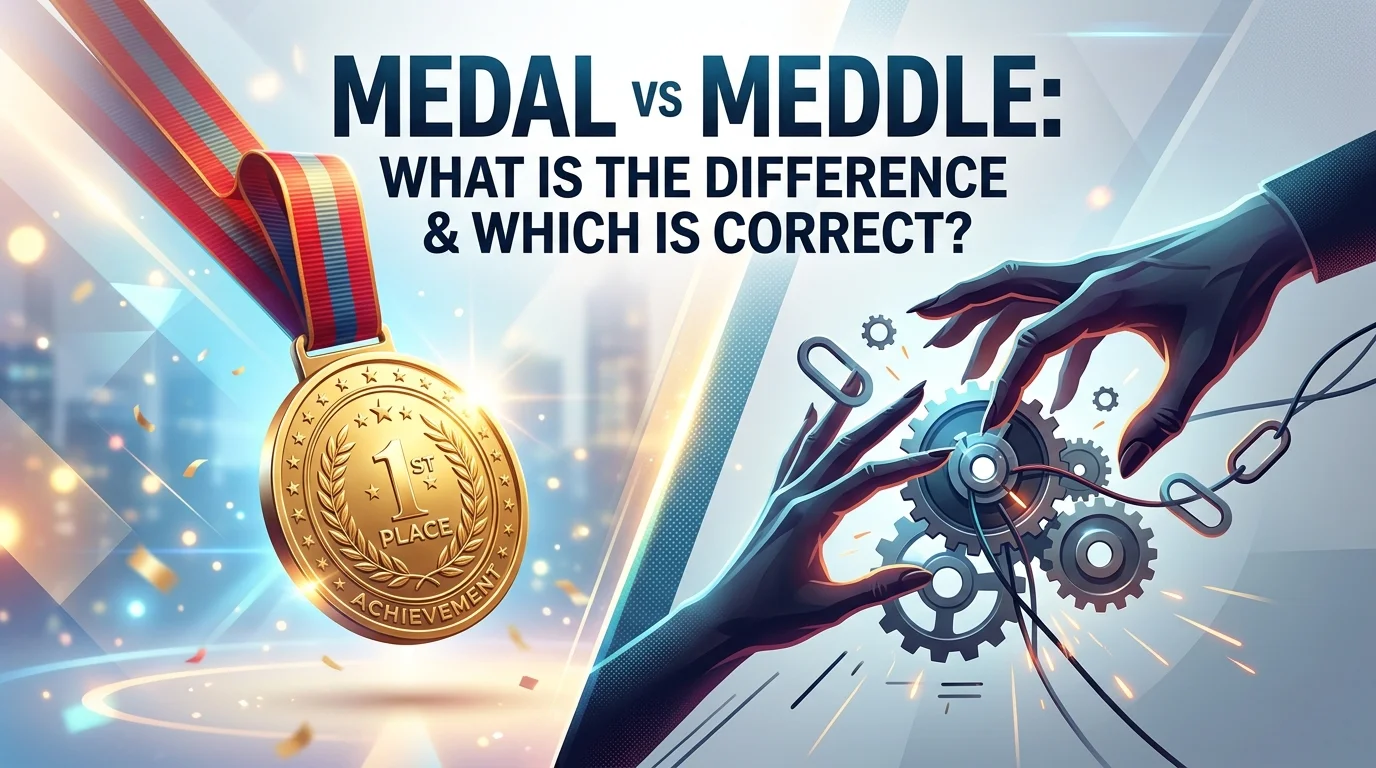
Many English learners confuse medal and meddle because the words look somewhat similar and are pronounced differently only by a small sound change. However, their meanings are completely different. One relates to awards and achievements, while the other refers to interfering in situations. Understanding the difference between medal vs meddle helps improve writing, speaking, and grammar accuracy in everyday communication.
Comparison Overview
Although medal and meddle may appear similar at first glance, they belong to different parts of speech and serve different purposes in English. A medal is an object given as a reward or honor, while meddle is a verb that means to interfere in something that does not concern you. Knowing when to use each word prevents misunderstandings and improves language skills.
| Feature | Medal | Meddle |
| Part of Speech | Noun | Verb |
| Meaning | An award or decoration | To interfere or intrude |
| Usage | Achievements, competitions, recognition | Involvement in others’ affairs |
| Example | She won a gold medal. | Do not meddle in their argument. |
| Context | Sports, military, academics | Relationships, business, personal matters |
Definition of Medal
A medal is a piece of metal, usually circular, awarded to someone as recognition for an achievement, victory, bravery, or service.
People commonly receive medals in sports competitions, military service, academic events, and other forms of recognition.
Examples
- She received a gold medal for swimming.
- The soldier earned a medal for bravery.
- The school awarded a medal to the top student.
- He proudly displayed his medal.
- Winning a medal was her dream.
Definition of Meddle
Meddle is a verb that means to interfere in someone else’s affairs or become involved in matters that do not concern you.
The word often carries a negative meaning because unwanted interference can create problems.
Examples
- Do not meddle in their personal issues.
- He likes to meddle in office politics.
- She warned him not to meddle.
- Parents should avoid meddling excessively in adult children’s decisions.
- The neighbor constantly meddles in community disputes.
Main Differences Between Medal and Meddle
The primary difference between these words is their meaning and grammatical function.
| Aspect | Medal | Meddle |
| Meaning | Award or honor | Interfere in affairs |
| Part of Speech | Noun | Verb |
| Positive or Negative | Usually positive | Usually negative |
| Physical Object | Yes | No |
| Action Word | No | Yes |
Key Difference
A medal is something you can receive, hold, or display.
A meddle is an action where someone interferes in matters that are not their responsibility.
Correct:
- She won a medal.
- Please do not meddle in my work.
Incorrect:
- She won a meddle.
- Please do not medal in my work.
Awards and Interference: Understanding the Context
One useful way to distinguish these words is by considering their contexts.
Medal appears in:
- Sports
- Education
- Military service
- Competitions
- Recognition ceremonies
Meddle appears in:
- Personal relationships
- Workplace conflicts
- Family disputes
- Social situations
- Political discussions
Pronunciation Differences
Even though the spellings are similar, pronunciation helps separate them.
| Word | Pronunciation |
| Medal | MED-ul |
| Meddle | MED-l |
In many accents they sound quite similar, which is one reason learners confuse them.
Grammar Guide
How Each Term Is Used in Sentences
Medal (Noun)
Pattern:
- Receive a medal
- Win a medal
- Earn a medal
Examples:
- She earned a silver medal.
- They won medals at the tournament.
Meddle (Verb)
Pattern:
- Meddle in something
- Meddle with something
Examples:
- Do not meddle in family affairs.
- He meddled with the equipment.
Common Mistakes Learners Make
Mistake 1
Incorrect:
- He won a meddle.
Correct:
- He won a medal.
Mistake 2
Incorrect:
- Please don’t medal in my business.
Correct:
- Please don’t meddle in my business.
Mistake 3
Confusing the noun and verb forms.
Remember:
- Medal = thing
- Meddle = action
Simple Rules to Remember
- A medal is an award.
- Meddle means interfere.
- Medal is a noun.
- Meddle is a verb.
- If someone wins something, it is usually a medal.
- If someone intrudes, they meddle.
Quick Tips for Writing and Speaking
- Think of sports when you see medal.
- Think of interference when you see meddle.
- Check whether you need a noun or a verb.
- Replace medal with “award” to test meaning.
- Replace meddle with “interfere” to test meaning.
When to Use Each One
Use Medal When
- Talking about awards.
- Discussing competitions.
- Referring to military honors.
- Mentioning academic achievements.
- Describing recognition for excellence.
Examples:
- She won a gold medal.
- The athlete received a medal.
Use Meddle When
- Talking about interference.
- Discussing unwanted involvement.
- Referring to intruding in private matters.
- Describing interference in business or politics.
- Warning someone to stay out of a situation.
Examples:
- Do not meddle in their relationship.
- He often meddles in company decisions.
When NOT to Use Each One
Do Not Use Medal
- When describing interference.
- When talking about involvement in disputes.
- As a verb meaning interfere.
Incorrect:
- She medaled in their argument.
Do Not Use Meddle
- When referring to prizes or awards.
- For achievements in competitions.
- As a replacement for award or trophy.
Incorrect:
- He won a meddle in the Olympics.
Which One to Use (Decision Guide)
Use this simple guide:
Ask yourself:
Are you talking about an award, honor, or prize?
→ Use medal.
Are you talking about interfering or becoming involved in someone else’s affairs?
→ Use meddle.
Quick formula:
- Award = Medal
- Interfere = Meddle
Real-World Practical Examples
Medal Examples
- The athlete won a gold medal at the Olympics.
- The student received a medal for academic excellence.
- The soldier earned a bravery medal.
- The science fair winner proudly displayed her medal.
- The runner trained hard to secure a medal.
Meddle Examples
- Do not meddle in other people’s relationships.
- The manager warned employees not to meddle in confidential matters.
- He tends to meddle in office politics.
- Parents sometimes meddle in their children’s career choices.
- The neighbor likes to meddle in community disputes.
Self-Assessment (Fill in the Blanks)
- I will use ______ when referring to an award earned in sports.
- The correct word is ______ because it means interfere in personal matters.
- I will use ______ when discussing Olympic achievements.
- The correct word is ______ because it describes unwanted involvement.
- She won a gold ______ at the competition.
- Please do not ______ in our conversation.
- The soldier received a ______ for bravery.
- He likes to ______ in family disputes.
- The student proudly displayed her ______.
- The correct word is ______ because it means intrude.
- The athlete hoped to win a ______.
- Do not ______ with the machine settings.
- The military honored him with a ______.
- The correct word is ______ because it is a noun.
- The correct word is ______ because it is a verb.
- She earned a silver ______.
- Stop trying to ______ in my decisions.
- The award ceremony featured a special ______ presentation.
- The correct word is ______ because it means an honor or prize.
- He promised not to ______ in matters that were not his concern.
Answers
- Medal
- Meddle
- Medal
- Meddle
- Medal
- Meddle
- Medal
- Meddle
- Medal
- Meddle
- Medal
- Meddle
- Medal
- Medal
- Meddle
- Medal
- Meddle
- Medal
- Medal
- Meddle
Final Verdict
The comparison between medal vs meddle becomes easy once you understand their meanings and grammatical roles. A medal is a noun that refers to an award, honor, or prize given for achievement, bravery, or excellence. Meddle is a verb that means to interfere in matters that do not concern you. While the words may look and sometimes sound similar, their usage is completely different. If you are talking about winning, earning, receiving, or displaying an award, choose medal. If you are talking about interfering, intruding, or becoming involved in someone else’s affairs, choose meddle. Remembering the simple rule “award equals medal, interfere equals meddle” will help you use both words correctly and confidently in writing and conversation.
Conclusion About Medal vs Meddle
Understanding the difference between medal vs meddle is important because these two words may look similar, but they have completely different meanings and uses. A medal is a noun that refers to an award, honor, or symbol of achievement, often given in sports, academics, or military service. In contrast, meddle is a verb that means to interfere in someone else’s affairs or become involved in situations where your participation is not wanted. Confusing these words can lead to misunderstandings in both writing and conversation. The easiest way to remember them is to associate medal with recognition and achievement, while meddle relates to interference and unwanted involvement. By learning their meanings, grammar roles, and real-world applications, you can confidently choose the correct word every time. Mastering commonly confused words like these helps improve communication skills and makes your English more accurate, natural, and professional.
FAQs
What is the difference between medal and meddle?
A medal is an award or honor given for achievement, bravery, or success. Meddle means to interfere in matters that do not concern you. The first is a noun, while the second is a verb. Although they look similar, they are used in completely different situations.
Is medal a noun or a verb?
Medal is primarily used as a noun. It refers to a physical award or decoration given for accomplishment or recognition. In everyday English, people commonly use it when discussing sports competitions, academic achievements, military honors, and special awards.
Is meddle a noun or a verb?
Meddle is a verb. It describes the action of interfering or becoming involved in someone else’s affairs without being invited or needed. The word often carries a negative meaning because such involvement is usually considered unwanted.
How can I remember the difference between medal and meddle?
A simple trick is to connect medal with achievement and awards. Think of athletes winning medals. Connect meddle with interference. If someone is getting involved in matters that are not their responsibility, they are meddling. This memory aid makes the distinction easy.
Can medal and meddle be used interchangeably?
No, they cannot be used interchangeably. A medal refers to an award, while meddle means to interfere. Replacing one with the other creates grammatical and meaning errors that can confuse readers and listeners.
What are some common examples of medal?
Common examples include winning a gold medal in sports, receiving a medal for bravery, earning a medal in a school competition, obtaining a service medal in the military, or being honored with a commemorative medal for achievement.
What are some common examples of meddle?
Examples include meddling in family disputes, interfering in workplace decisions, getting involved in personal relationships, intruding on private matters, or attempting to influence situations that do not directly concern you.
Why do people confuse medal and meddle?
People often confuse these words because their spellings and pronunciations are somewhat similar. However, they belong to different parts of speech and have unrelated meanings. Learning their definitions and usage patterns helps eliminate confusion.
Is meddle always used negatively?
In most situations, meddle has a negative meaning because it suggests unwanted interference. It often implies that someone is becoming involved in matters where their participation is unnecessary or unwelcome. This is why the term is usually viewed unfavorably.
Which word should I use when talking about awards?
When discussing prizes, achievements, honors, recognition, or competition victories, the correct word is medal. The word meddle should never be used in these contexts because it refers only to interference and involvement in others’ affairs.

Sarah Mitchell is an experienced writer and grammar teacher with over 10 years of expertise in English language education. She helps learners improve their grammar, writing, and communication skills through clear explanations and practical examples. Sarah creates learner-friendly content focused on real-life English, making language learning simple, effective, and confidence-building.