
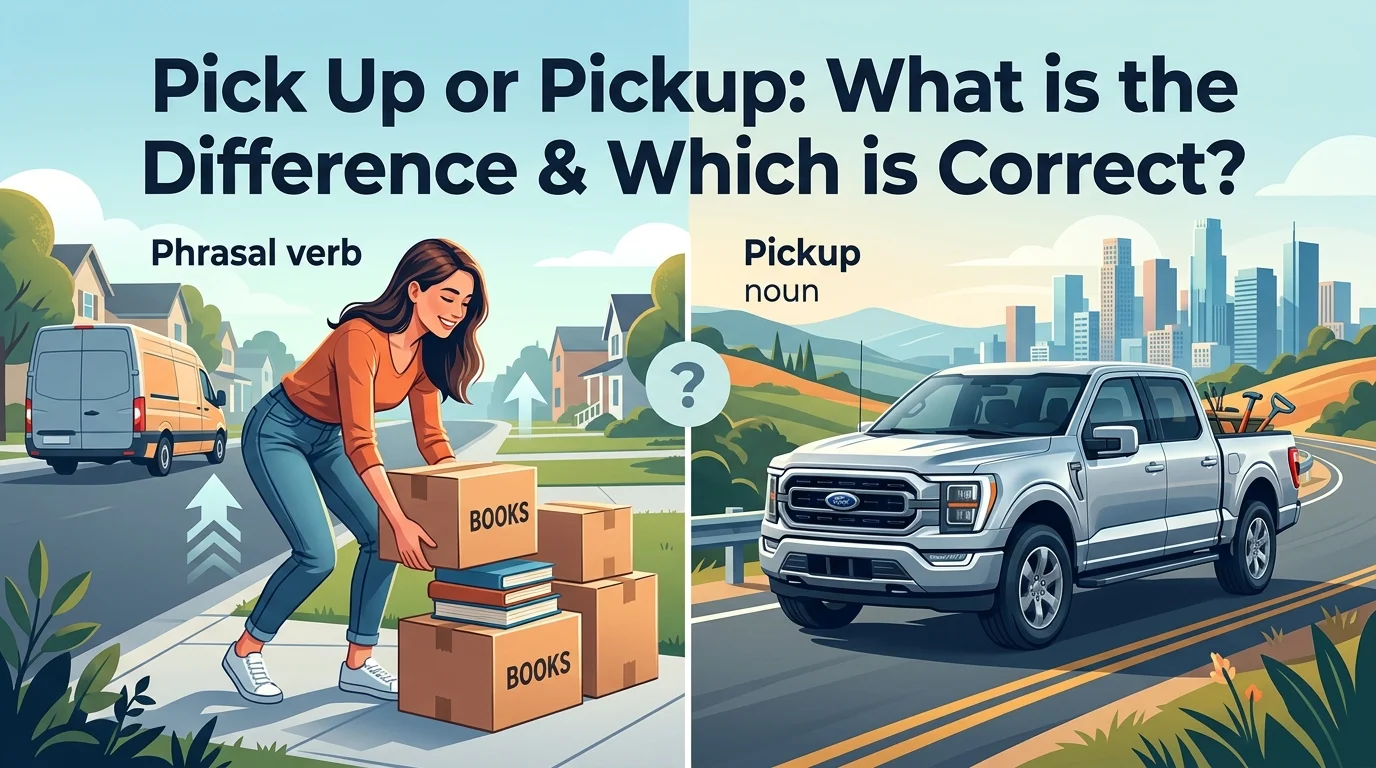
Many English learners get confused between “pick up” and “pickup” because they look similar but are used in different grammatical ways. One is a verb phrase, while the other often works as a noun or adjective. Understanding the difference helps you write correctly, sound natural, and avoid common mistakes in everyday English.
Comparison Overview
“Pick up” and “pickup” are closely related in meaning but serve different roles in English grammar. “Pick up” is mainly a verb phrase used to describe an action, while “pickup” is usually a noun or adjective referring to a thing, event, or type of object. Both appear frequently in daily communication.
Definition of Pick Up
“Pick up” is a verb phrase that describes the action of collecting, lifting, or receiving something. It is always written as two words when used as a verb. It can also refer to learning, improving, or answering something, depending on the context.
Definition of Pickup
“Pickup” is usually a noun or adjective. As a noun, it refers to the act of collecting something or someone, or a vehicle designed for carrying goods. As an adjective, it describes something related to collection or informal arrangements.
Main Differences Between Pick Up and Pickup
The main difference lies in grammar and function. “Pick up” is an action phrase (verb), while “pickup” is a thing or concept (noun or adjective). One shows action, the other describes an object or event.
“Pick up” is used when someone performs an action like collecting items or raising something. “Pickup” is used when referring to a scheduled collection, a type of vehicle, or an informal meeting arrangement.
In short, if you are describing doing something, use “pick up.” If you are naming something, use “pickup.”
Comparison Table
Pick Up (verb phrase): to perform an action
Pickup (noun/adjective): a thing, event, or description
Grammar Guide
Understanding grammar is key to using these terms correctly.
“Pick up” functions as a verb phrase and changes form based on tense, such as “picked up” or “picking up.” “Pickup” stays fixed when used as a noun or adjective and does not change form.
How each term is used in sentences
“Pick up” follows subject + verb structure:
- I will pick up the package.
- She picked up the phone quickly.
- They are picking up groceries.
“Pickup” is used as a noun or adjective:
- The pickup is scheduled for tomorrow.
- He drives a pickup truck.
- We arranged a pickup service.
Common mistakes learners make
Many learners incorrectly write “pickup” when they mean the verb action. Another mistake is separating “pick up” when it should be a noun, such as in formal writing where “pickup truck” is correct.
Simple rules to remember
If you can replace it with a verb like “collect” or “lift,” use “pick up.” If it refers to a thing, service, or type of object, use “pickup.”
Quick tips for writing and speaking
Think action versus thing. Action equals two words. Thing equals one word. This simple rule works in most cases.
When to Use Each One
Use “pick up” when talking about actions like collecting items, answering calls, or learning something. Use “pickup” when referring to scheduled collections, vehicles, or services.
When NOT to Use Each One
Do not use “pickup” when describing an action in progress. Avoid using “pick up” when naming a noun like a truck or arranged collection service.
Which One to Use (Decision Guide)
If you are describing something happening, choose “pick up.” If you are naming a concept, object, or service, choose “pickup.” Ask yourself whether the word is doing something or being something.
Real-World Practical Examples
Pick Up Examples
- I will pick up my friend after school.
- She picked up the book from the table.
- They are going to pick up supplies for the event.
- He picked up new skills quickly in class.
- We will pick up the conversation later.
Pickup Examples
- The pickup is scheduled for 5 PM.
- He owns a pickup truck for work.
- The store offers free pickup for online orders.
- We arranged a pickup service for the package.
- The airport pickup was delayed due to traffic.
Self-Assessment (Fill in the Blanks)
- I will ______ my groceries after work.
- The ______ truck is parked outside.
- She forgot to ______ her bag from school.
- The courier arranged a ______ for the parcel.
- We will ______ the discussion tomorrow.
- The ______ service is very fast.
- He can ______ the phone easily.
- The delivery ______ is at 3 PM.
- They will ______ their friend from the station.
- The company offers home ______ options.
- I need to ______ my order today.
- The ______ vehicle is used for transport.
- She will ______ the children after class.
- The store confirmed the ______ time.
- He forgot to ______ the documents.
- The online store provides curbside ______.
- We can ______ lunch on the way.
- The ______ area is near the entrance.
- I will ______ the package later.
- The airport ______ was smooth.
Answers
- pick up
- pickup
- pick up
- pickup
- pick up
- pickup
- pick up
- pickup
- pick up
- pickup
- pick up
- pickup
- pick up
- pickup
- pick up
- pickup
- pick up
- pickup
- pick up
- pickup
Final Verdict
The difference between “pick up” and “pickup” is simple once you understand grammar roles. “Pick up” is always used for actions, while “pickup” refers to nouns or descriptive uses like vehicles, services, or scheduled collections. Mastering this distinction helps you write clearer, more natural English and avoid one of the most common spelling and usage mistakes.
Conclusion About Pick Up or Pickup
Understanding the difference between Pick Up and Pickup makes English clearer and more accurate in everyday communication. While they look almost identical, their roles in grammar are very different. Pick up is used when describing an action such as collecting, lifting, or learning something. On the other hand, pickup is used as a noun or adjective to describe things like a vehicle, a scheduled collection, or a service. Once you recognize this simple pattern of action versus object, it becomes much easier to choose the correct form without hesitation. Whether you are writing emails, improving grammar, or speaking in daily conversations, using these terms correctly helps you sound more natural and confident. With a little practice and attention to context, you can avoid common mistakes and use both forms accurately in real life situations. This distinction is essential for clear writing and better understanding in English usage overall.
FAQs About Pick Up or Pickup
What is difference between pick up and pickup?
Pick up is a verb phrase describing an action, while pickup is usually a noun or adjective referring to a thing, service, or object. For example, you pick up a package, but the package is available for pickup. Understanding this difference helps avoid grammar mistakes and improves clarity in both writing and speaking in everyday communication effectively.
Is pickup one word or two words?
It depends on usage. When used as a noun or adjective, it is written as one word, pickup, such as pickup truck or pickup service. When used as a verb, it is written as two words, pick up, such as pick up the phone or pick up groceries. Grammar context determines correct spelling in most English cases and usage rules.
When should I use pick up in a sentence?
Use pick up when describing an action such as collecting, lifting, or receiving something. It is always used as a verb phrase and often changes tense like picked up or picking up. Examples include I will pick up my friend or she picked up the book. It focuses on doing something rather than naming something in context clearly and naturally.
Can pickup be used as a verb?
Pickup is not commonly used as a verb in modern English. Instead, it functions as a noun or adjective, while the verb form is pick up. For example, you schedule a pickup, but you do not pickup something as a verb. Using pickup as a verb is generally considered incorrect in standard grammar in formal writing usage and education contexts.
What does pickup truck mean?
Pickup truck is a type of vehicle designed with an open cargo area at the back for carrying goods and equipment. It is commonly used in transportation, construction, and farming due to its utility and strength. The word pickup here is a noun describing the vehicle type, not an action, making it a compound term in everyday usage clearly defined.
Is pick up informal or formal?
Pick up is neutral in tone and can be used in both formal and informal contexts depending on the sentence. In professional writing, it is commonly used to describe actions like pick up data or pick up items. In casual speech, it is also widely used. Its flexibility makes it suitable for most situations usually across communication settings without confusion.
Why do people confuse pick up and pickup?
People confuse pick up and pickup because they look and sound similar but function differently in grammar. The lack of spacing change often causes spelling errors. Additionally, both forms are used in related contexts like collecting or receiving something, which adds to confusion. Learning their roles as verb versus noun helps reduce mistakes significantly especially in language learning for beginners.
What is pickup in business context?
Pickup in business refers to the collection or retrieval of goods, orders, or services arranged between a customer and a company. It is commonly used in retail, logistics, and delivery services where customers collect items in person or schedule collection times. The term helps describe organized and scheduled handling of products or services efficiently in modern commerce systems globally used.
How do I remember pick up vs pickup easily?
Remember it by separating action and object. If the word shows an action like collect or lift, use pick up as two words. If it names something like a service, vehicle, or scheduled event, use pickup as one word. This simple rule helps reduce confusion and improves accuracy in writing and speaking English in everyday practice effectively long term learning.
Are pick up and pickup interchangeable?
Pick up and pickup are not interchangeable because they serve different grammatical roles. Pick up is a verb phrase used for actions, while pickup is a noun or adjective used for things or concepts. Using them incorrectly can change meaning or create grammar errors. Understanding context ensures correct usage in both writing and speech across communication effectively in English language.

Daniel Brooks is an English educator with a passion for explaining similes and word comparisons in plain language. He covers topics like versus meanings, correct usage, and figurative language to help writers avoid common mistakes and improve clarity in everyday writing.