
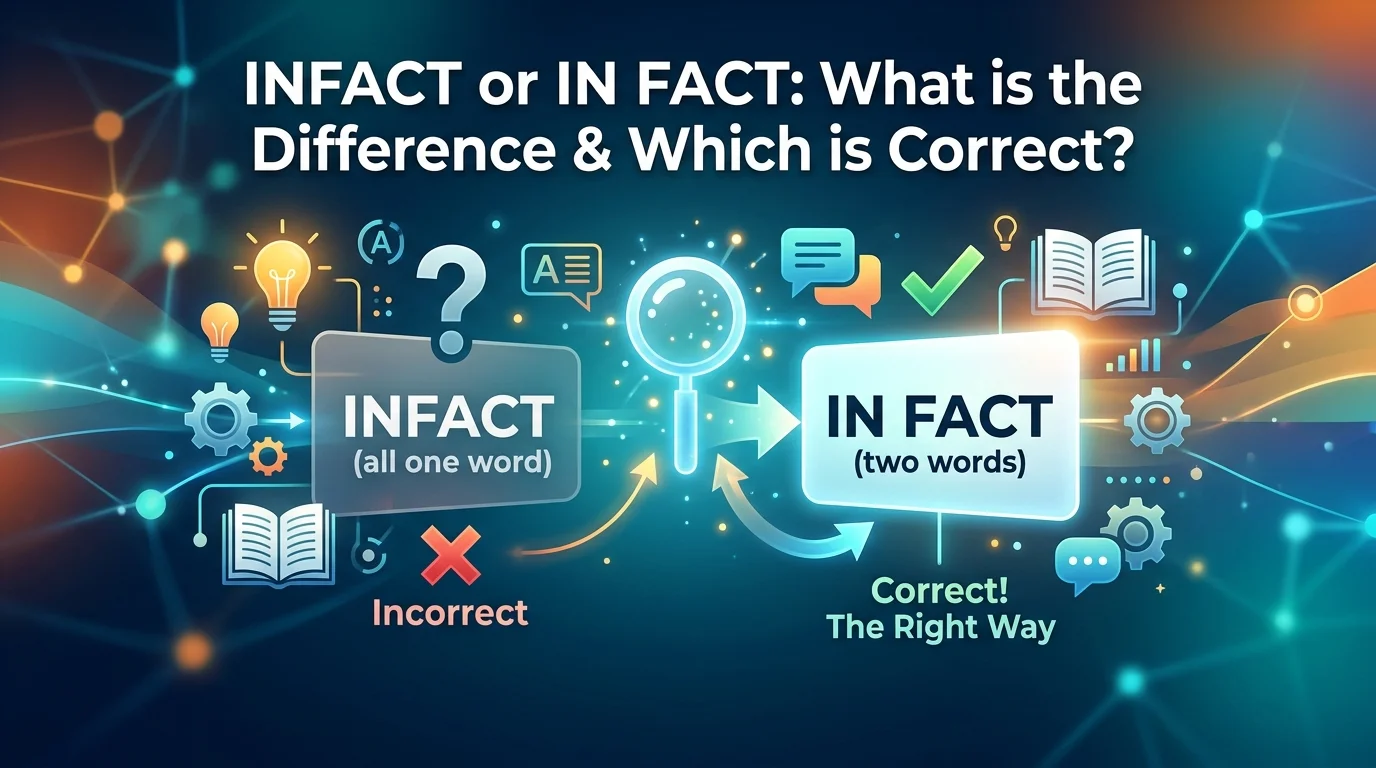
Many writers often get confused between “infact” and “in fact,” especially when writing quickly or informally. This comparison helps you clearly understand which form is correct, how each is used, and why one is widely accepted in English while the other is not commonly considered standard.
Comparison Overview
“Infact” and “in fact” look similar, but they are not used in the same way. One is widely recognized in formal English writing, while the other is generally considered incorrect or informal. Understanding the difference helps improve grammar accuracy, writing clarity, and professional communication.
Definition of Infact
“Infact” as a single word is not considered standard in modern English grammar. It is sometimes seen in informal writing, online posts, or typing errors where spacing is missed. Because English grammar rules treat it as incorrect, it should be avoided in formal communication, academic writing, and professional documents.
Definition of In Fact
“In fact” is a correct English phrase used to emphasize or clarify a statement. It is made of two words and functions as an adverbial phrase. Writers use it to introduce additional information, strengthen a point, or correct a misunderstanding in a sentence.
Main Differences Between Infact and In Fact
The key difference lies in correctness and usage. “Infact” is not accepted as a proper English term, while “in fact” is a standard grammatical phrase. “In fact” adds emphasis or clarification, whereas “infact” is usually just a spelling mistake or informal shortcut.
| Feature | Infact | In Fact |
| Correctness | Incorrect in standard English | Correct and widely accepted |
| Structure | Single word (non-standard) | Two-word phrase |
| Usage | Informal or error | Formal and informal writing |
| Function | No grammatical function | Emphasizes or clarifies a point |
Grammar Guide
“In fact” works as an adverbial phrase that adds emphasis or contrast in a sentence. It is commonly placed at the beginning or middle of a sentence.
How each term is used in sentences
Correct usage follows simple patterns:
- In fact, + statement
- Subject + verb + in fact + emphasis
Example:
- In fact, she arrived earlier than expected.
- He is, in fact, the best candidate for the job.
“Infact” has no grammatical structure because it is not recognized as a valid word.
Common mistakes learners make
Many learners combine words due to fast typing or spoken influence. A common mistake is writing “infact” instead of separating the phrase correctly. Another error is placing it where it does not add emphasis or clarity.
Simple rules to remember
If you can replace it with “actually” or “as a matter of fact,” then you should use “in fact.” Always keep it as two separate words.
Quick tips for writing and speaking
Use “in fact” when you want to strengthen a statement. Avoid merging the words, especially in academic or professional writing.
When to Use Each One
“In fact” is used when you want to add emphasis, correct information, or highlight truth. It is common in essays, reports, conversations, and formal writing. “Infact” should not be used in any standard writing because it is not grammatically accepted.
When NOT to Use Each One
Do not use “infact” in any academic, business, or professional context. Even in informal writing, it is better to separate the words correctly. Avoid using “in fact” too frequently, as overuse can make writing repetitive.
Which One to Use (Decision Guide)
If you are writing anything formal, academic, or professional, always choose “in fact.” If you are typing casually, still use “in fact” because it is the correct form. Never rely on “infact,” as it is considered incorrect in standard English.
Real-World Practical Examples
Infact Examples
Since “infact” is not standard, there are no correct usage examples. It is generally treated as a spelling error.
In Fact Examples
- In fact, I was already aware of the situation before the meeting.
- She is very experienced; in fact, she has worked in the field for over ten years.
- The project is nearly complete. In fact, we are ahead of schedule.
- He didn’t just participate; in fact, he led the entire team.
- In fact, this is the most efficient method we have tested so far.
Self-Assessment (Fill in the Blanks)
- I was late, but ______ I still finished the task on time.
- The correct phrase is ______ instead of a single word.
- ______, she was the one who solved the problem first.
- He is, ______, the most qualified candidate.
- Many people mistakenly write ______ instead of two words.
- ______, the results were better than expected.
- She didn’t fail; ______, she excelled.
- The phrase ______ is used for emphasis.
- We should avoid writing ______ in formal essays.
- ______, the weather improved later in the day.
- He is not new; ______, he has years of experience.
- The correct grammatical form is ______.
- ______, I have already completed the assignment.
- This method is useful; ______, it saves time.
- Many learners confuse ______ with the correct phrase.
- ______, the experiment proved successful.
- She is skilled; ______, she is highly respected.
- The proper usage is always ______.
- ______, I disagree with that statement.
- You should always write ______ in two words.
Answers
- in fact
- in fact
- in fact
- in fact
- infact
- in fact
- in fact
- in fact
- infact
- in fact
- in fact
- in fact
- in fact
- in fact
- infact
- in fact
- in fact
- in fact
- in fact
- in fact
Final Verdict
“In fact” is the only correct and grammatically accepted form in English, used to add emphasis, clarity, or correction in sentences. “Infact” is not standard and is generally treated as a spelling error. For clear, correct, and professional writing, always use “in fact” as two separate words.
Conclusion About Infact or In Fact
To sum up, the difference between “infact” and “in fact” is simple but important for clear and correct writing. “In fact” is the only standard and grammatically accepted form used in everyday communication, academic writing, and professional contexts. It helps add emphasis, clarity, and correction to statements, making sentences more natural and expressive. On the other hand, “infact” is not recognized in standard English and is generally considered a spelling mistake caused by fast typing or lack of spacing. By consistently using “in fact,” writers can improve readability, avoid errors, and communicate ideas more effectively. Whether you are writing essays, emails, or casual messages, choosing the correct form strengthens your language skills and leaves a better impression on readers.
FAQs
What is the correct spelling infact or in fact?
The correct spelling is “in fact,” written as two separate words. It is a standard English phrase used for emphasis or clarification. “Infact” is not accepted in formal grammar and is generally considered a typing mistake. Using the correct form ensures clarity and professionalism in both writing and communication.
Is infact a real English word?
“Infact” is not considered a real or standard English word. It often appears due to fast typing or lack of spacing between words. In proper grammar rules, it is incorrect and should be avoided. The correct and accepted phrase is “in fact,” which serves a clear grammatical purpose.
When should I use in fact in a sentence?
“In fact” is used when you want to emphasize, clarify, or strengthen a statement. It often introduces additional information or corrects a misunderstanding. For example, it can be placed at the beginning or middle of a sentence to make your message more precise and impactful.
Why do people write infact?
People often write “infact” due to fast typing, autocorrect errors, or lack of awareness about proper spacing. Since it sounds like a single word when spoken quickly, many users mistakenly combine it. However, in formal English writing, it should always be written as “in fact.”
Can in fact start a sentence?
Yes, “in fact” can absolutely start a sentence. It is commonly used at the beginning to add emphasis or introduce supporting information. For example, “In fact, the results were better than expected.” This usage is grammatically correct and widely accepted in both formal and informal writing.
Is in fact formal or informal?
“In fact” is suitable for both formal and informal writing. It is commonly used in academic papers, professional emails, and everyday conversations. Its flexibility makes it a useful phrase for adding emphasis or clarification in almost any context without sounding unnatural.
What is the meaning of in fact?
“In fact” means “actually” or “as a matter of fact.” It is used to emphasize truth, provide clarification, or introduce surprising information. This phrase helps make statements stronger and more precise by highlighting what is really true in a given situation.
What mistakes happen with infact?
The most common mistake is merging the two words into “infact.” This usually happens due to fast typing or misunderstanding of English spacing rules. Another error is using it in formal writing where only “in fact” is correct. These mistakes can reduce clarity and credibility.
How can I remember the correct form?
A simple way to remember is to think of “in fact” as similar to “in reality,” both needing two separate words. You can also replace it with “actually” to check usage. If the sentence still makes sense, then “in fact” is the correct choice.
Is in fact used in academic writing?
Yes, “in fact” is widely used in academic writing. It helps strengthen arguments, clarify points, and add supporting information. Researchers, students, and professionals use it to make their writing more precise and persuasive, making it a valuable phrase in formal contexts.

Ethan Clarke is a language writer who specializes in breaking down similes, word meanings, and commonly confused terms. His work focuses on clear explanations, practical examples, and simple comparisons that help readers understand how English