
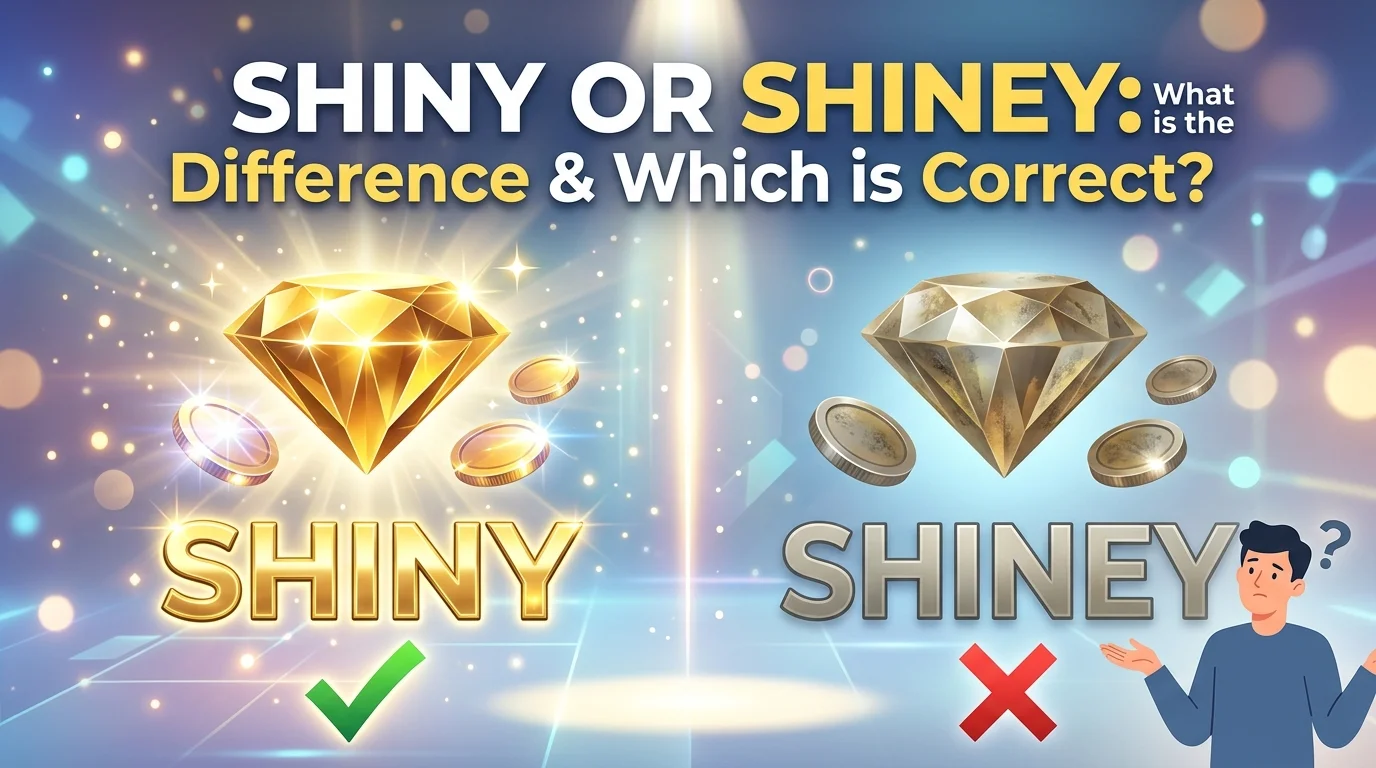
The confusion between “shiny” and “shiney” is common in English writing, especially for learners and casual writers. While they look similar, only one is grammatically correct. This comparison explains their meanings, usage, and correct spelling so you can confidently choose the right form in writing and avoid a frequent spelling mistake.
Comparison Overview
“Shiny” and “shiney” are often used when people want to describe something that reflects light or looks bright and polished. However, only one of these forms is accepted in standard English. The other is a frequent misspelling that appears in informal writing and online text. Understanding the difference helps improve spelling accuracy and writing clarity.
Definition of Shiny
“Shiny” is the correct English adjective used to describe something that has a bright, smooth, and reflective surface. It refers to objects that reflect light clearly, giving them a polished or glowing appearance. It can also be used figuratively to describe something new, impressive, or attractive.
Definition of Shiney
“Shiney” is an incorrect spelling of the word “shiny.” It is not recognized in standard English dictionaries. People often write it mistakenly because it sounds like it should contain an “e,” but grammatically it is considered an error and should be avoided in formal writing.
Main Differences Between Shiny and Shiney
The key difference is correctness. “Shiny” is the standard and accepted form, while “shiney” is a spelling mistake. “Shiny” is used in academic writing, professional communication, and everyday speech. “Shiney” appears mainly in informal writing or typographical errors. The meaning intended is the same, but only one form is grammatically valid.
Comparison Table
| Feature | Shiny | Shiney |
| Correctness | Correct | Incorrect |
| Dictionary status | Recognized | Not recognized |
| Usage | Formal and informal writing | Common spelling mistake |
| Meaning | Bright or reflective | No valid meaning |
Grammar Guide
“Shiny” is an adjective derived from the verb “shine.” It follows standard adjective formation rules in English, where the suffix “-y” is added to describe a quality or state. Since “shiney” does not follow correct derivation rules, it is not accepted in standard grammar.
How each term is used in sentences
Shiny is used to describe appearance or quality.
Examples:
- The floor looks shiny after cleaning.
- She wore a shiny silver dress.
- His shoes are shiny and polished.
- The car has a shiny red finish.
- The stars looked shiny in the night sky.
Common mistakes learners make
A frequent mistake is adding an “e” before the suffix “-y,” resulting in “shiney.” Another error is assuming spelling should match pronunciation. Learners also sometimes overgeneralize spelling patterns from words like “honey” or “money.”
Simple rules to remember
If the base word is “shine,” the adjective form drops the final “e” before adding “-y.” So it becomes “shiny,” not “shiney.” Always trust dictionary spelling when uncertain.
Quick tips for writing and speaking
Remember that “shiney” is never correct in formal writing. If you are unsure, replace it with “bright,” “glossy,” or “polished” as alternatives. Reading regularly helps reinforce correct spelling patterns.
When to Use Each One
Use “shiny” when describing something reflective, polished, or visually bright. It works in both formal and informal contexts. “Shiney” should never be used intentionally because it is a spelling error rather than a valid word.
When NOT to Use Each One
Do not use “shiney” in essays, emails, articles, or professional documents. Avoid it in exams or academic writing. Even in casual writing, it is better to correct it to “shiny” for accuracy and clarity.
Which One to Use (Decision Guide)
If you are describing something that reflects light or looks polished, always choose “shiny.” If you are tempted to write “shiney,” stop and correct it to “shiny.” When in doubt, rely on dictionary-approved spelling rather than phonetic spelling.
Real-World Practical Examples
Shiny Examples
- The kitchen counter is shiny after polishing.
- She bought a shiny new laptop.
- The metal surface looked shiny under the light.
- His hair looked shiny after using conditioner.
- The toy had a shiny finish that attracted children.
Shiney Examples
- This section has no valid examples because “shiney” is incorrect in standard English.
Self-Assessment (Fill in the Blanks)
- The floor looks ______ after cleaning.
- “Shiney” is considered a ______ spelling.
- The car has a ______ red surface.
- The correct form is ______, not shiney.
- Her shoes are very ______ and clean.
- “Shiney” is not found in the ______.
- The metal spoon looks ______ after polishing.
- Students should avoid writing ______ in exams.
- The stars appear ______ at night.
- The correct adjective is ______.
- The table is very ______ after waxing.
- Shiney is an ______ spelling mistake.
- The glass looks ______ under sunlight.
- The correct spelling is ______.
- His jacket looks ______ and new.
- Shiney is not accepted in ______ English.
- The ring appears ______ after cleaning.
- Writers should use ______ in formal writing.
- The surface is smooth and ______.
- Shiney should be replaced with ______.
Answers
- shiny
- incorrect
- shiny
- shiny
- shiny
- dictionary
- shiny
- shiney
- shiny
- shiny
- shiny
- incorrect
- shiny
- shiny
- shiny
- standard
- shiny
- shiny
- shiny
- shiny
Final Verdict
The correct spelling is “shiny,” and it is the only accepted form in English. “Shiney” is simply a common misspelling that should be avoided in all types of writing. By remembering the correct spelling and practicing usage, you can improve accuracy and write more confidently in both formal and informal contexts.
Conclusion About Shiny or Shiney
Shiny or Shiney is a simple but common spelling confusion in English that often misleads writers of all levels. The correct form is shiny, which describes something bright, polished, or reflective. Shiney, on the other hand, is simply a spelling error and not accepted in standard English. Understanding this difference helps improve writing accuracy, especially in academic, professional, and online communication. By remembering that shiny comes from the word shine and drops the final e before adding y, learners can avoid one of the most frequent mistakes. Using the correct form also makes your writing clearer and more credible. Whether you are describing objects, clothing, or surfaces, shiny is always the right choice. With consistent practice and awareness, this confusion becomes easy to eliminate, helping you write with greater confidence and precision in everyday communication. Mastering this distinction ensures more polished, accurate, and professional writing in all situations.
FAQs
Why is shiny the correct spelling instead of shiney?
Shiny is correct because it follows standard English spelling rules where the final “e” in shine is dropped before adding the suffix “y.” This creates a proper adjective form used in dictionaries and formal writing. Shiney is simply a phonetic mistake and does not exist in standard usage, making shiny the only accepted and grammatically correct option.
Is shiney ever acceptable in English?
Shiney is not acceptable in standard English writing. It is commonly seen as a typo or spelling mistake in informal text, but it is not recognized by dictionaries or grammar rules. Whether in academic work, professional documents, or exams, using shiney is considered incorrect, and it should always be replaced with the correct form shiny.
What does shiny mean in everyday usage?
Shiny means something that reflects light and appears bright, smooth, or polished. It can describe physical objects like metal, glass, or surfaces, as well as figurative meanings such as new, attractive, or impressive things. It is widely used in both spoken and written English to describe appearance and quality in a simple, visual way.
How can I remember the correct spelling shiny?
A simple way to remember is that the word comes from shine, but the final “e” is dropped before adding “y.” Think of it as shine becoming shiny. Repeating this rule and practicing examples helps reinforce correct spelling, making it easier to avoid the common mistake of adding an extra “e.”
Why do people often write shiney instead of shiny?
People often write shiney because they assume the spelling should match pronunciation. Since shine ends with a silent “e,” many learners mistakenly keep it when adding “y.” This creates shiney, which looks logical but is grammatically incorrect. The confusion is common among beginners and non-native speakers learning English spelling patterns.
Can shiny be used in both formal and informal writing?
Yes, shiny is suitable for both formal and informal contexts. It can be used in academic writing, business communication, and everyday conversation without any issues. It is a standard adjective recognized in English dictionaries, making it a safe and correct choice whenever you need to describe something bright or reflective.
What are some synonyms of shiny?
Common synonyms of shiny include glossy, bright, polished, gleaming, and lustrous. These words can be used depending on context and tone. For example, glossy is often used for surfaces, while gleaming suggests stronger brightness. Choosing synonyms helps improve variety in writing while still expressing the same idea of a reflective or attractive surface.
Is shiny only used for physical objects?
No, shiny is not limited to physical objects. While it commonly describes surfaces like metal, glass, or water, it can also be used figuratively. For example, it may describe something new, impressive, or attractive, such as a shiny idea or opportunity. This makes it a flexible adjective in both literal and figurative contexts.
What is the origin of the word shiny?
The word shiny originates from the verb shine combined with the adjective-forming suffix “y.” This formation removes the final “e” from shine before adding the suffix, following standard English word-building rules. It has been used for a long time in English to describe brightness, reflection, and smooth visual appearance.
How does using shiny correctly improve writing?
Using shiny correctly improves writing by ensuring clarity, accuracy, and professionalism. Correct spelling builds trust with readers and avoids distractions caused by errors. It also reflects strong language skills, especially in academic or professional contexts. Choosing shiny over incorrect forms like shiney makes communication smoother and more credible overall.

Sarah Mitchell is an experienced writer and grammar teacher with over 10 years of expertise in English language education. She helps learners improve their grammar, writing, and communication skills through clear explanations and practical examples. Sarah creates learner-friendly content focused on real-life English, making language learning simple, effective, and confidence-building.