
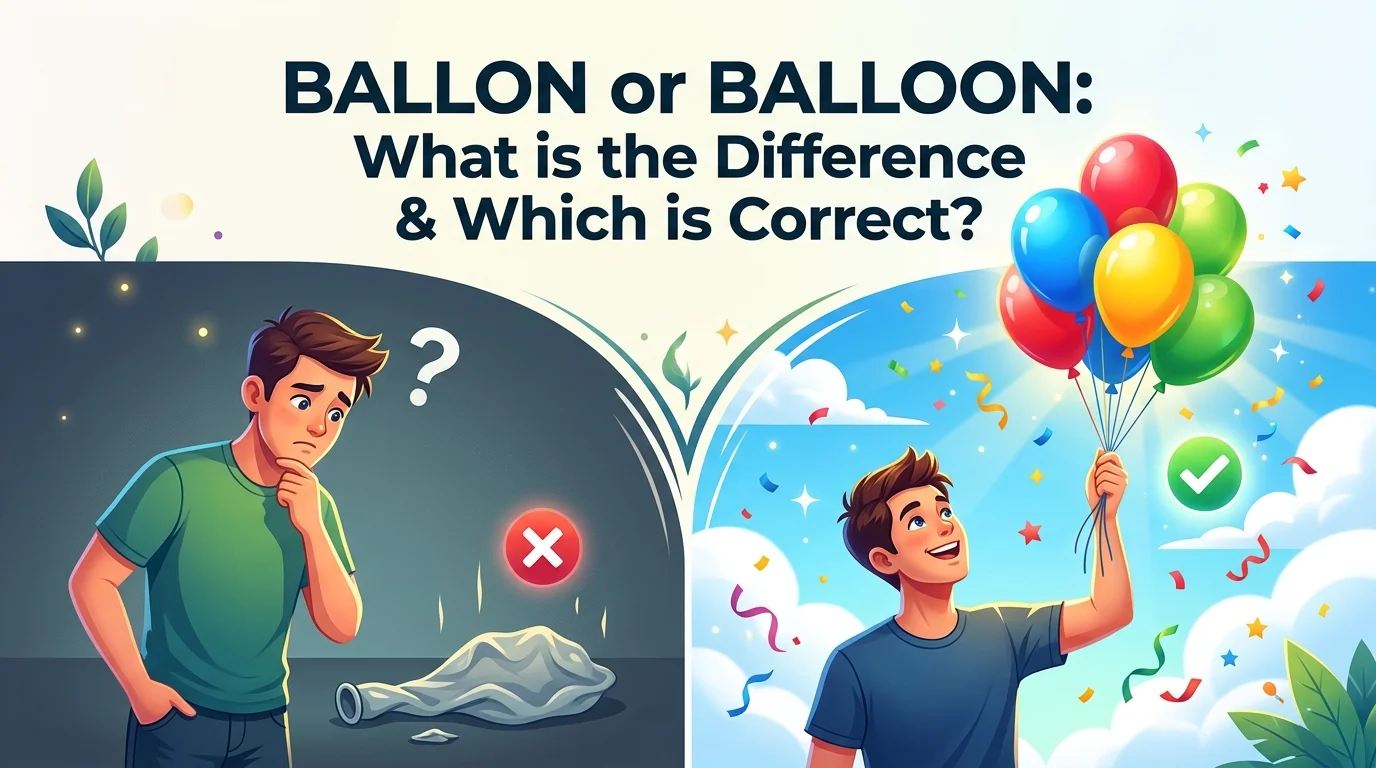
The terms “Ballon” and “Balloon” are often confused due to their similar spelling and pronunciation. However, only one is correct in standard English. This comparison explains the difference between both terms, their meanings, correct usage, and common mistakes so you can write and speak accurately with confidence.
Comparison Overview
“Ballon” and “Balloon” may look similar, but they are not interchangeable in English. “Balloon” is the correct spelling used in everyday language, science, and celebrations, while “Ballon” is usually a misspelling or appears in other languages like French. Understanding this difference helps avoid spelling errors and improves writing accuracy.
Definition of Ballon
“Ballon” is not a standard English word in most contexts. It is often considered a spelling error when someone intends to write “balloon.” However, in some languages like French, “ballon” refers to a ball or inflatable object. In English usage, it is generally incorrect.
Definition of Balloon
“Balloon” is a correct English noun that refers to a flexible bag filled with gas such as air or helium. It is commonly used for decoration, celebrations, scientific experiments, and even metaphorical expressions like “ballooning costs” or “hot air balloon.”
Main Differences Between Ballon and Balloon
The main difference lies in correctness and usage. “Balloon” is the standard English spelling, while “Ballon” is typically incorrect in English writing.
| Feature | Ballon | Balloon |
| Correctness | Incorrect in English | Correct English word |
| Usage | Rare, foreign language use | Common in daily English |
| Meaning | Ball (French usage) | Inflatable object or air-filled item |
| Context | Non-English or mistaken spelling | Education, science, celebrations |
| Acceptance | Not accepted in standard English | Fully accepted |
Grammar Guide
Understanding how “balloon” functions grammatically helps avoid confusion. It is primarily a noun but can also be used as a verb.
How each term is used in sentences
Balloon as a noun:
- The children played with a red balloon.
- The balloon floated into the sky.
Balloon as a verb:
- Prices ballooned after the shortage.
- The company’s expenses ballooned last year.
Ballon is not used in standard English sentences.
Common mistakes learners make
- Writing “ballon” instead of “balloon”
- Assuming both words are interchangeable
- Using incorrect spelling in formal writing
- Mixing up foreign language meaning with English usage
Simple rules to remember
- Double “o” is required in correct English spelling
- “Ballon” is not used in standard English writing
- Always use “balloon” for inflatable objects
Quick tips for writing and speaking
- Think of “double air = double o”
- Remember celebrations use balloons, not ballon
- Proofread spelling in formal writing
When to Use Each One
Use “balloon” when referring to decorations, party items, scientific gas-filled objects, or metaphorical growth. “Ballon” should only appear when discussing foreign language terms or non-English contexts, but it is generally avoided in English writing.
When NOT to Use Each One
Do not use “ballon” in English essays, emails, academic writing, or professional communication. It is also incorrect in descriptions of party decorations or hot air travel. Always replace it with “balloon.”
Which One to Use (Decision Guide)
If you are writing in English and referring to an inflatable object or expression of increase, always choose “balloon.” If you are unsure, default to “balloon” because it is the correct and accepted form. “Ballon” should be treated as incorrect in English contexts.
Real-World Practical Examples
Ballon Examples
- The word “ballon” is not commonly used in English sentences.
- He mistakenly wrote “ballon” in his assignment.
- In French, “ballon” means a ball.
- The teacher corrected the spelling from ballon to balloon.
- Tourists may confuse ballon with balloon in English writing.
Balloon Examples
- The child released a balloon into the sky.
- The hot air balloon flew over the mountains.
- We decorated the room with colorful balloons.
- Prices began to balloon after the crisis.
- The balloon burst loudly during the party.
Self-Assessment (Fill in the Blanks)
- I will use ______ when referring to party decorations.
- The correct word is ______ because it is the standard English spelling.
- In French, ______ can mean a ball.
- The teacher corrected my spelling from ______ to balloon.
- A hot air ______ floats using heated gas.
- Prices tend to ______ during inflation.
- The correct English term is ______, not ballon.
- Children love playing with a ______ at birthdays.
- The word ______ is often considered incorrect in English.
- A red ______ floated into the sky.
- I should avoid writing ______ in formal essays.
- The correct spelling has double ______.
- A science experiment used a gas-filled ______.
- The economy can ______ rapidly in crisis.
- ______ is not commonly accepted in English writing.
- We used a helium ______ for decoration.
- My mistake was writing ______ instead of balloon.
- The correct form for celebrations is ______.
- Inflation can cause costs to ______.
- Always choose ______ when writing in English.
Answers
- balloon
- balloon
- ballon
- ballon
- balloon
- balloon
- balloon
- balloon
- ballon
- balloon
- ballon
- o
- balloon
- balloon
- ballon
- balloon
- ballon
- balloon
- balloon
- balloon
Final Verdict
“Balloon” is the only correct English spelling for inflatable objects, celebrations, and related expressions. “Ballon” is generally incorrect in English and should be avoided in formal writing. By remembering the double “o” rule and practicing proper usage, you can easily choose the right word every time and avoid common spelling mistakes.
Conclusion About Ballon or Balloon
Understanding the difference between “Ballon” and “Balloon” helps eliminate one of the most common spelling confusions in English writing. While “Balloon” is the correct and widely accepted term used in education, celebrations, science, and everyday communication, “Ballon” is generally considered incorrect in English and often appears due to spelling mistakes or foreign language influence. Knowing this distinction improves writing accuracy, reading confidence, and overall language clarity. Whether you are describing party decorations, scientific experiments, or figurative expressions like rising costs, the correct choice is always “Balloon.” By remembering the double “o” rule and practicing proper usage in real sentences, learners can easily avoid errors and communicate more professionally in both casual and formal contexts.
FAQs About Ballon or Balloon
Is Ballon correct in English?
“Ballon” is not considered correct in standard English. It is often a misspelling of “balloon.” In some languages like French, it may have meaning, but in English writing, it should be avoided to maintain accuracy and clarity in communication.
What does Balloon mean?
A balloon is a flexible object usually filled with air or helium. It is commonly used for decoration, celebrations, scientific experiments, and entertainment. It can also be used figuratively to describe something that expands quickly, such as prices or expenses.
Why do people confuse Ballon and Balloon?
The confusion happens because both words look and sound similar. Many learners drop one “o” by mistake. Also, exposure to other languages where “ballon” exists adds to the misunderstanding, making spelling errors more frequent in English writing.
Can Balloon be used as a verb?
Yes, “balloon” can be used as a verb in English. It describes something that increases rapidly in size, amount, or importance. For example, costs can balloon unexpectedly, meaning they rise quickly beyond expectations in real situations.
Is Balloon only used for parties?
No, balloon is not limited to parties. It is also used in science, aviation, and figurative language. Hot air balloons travel through the sky, and in business, the term describes rapid growth or expansion in numbers or values.
What is a hot air balloon?
A hot air balloon is a large balloon filled with heated air that allows it to float in the sky. It is used for recreational flights and sightseeing, offering a unique aerial view of landscapes and natural surroundings.
How do you remember Balloon spelling?
A simple trick is to remember the double “o” in balloon, which looks like two inflated circles. This visual reminder helps learners avoid missing one “o” and ensures correct spelling in both writing and speaking.
Is Balloon a noun or verb?
Balloon is mainly a noun when referring to an object filled with gas. It can also be a verb when describing rapid increase or expansion, such as when prices or numbers grow quickly in a short period of time.
What are common mistakes with Balloon?
Common mistakes include spelling it as “ballon,” forgetting the double “o,” or using it incorrectly in formal writing. Learners also sometimes confuse its noun and verb forms, leading to grammatical errors in sentences.
Why is correct spelling important for Balloon?
Correct spelling ensures clear communication and prevents misunderstandings. Using “balloon” properly improves writing credibility, especially in academic, professional, and digital content where accuracy plays an important role in effective expression.

Sarah Mitchell is an experienced writer and grammar teacher with over 10 years of expertise in English language education. She helps learners improve their grammar, writing, and communication skills through clear explanations and practical examples. Sarah creates learner-friendly content focused on real-life English, making language learning simple, effective, and confidence-building.