
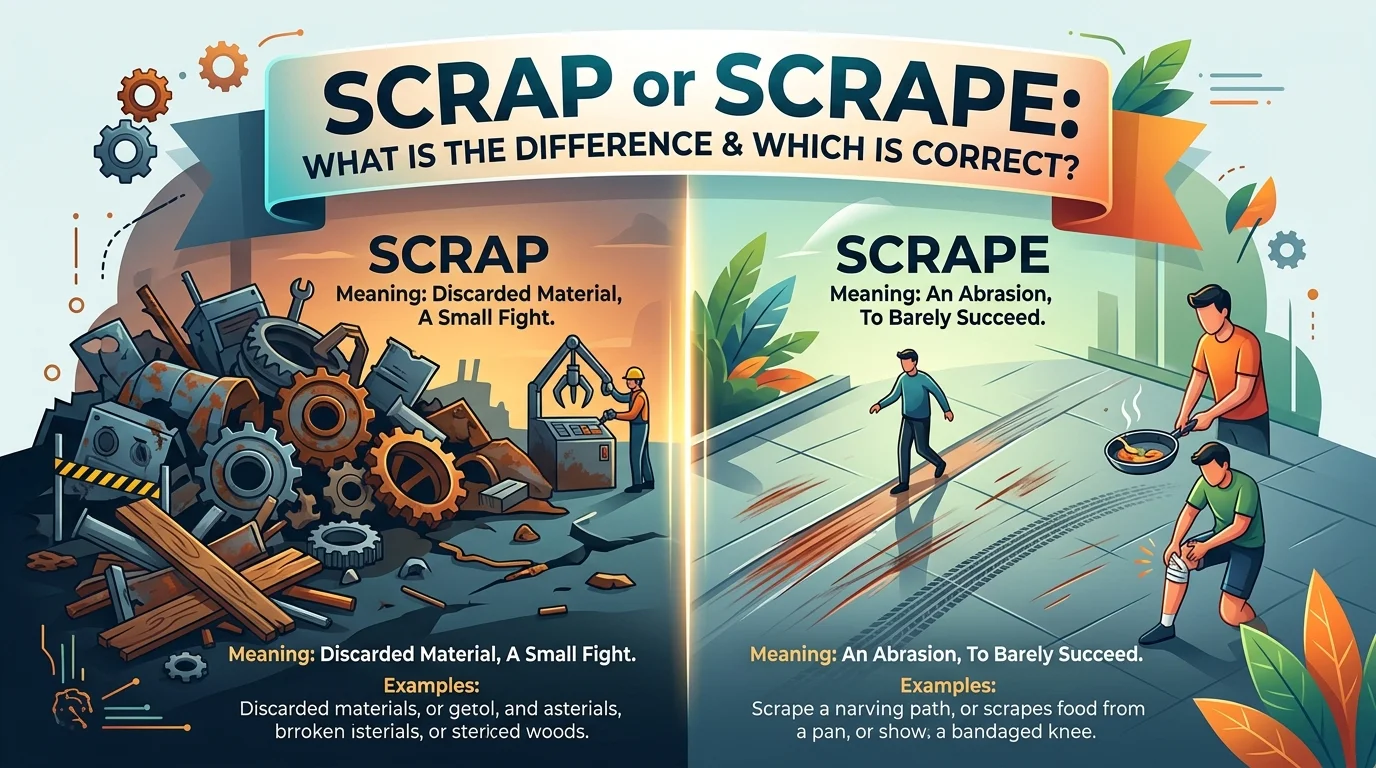
Scrap and scrape are two English words that look similar but have very different meanings and uses. Many learners confuse them because of their spelling and pronunciation. This guide explains the clear difference between scrap and scrape, how each word is used, and when to choose the correct one in real-life communication.
Comparison Overview
Scrap and scrape are both verbs and nouns, but they belong to completely different contexts. Scrap is often related to discarding, removing, or leftover material, while scrape is related to rubbing, scratching, or lightly removing something from a surface. Understanding their usage helps avoid common grammar and vocabulary mistakes in writing and speaking.
Definition of Scrap
Scrap means something that is no longer useful or has been thrown away. As a verb, it means to discard, abandon, or get rid of something. As a noun, it refers to small pieces of leftover material or waste.
In simple terms, scrap is about removing or rejecting something that is not needed anymore.
Definition of Scrape
Scrape means to drag or rub something against a surface in order to remove dirt, paint, or a layer of material. It can also mean to accidentally scratch a surface.
In simple terms, scrape is about physical contact that removes something from a surface through friction.
Main Differences Between Scrap and Scrape
Scrap and scrape differ in meaning, usage, and context. Scrap is usually related to rejection, waste, or cancellation, while scrape is related to physical action involving surfaces.
| Feature | Scrap | Scrape |
| Meaning | Discard or waste material | Rub or scratch a surface |
| Usage | Plans, materials, ideas | Cleaning, movement, accidents |
| Word type | Verb and noun | Verb and noun |
| Context | Abstract or material removal | Physical action |
Scrap is more about decision making or waste, while scrape is about physical interaction.
Grammar Guide
Scrap and scrape can both function as verbs and nouns, but their sentence patterns are different based on meaning.
How each term is used in sentences
Scrap is used when something is canceled or discarded.
Scrape is used when something is physically rubbed or removed.
Examples:
- They decided to scrap the project.
- He scraped the paint off the wall.
Common mistakes learners make
Many learners confuse scrap with scrape in writing, especially when describing cleaning actions or cancellation decisions. Another common mistake is using scrap when describing physical actions like scratching.
Simple rules to remember
Use scrap when something is thrown away, canceled, or rejected.
Use scrape when something is physically rubbed, scratched, or cleaned.
Quick tips for writing and speaking
If you can replace the word with “cancel” or “discard,” use scrap.
If you can replace it with “rub” or “scratch,” use scrape.
When to Use Each One
Use scrap when talking about plans, ideas, machines, or materials that are no longer needed. Use scrape when talking about cleaning surfaces, removing layers, or accidental scratching.
When NOT to Use Each One
Do not use scrap when describing physical cleaning or surface actions. Do not use scrape when describing cancellation, rejection, or disposal of ideas or projects.
Which One to Use (Decision Guide)
If the action involves removing something from existence or canceling it, choose scrap. If the action involves physically rubbing or scratching something, choose scrape. The key difference is abstract removal versus physical contact.
Real-World Practical Examples
Scrap Examples
- The company decided to scrap the old system.
- I had to scrap my travel plans due to bad weather.
- They will scrap the outdated machine next week.
- She scrapped her original essay and wrote a new one.
- The team scrapped the idea after the meeting.
Scrape Examples
- He scraped the dirt off his shoes before entering.
- She scraped the burnt food from the pan.
- The car scraped the wall while parking.
- I scraped my knee while playing football.
- They scraped the ice off the windshield.
Self-Assessment (Fill in the Blanks)
- I will ______ my old phone because it is broken.
- She had to ______ the paint off the door.
- The team decided to ______ the project.
- He ______ his knee while running.
- We should ______ this idea and start again.
- Please ______ the dirt off your shoes.
- They plan to ______ the outdated policy.
- I accidentally ______ the table with a knife.
- The company will ______ the machine next month.
- He ______ the ice from the car window.
- We might ______ the entire plan.
- She ______ her hand while cleaning.
- The workers ______ the damaged equipment.
- I need to ______ this sticker off the wall.
- They decided to ______ the proposal.
- He ______ his arm on a rough surface.
- The government may ______ the old rule.
- She ______ the mud off her boots.
- The factory will ______ old parts.
- I ______ my leg while climbing.
Answers
- scrap
- scrape
- scrap
- scraped
- scrap
- scrape
- scrap
- scraped
- scrap
- scraped
- scrap
- scraped
- scrapped
- scrape
- scrap
- scraped
- scrap
- scraped
- scrap
- scraped
Final Verdict
Scrap and scrape may look similar, but they serve very different purposes in English. Scrap is used for discarding or canceling something, while scrape is used for physically removing or scratching a surface. Once you understand this core difference, choosing the correct word becomes simple and natural in both writing and speaking.
Conclusion About Scrap or Scrape
Scrap and scrape are two words that often confuse English learners because they look and sound similar, but their meanings are very different. Scrap is used when something is discarded, canceled, or no longer needed, while scrape refers to physically rubbing or scratching a surface to remove something. Understanding this difference helps improve clarity in both writing and speaking. Once you remember the context, choosing the right word becomes quick and natural in everyday communication.
FAQs About Scrap or Scrape
What is the main difference between scrap and scrape?
Scrap means to discard, cancel, or reject something that is no longer useful, while scrape refers to physically rubbing a surface to remove dirt, paint, or material. The key difference is that scrap is about removal in decision or planning, while scrape involves physical contact and action on surfaces.
Can scrap and scrape be used interchangeably?
No, scrap and scrape cannot be used interchangeably because they have completely different meanings. Scrap relates to abandoning ideas, plans, or materials, while scrape relates to physically scratching or cleaning something. Using them incorrectly can change the meaning of a sentence and create confusion for the reader or listener.
Is scrap used as a noun or verb?
Scrap can be used as both a noun and a verb. As a noun, it refers to small leftover pieces or waste material. As a verb, it means to discard or abandon something. Its meaning depends on the context in which it is used in a sentence.
What does scrape mean in daily life?
In daily life, scrape usually means rubbing something off a surface, such as scraping food off a plate or ice off a windshield. It can also refer to accidentally scratching a surface. The word always involves physical contact and some form of friction or removal.
Why do people confuse scrap and scrape?
People confuse scrap and scrape because the words sound similar and differ only by one letter. However, their meanings are unrelated. Scrap is about rejection or waste, while scrape is about physical action. This similarity in spelling often leads to mistakes among English learners.
Can scrap be used for projects or ideas?
Yes, scrap is commonly used when referring to projects, ideas, or plans that are canceled or abandoned. For example, a company might scrap a project if it is not profitable. It is widely used in business, education, and decision-making contexts to indicate rejection.
Is scrape always a physical action?
Yes, scrape usually involves a physical action where something is rubbed or scratched off a surface. It can describe cleaning, removing layers, or accidental damage. The action always includes contact between objects and is not used for abstract or decision based situations.
How can I remember scrap vs scrape easily?
A simple way to remember is that scrap is linked to cancel or discard, while scrape is linked to scratch or rub. If the action is mental or related to decisions, choose scrap. If it involves physical movement on a surface, choose scrape.
What are common examples of scrap usage?
Common examples of scrap include scrapping old machines, scrapping plans, or scrapping ideas. It is often used in workplaces, schools, and daily decisions where something is no longer needed or useful and is therefore abandoned or removed from consideration.
What are common examples of scrape usage?
Common examples of scrape include scraping dirt off shoes, scraping ice from a car, or scraping a knee while falling. It is used in everyday physical actions where something is removed from a surface through rubbing or accidental contact.

Daniel Brooks is an English educator with a passion for explaining similes and word comparisons in plain language. He covers topics like versus meanings, correct usage, and figurative language to help writers avoid common mistakes and improve clarity in everyday writing.