
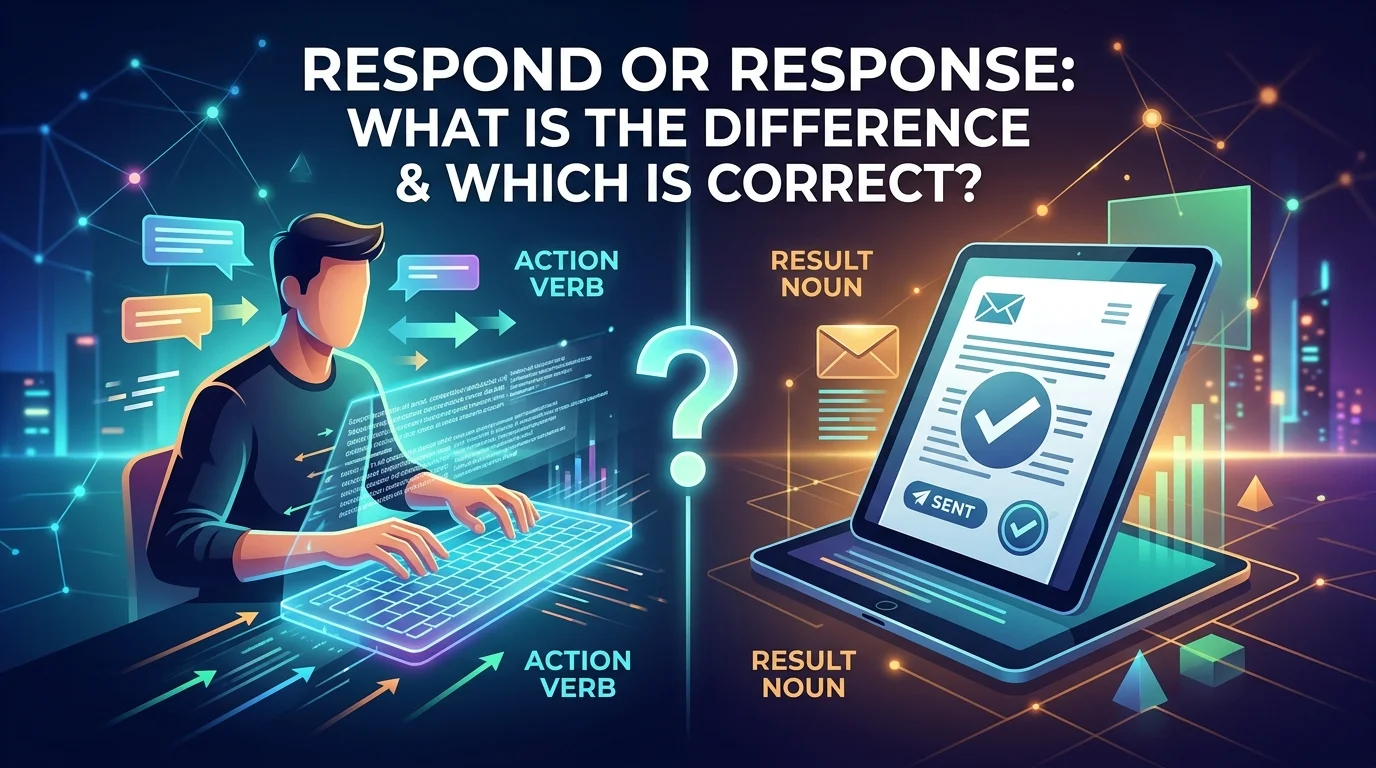
Understanding the difference between “respond” and “response” is essential for clear communication in English. These two words are closely related but serve different grammatical roles. Many learners confuse them in writing and speaking, which can lead to errors. This guide explains their meanings, usage, and key differences in a simple and practical way.
Comparison Overview
“Respond” and “response” are connected in meaning but different in function. “Respond” is mainly used as a verb, describing an action, while “response” is a noun that refers to the result of that action. Both are commonly used in daily communication, writing, education, and professional contexts. Understanding how they work together helps improve clarity and accuracy in English.
Definition of Respond
“Respond” is a verb that means to reply, answer, or react to something. It is used when someone takes action after hearing, seeing, or experiencing something. It often appears in conversations, messages, emails, and formal communication.
Definition of Response
“Response” is a noun that refers to the answer, reply, or reaction given after something happens. It is the result or outcome of responding. It is commonly used in both formal and informal contexts, especially in writing and reports.
Main Differences Between Respond and Response
The main difference lies in grammar and function. “Respond” is an action word, while “response” is the result of that action. “Respond” is used when describing what someone does, whereas “response” is used when referring to what is given back.
Key differences include:
- “Respond” is a verb, “response” is a noun
- “Respond” shows action, “response” shows result
- “Respond” is used with subjects, “response” is often used with verbs like give or receive
Comparison Table
| Feature | Respond | Response |
| Part of speech | Verb | Noun |
| Meaning | To reply or react | The reply or reaction |
| Usage | Action-based | Result-based |
| Example | I respond quickly | I received a response |
Grammar Guide
How each term is used in sentences
“Respond” is used when someone performs the action of replying. Example patterns include “respond to something” or “respond quickly.”
“Response” is used when referring to the reply itself, often with verbs like “give,” “get,” or “receive.”
Examples:
- She responds to emails immediately.
- He gave a thoughtful response.
Common mistakes learners make
Many learners use “response” when they should use “respond,” especially in speaking. Another common mistake is using “respond” without an object or preposition.
Incorrect: I response to him quickly.
Correct: I respond to him quickly.
Simple rules to remember
- Use “respond” when talking about action
- Use “response” when talking about the result
- If you can replace it with “reply,” check the grammar role
Quick tips for writing and speaking
- Think: action = respond
- Think: result = response
- In emails, “respond” is for what you do, “response” is what you receive
When to Use Each One
Use “respond” when describing actions like replying to messages, reacting to events, or answering questions. Use “response” when referring to feedback, answers, or reactions that have already been given or received.
When NOT to Use Each One
Do not use “response” when an action is required in the sentence. Avoid using “respond” when you are referring to a noun or outcome. Mixing them can change the meaning and make sentences grammatically incorrect.
Which One to Use (Decision Guide)
If you are describing what someone does, choose “respond.” If you are talking about what someone receives or gives as an answer, choose “response.” A simple test is to see if the word fits as a verb or noun in the sentence.
Real-World Practical Examples
Respond Examples
- I respond to messages within minutes.
- She responds calmly under pressure.
- They respond to customer complaints quickly.
- He responded to the invitation immediately.
- We respond to emergencies with care and speed.
Response Examples
- I received no response from the manager.
- Her response was very helpful.
- The response to the survey was positive.
- He gave a short response to the question.
- There was no response after the announcement.
Self-Assessment (Fill in the Blanks)
- I will ______ to your email soon.
- Her ______ was very polite.
- They always ______ quickly in emergencies.
- The teacher’s ______ was clear and helpful.
- He did not ______ to the question.
- I received a fast ______ from support.
- She ______ to the message immediately.
- The audience’s ______ was unexpected.
- We must ______ to changes quickly.
- His ______ surprised everyone.
- Please ______ as soon as possible.
- The ______ from the company was delayed.
- I always ______ politely in conversations.
- There was no ______ from the client.
- She will ______ after checking the details.
- The official ______ was published today.
- They ______ to criticism professionally.
- His ______ helped solve the issue.
- I forgot to ______ yesterday.
- The final ______ was positive.
Answers
- respond
- response
- respond
- response
- respond
- response
- respond
- response
- respond
- response
- respond
- response
- respond
- response
- respond
- response
- respond
- response
- respond
- response
Final Verdict
“Respond” and “response” are closely related but serve different grammatical roles. “Respond” is the action word used when someone replies or reacts, while “response” is the noun that represents the reply itself. Understanding this difference helps you use both words correctly in writing and speaking, making your English clearer, more accurate, and more natural.
Conclusion About Respond or Response
Understanding the difference between “respond” and “response” makes English communication much clearer and more accurate. Although these two words are closely related, they serve different roles in grammar and meaning. “Respond” is used when describing an action, while “response” refers to the result of that action. Knowing when to use each helps you write better emails, improve conversations, and avoid common mistakes in both formal and informal settings. With practice, choosing between them becomes natural and effortless in everyday communication.
FAQs About Respond or Response
What is the main difference between respond and response?
“Respond” is a verb that shows the action of replying or reacting. “Response” is a noun that refers to the reply itself. One describes doing something, while the other describes the result of that action. Understanding this helps avoid grammar mistakes in both speaking and writing.
Can respond and response be used in the same sentence?
Yes, both words can appear in the same sentence because they serve different roles. For example, you respond to a message and receive a response. This combination is common in communication, especially in emails, customer service, and formal writing where clarity is important.
Is respond always a verb?
Yes, “respond” is always used as a verb. It describes the action of replying, reacting, or answering something. It is commonly followed by “to” when connecting it to an object, such as respond to a question or respond to an email.
Is response always a noun?
Yes, “response” is always a noun. It represents the answer, reaction, or feedback given after something happens. It is often used with verbs like give, receive, or get, such as give a response or receive a response.
How do I use respond in a sentence correctly?
Use “respond” when describing an action. For example, you can say “She responds quickly to messages” or “He responded to the invitation.” It always shows what someone does in reaction to something.
How do I use response in a sentence correctly?
Use “response” when referring to the reply itself. For example, “The response was positive” or “I received a response from the manager.” It focuses on the result rather than the action.
Why do learners confuse respond and response?
Learners often confuse them because they share the same root meaning and are used in similar contexts. However, their grammatical roles differ. One is an action word, and the other is a naming word, which can make them tricky at first.
Can respond be used without “to”?
In most cases, “respond” is followed by “to,” especially when an object is mentioned. However, it can also stand alone when the context is clear, such as “He responded quickly” without specifying what he replied to.
What is a simple trick to remember the difference?
Think of “respond” as doing something and “response” as something you get or give. Action equals respond, result equals response. This simple rule helps you choose the correct word in most situations.
Are respond and response used in formal writing?
Yes, both are widely used in formal writing such as reports, emails, academic papers, and business communication. “Respond” describes actions taken, while “response” refers to feedback, results, or replies in a structured and professional way.

Sophia Turner is a grammar-focused writer who covers similes, word-versus-word meanings, and correct English usage. Her content is designed for learners who want quick answers, logical explanations, and practical guidance for improving writing accuracy and style.