
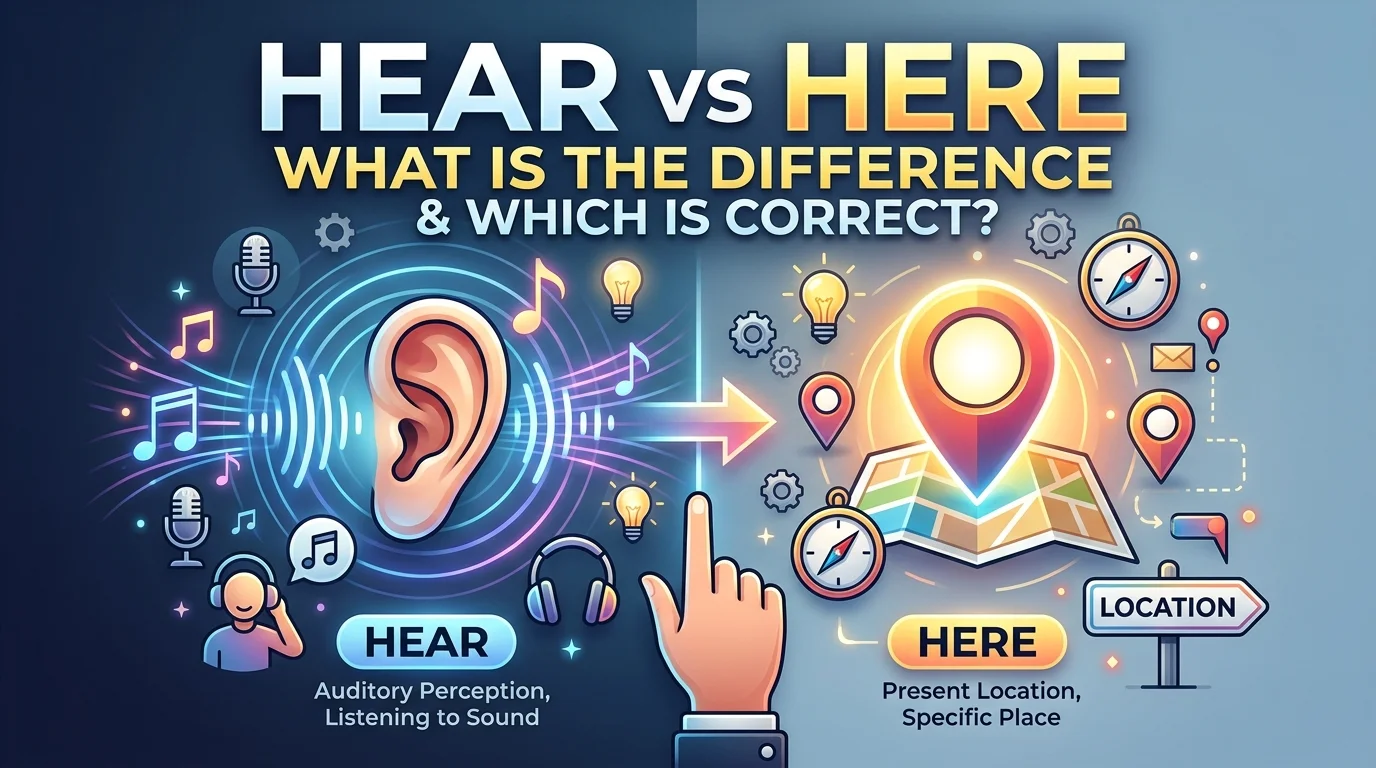
Many English learners confuse hear and here because they sound exactly the same when spoken. These words are examples of homophones, meaning they share the same pronunciation but have different meanings and spellings. Understanding the difference between hear and here improves writing and communication. It helps keep your message clear and grammatically correct.
Comparison Overview
Although hear and here sound alike, they serve completely different purposes in English.
| Word | Part of Speech | Meaning | Example |
| Hear | Verb | To perceive sound through the ears | I can hear music. |
| Here | Adverb, Noun, Interjection | In this place or location | Please come here. |
The confusion usually occurs because both words are pronounced the same way. However, their meanings, grammatical roles, and usage contexts are entirely different.
Definition of Hear
Hear is a verb that means to perceive sounds using your ears. It refers to the natural ability or act of receiving sound.
Examples:
- I can hear the birds singing.
- Did you hear the announcement?
- She heard someone knocking at the door.
- We hear music from the next room.
- They could hear thunder in the distance.
As a verb, hear often relates to listening, sounds, conversations, music, or noise.
Definition of Here
Here refers to a place, position, or location. It commonly functions as an adverb indicating where something or someone is.
Examples:
- Please sit here.
- I am here to help.
- The keys are here on the table.
- Come here immediately.
- We live here now.
Here is associated with location, presence, and direction.
Main Differences Between Hear and Here
| Feature | Hear | Here |
| Meaning | Perceive sound | In this place |
| Part of Speech | Verb | Usually an adverb |
| Related To | Listening and sound | Location and position |
| Question Answered | What sound did you perceive? | Where is something? |
| Example | I hear music. | Put the book here. |
Key Difference
- Hear relates to sounds and hearing.
- Here relates to places and locations.
Compare:
- I can hear the teacher speaking.
- The teacher is standing here.
One sentence involves sound; the other involves location.
Why Are Hear and Here Confusing?
The main reason these words are confusing is that they are homophones.
Homophones are words that:
- Sound the same
- Have different spellings
- Have different meanings
Examples of homophones include:
- Hear / Here
- Their / There
- Right / Write
- Sea / See
Because hear and here sound identical, writers sometimes accidentally choose the wrong spelling.
Comparison Table
| Aspect | Hear | Here |
| Pronunciation | Same as “here” | Same as “hear” |
| Word Type | Verb | Adverb/Noun |
| Meaning | Receive sound | This place |
| Focus | Hearing | Location |
| Common Usage | Conversations, music, sounds | Directions, places, positions |
| Example Sentence | I hear laughter. | Stand here. |
Grammar Guide
How Each Term Is Used in Sentences
Hear
Pattern:
Subject + hear + object
Examples:
- I hear the alarm.
- She hears footsteps.
- We heard the news yesterday.
- They hear music every night.
- Can you hear me?
Here
Pattern:
Subject + be + here
or
Come/Stay/Stand + here
Examples:
- I am here.
- She is here today.
- Come here.
- Stay here.
- Put the bag here.
Common Mistakes Learners Make
Mistake 1
❌ I can here the music.
✅ I can hear the music.
Reason: Sound perception requires the verb hear.
Mistake 2
❌ Come hear please.
✅ Come here please.
Reason: Location requires here.
Mistake 3
❌ We can here the teacher.
✅ We can hear the teacher.
Reason: Hearing sounds uses hear.
Mistake 4
❌ Leave your shoes hear.
✅ Leave your shoes here.
Reason: A place or position uses here.
Simple Rules to Remember
- If it involves sound, use hear.
- If it involves place, use here.
- Hear contains “ear,” which helps you remember hearing.
- Here contains “ere,” often associated with location words.
Memory Trick:
You hear with your ear.
Since ear appears inside hear, this is an easy reminder.
Quick Tips for Writing and Speaking
- Think about whether the sentence discusses sound or location.
- Replace the word mentally with “listen” or “sound.” If it fits, use hear.
- Replace the word with “in this place.” If it fits, use here.
- Proofread homophones carefully.
- Use context to identify the correct choice.
When to Use Each One
Use Hear When
- Talking about sounds
- Discussing conversations
- Referring to music
- Mentioning announcements
- Describing hearing abilities
Examples:
- I hear a strange noise.
- Did you hear the speech?
- She heard the phone ring.
- We hear birds every morning.
- They heard the explosion.
Use Here When
- Referring to a location
- Giving directions
- Indicating presence
- Pointing to something nearby
- Describing where something is
Examples:
- Sit here.
- The meeting is here.
- Leave the package here.
- We are here now.
- Come here quickly.
When NOT to Use Each One
Do Not Use Hear When
- Talking about places
- Giving directions
- Indicating location
Incorrect:
- ❌ Put the chair hear.
Correct:
- ✅ Put the chair here.
Do Not Use Here When
- Talking about sounds
- Discussing listening
- Referring to hearing
Incorrect:
- ❌ I can here the music.
Correct:
- ✅ I can hear the music.
Which One to Use (Decision Guide)
Ask yourself one simple question:
Am I talking about sound or location?
If the answer is:
- Sound → Use hear
- Location → Use here
Quick Decision Chart:
| Situation | Correct Word |
| Listening to music | Hear |
| Hearing a conversation | Hear |
| Hearing a warning | Hear |
| Pointing to a location | Here |
| Giving directions | Here |
| Showing where something is | Here |
Real-World Practical Examples
Hear Examples
- Education: I could hear the teacher clearly from the back row.
- Daily Life: We hear traffic outside every morning.
- Technology: Can you hear me on this video call?
- Business: Employees heard the company announcement.
- Science: Bats can hear high-frequency sounds.
Here Examples
- Education: Your classroom is here.
- Daily Life: Leave your umbrella here.
- Technology: Click here to download the file.
- Business: Sign your name here.
- Conversation: I’m here if you need help.
Self-Assessment (Fill in the Blanks)
- I will use ______ when referring to sounds and listening.
- The correct word is ______ because it means in this place.
- I can ______ the birds singing outside.
- Please come ______ right now.
- We could ______ the thunder.
- Leave your bag ______.
- Did you ______ the announcement?
- The restaurant is located ______.
- Can you ______ what she said?
- Sit ______ and wait.
- I ______ music from the next room.
- The manager is standing ______.
- We ______ the bell ring.
- Put the document ______.
- They could ______ the crowd cheering.
- The keys are ______ on the desk.
- Did you ______ the news today?
- Come over ______.
- I can ______ someone calling my name.
- Everyone is gathered ______.
Answers
- hear
- here
- hear
- here
- hear
- here
- hear
- here
- hear
- here
- hear
- here
- hear
- here
- hear
- here
- hear
- here
- hear
- here
Final Verdict
Hear and here are commonly confused because they sound identical, but their meanings are completely different. Hear is a verb connected to sounds, listening, and the ability to perceive noise through your ears. Here refers to a place, position, or location. Whenever you are talking about hearing music, conversations, announcements, or sounds, choose hear. Whenever you are referring to a location, direction, or position, choose here. Remember the simple memory trick: you hear with your ear. By focusing on whether the sentence involves sound or place, you can confidently select the correct word every time.
Conclusion About Hear vs Here
Understanding the difference between hear and here is essential for clear and accurate communication. Although these two words sound exactly the same, they have completely different meanings and grammatical functions. Hear is a verb about sound. It means you notice noise with your ears.Here refers to a location. It means a place or position. Because they are homophones, many learners mix them up in writing. This can happen even if they know the meaning in conversation.
The easiest way to remember the difference is to focus on the context. If the sentence involves listening, sounds, music, conversations, or hearing something, use hear. If it refers to a place, direction, or where someone or something is located, use here. By using these words in real life and remembering their purpose, you can avoid common mistakes. You can also use them with confidence in spoken and written English.
FAQs
What is the difference between hear and here?
The word hear means to perceive sound through your ears, while here refers to a location or place. Although they sound the same, they have different meanings and grammatical functions.
Is hear a verb or a noun?
Hear is primarily a verb. It describes the action of noticing or receiving sound. For example, “I can hear the music playing in the background.”
Is here a verb?
No, here is not a verb. It is most commonly used as an adverb that indicates a specific location or place. For example, “Please come here.”
Why do people confuse hear and here?
People confuse them because they are homophones. This means they have the same pronunciation but different spellings and meanings, making them easy to mix up when writing.
How can I remember the difference between hear and here?
A simple memory trick is that hear contains the word “ear,” which helps you remember that it relates to hearing sounds. Here refers to a place or location.
Can hear and here be used interchangeably?
No, they cannot be used interchangeably. Using one instead of the other causes grammar and meaning errors. Each word has a completely different purpose.
What are examples of hear in a sentence?
Examples include: “I hear birds singing,” “Did you hear the announcement?” and “We heard thunder during the storm.” All of these sentences involve sound.
What are examples of here in a sentence?
Examples include: “Sit here,” “The keys are here,” and “We are here for the meeting.” Each sentence refers to a location or position.
Are hear and here commonly tested in English learning?
Yes, they are often used in spelling, grammar, and vocabulary exercises. Learners often confuse homophones and need to know their different meanings.
Which word should I use when talking about a place?
When referring to a location, direction, or position, you should use here. If the sentence is about sounds or listening, use hear instead.

Amelia Wright focuses on making figurative language easy to understand. Her writing explains similes, metaphors, and word meanings using relatable examples. She aims to help readers recognize subtle differences in usage and apply them correctly in both academic and casual writing.