
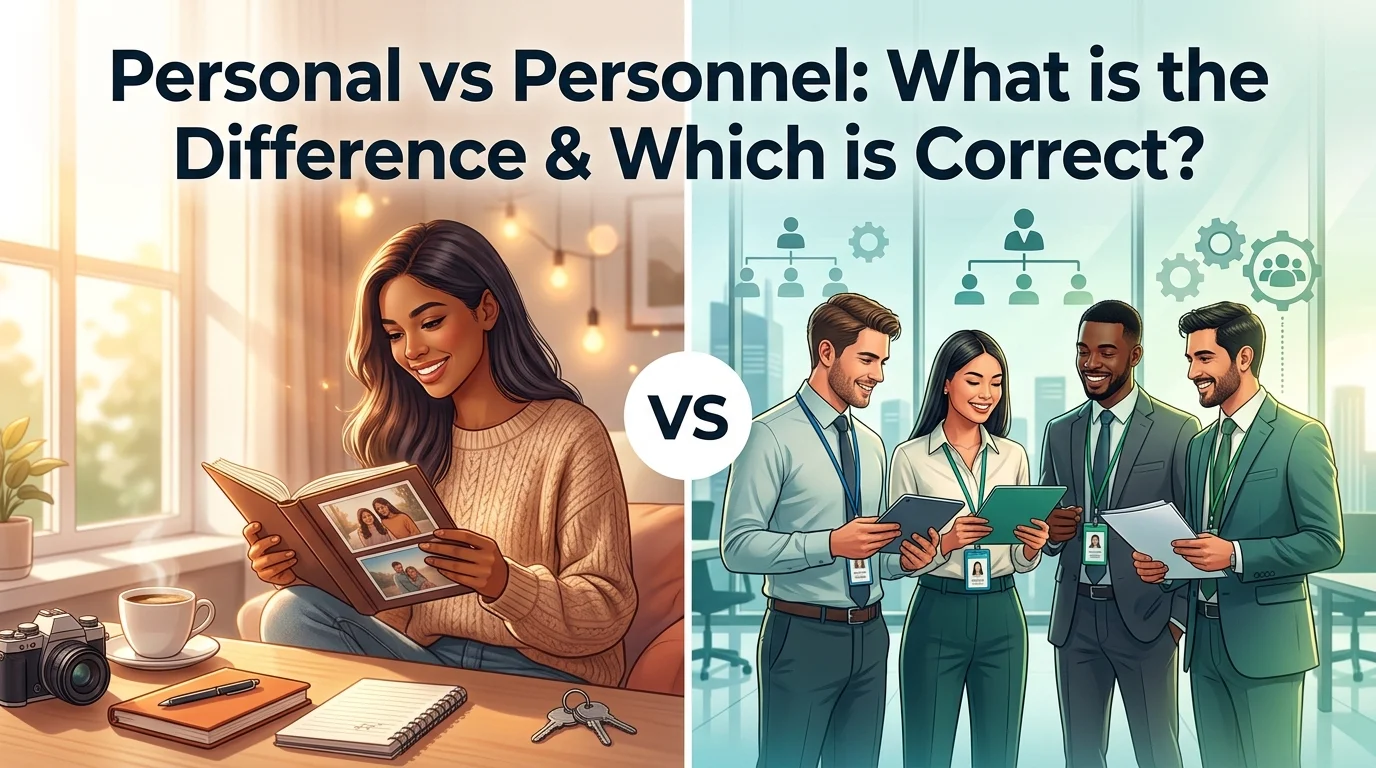
The words “personal” and “personnel” are often confused because they look similar and are used in professional and everyday language. However, they have completely different meanings and uses. Understanding the difference is important for clear writing, especially in academic, workplace, and formal communication contexts where precision matters.
Comparison Overview
“Personal” and “personnel” are two distinct English words that differ in meaning, usage, and grammatical role. “Personal” relates to an individual’s private life or identity, while “personnel” refers to people employed in an organization or workforce. Despite their similar spelling, they are not interchangeable in any context.
Definition of Personal
“Personal” is an adjective that refers to something private, individual, or related to a specific person. It describes things that belong to or affect a person directly rather than a group or organization. It is commonly used in everyday communication, emotional expression, and private matters.
Definition of Personnel
“Personnel” is a noun that refers to the people who work in an organization, company, military unit, or institution. It is always used in plural sense and represents a collective group of employees rather than a single individual.
Main Differences Between Personal and Personnel
The main difference lies in meaning and usage. “Personal” describes something belonging to or connected with an individual, while “personnel” refers to a group of employees or staff within an organization. “Personal” is an adjective, whereas “personnel” is a noun. One focuses on individuality, while the other focuses on workforce or staff structure.
A simple comparison table:
| Feature | Personal | Personnel |
| Part of Speech | Adjective | Noun |
| Meaning | Private or individual-related | Employees or staff members |
| Usage Context | Daily life, emotions, ownership | Workplace, military, organizations |
| Scope | Single person | Group of people |
Grammar Guide
“Personal” functions as an adjective and modifies nouns to show possession, privacy, or individuality. “Personnel” functions as a collective noun referring to employees or staff members in an organization.
How each term is used in sentences
“Personal” is used before nouns like “information,” “opinion,” or “experience.” Example pattern: personal + noun.
“Personnel” is used as a subject or object in sentences involving organizations or workplaces. Example pattern: personnel + verb or noun phrase.
Common mistakes learners make
A frequent mistake is using “personal” when referring to staff or employees. Another common error is treating “personnel” as singular or using it in personal emotional contexts, which is incorrect.
Simple rules to remember
“Personal” always relates to one individual’s private matters. “Personnel” always relates to groups of workers or staff in organizations.
Quick tips for writing and speaking
If you can replace the word with “private,” use “personal.” If you can replace it with “staff,” use “personnel.”
When to Use Each One
Use “personal” when talking about private life, opinions, belongings, feelings, or individual experiences. Use “personnel” when referring to employees, staff members, military teams, or organizational workforce structures.
When NOT to Use Each One
Do not use “personal” when discussing employees or teams in a company. Do not use “personnel” when describing emotions, private information, or individual experiences.
Which One to Use (Decision Guide)
If the sentence is about privacy, identity, or something belonging to one person, choose “personal.” If the sentence is about a group of workers or staff in an organization, choose “personnel.” Focus on whether the context is individual or collective to make the correct choice.
Real-World Practical Examples
Personal Examples
- I keep my personal documents in a locked drawer.
- She shared her personal experience during the meeting.
- He prefers to keep his personal life private.
- This is my personal opinion on the matter.
- They asked for my personal information on the form.
Personnel Examples
- The company hired new personnel for the IT department.
- Military personnel were deployed to the border area.
- All personnel must attend the safety briefing.
- The hospital increased its medical personnel this year.
- HR is responsible for managing personnel records.
Self-Assessment (Fill in the Blanks)
I will use ______ when referring to private life information.
The correct word is ______ because it refers to individual matters.
Employees in a company are called ______.
I should use ______ when talking about staff members.
The word ______ describes something belonging to a single person.
Company workers are referred to as ______.
I will choose ______ for personal opinions.
The organization increased its ______ last year.
______ information should not be shared publicly.
The hospital needs more trained ______.
I use ______ when talking about my own experiences.
The HR department manages ______ records.
______ matters are private and individual.
The company trained its new ______.
I will use ______ when describing emotions.
All ______ must follow safety rules.
______ data should remain confidential.
The firm hired additional ______.
My ______ opinion is different from yours.
______ refers to employees in an organization.
Answers
- personal
- personal
- personnel
- personnel
- personal
- personnel
- personal
- personnel
- personal
- personnel
- personal
- personnel
- personal
- personnel
- personal
- personnel
- personal
- personnel
- personal
- personnel
Final Verdict
“Personal” and “personnel” are completely different words with different meanings and uses. “Personal” relates to private, individual matters, while “personnel” refers to employees or staff in an organization. The easiest way to choose correctly is to check whether the context is about one person’s private life or a group of workers.
Conclusion About Personal vs Personnel
Understanding the difference between personal and personnel makes everyday communication much clearer and more accurate. Although these two words look similar, they serve completely different purposes in language. “Personal” always connects to an individual’s private life, feelings, or ownership, while “personnel” refers to a group of employees or staff working within an organization. Mixing them up can lead to confusion, especially in academic writing, professional documents, or workplace communication. Once you remember that “personal” is about one person and “personnel” is about people in a job setting, choosing the right word becomes simple and natural. With regular practice and attention to context, you can confidently use both terms correctly in speech and writing without hesitation.
FAQs
What is the main difference between personal and personnel?
Personal refers to private or individual matters, while personnel refers to employees or staff in an organization. One is used for personal life and experiences, and the other is used for workplace or group employment contexts.
Is personal and personnel interchangeable?
No, they are not interchangeable. Personal describes something private or individual, while personnel refers to a group of workers. Using them incorrectly can change the meaning of a sentence completely.
Can personnel be used for one person?
Generally, personnel is a collective noun and refers to a group of employees. It is not typically used for a single individual in formal English usage.
What does personal information mean?
Personal information refers to private details about an individual, such as name, address, contact details, or any data that relates specifically to one person’s identity or life.
What does personnel mean in a company?
Personnel in a company means the employees or staff members who work in different departments. It is often used in HR and organizational contexts.
Why do people confuse personal and personnel?
They are often confused because they look and sound similar. However, their meanings are different, with one referring to privacy and the other to workforce or employees.
Is personnel always plural?
Yes, personnel is always treated as a collective plural noun, even though it does not take a plural form like regular nouns.
Where is personal commonly used?
Personal is commonly used in daily communication, emotional expression, private matters, opinions, and ownership contexts involving individuals.
Can personal be used in business writing?
Yes, personal is used in business writing when referring to private data, personal opinions, or individual employee information, but not for staff groups.
How can I remember the difference easily?
Think of personal as related to one person’s private life and personnel as related to many people working in an organization. This simple idea helps avoid confusion.

Sarah Mitchell is an experienced writer and grammar teacher with over 10 years of expertise in English language education. She helps learners improve their grammar, writing, and communication skills through clear explanations and practical examples. Sarah creates learner-friendly content focused on real-life English, making language learning simple, effective, and confidence-building.