
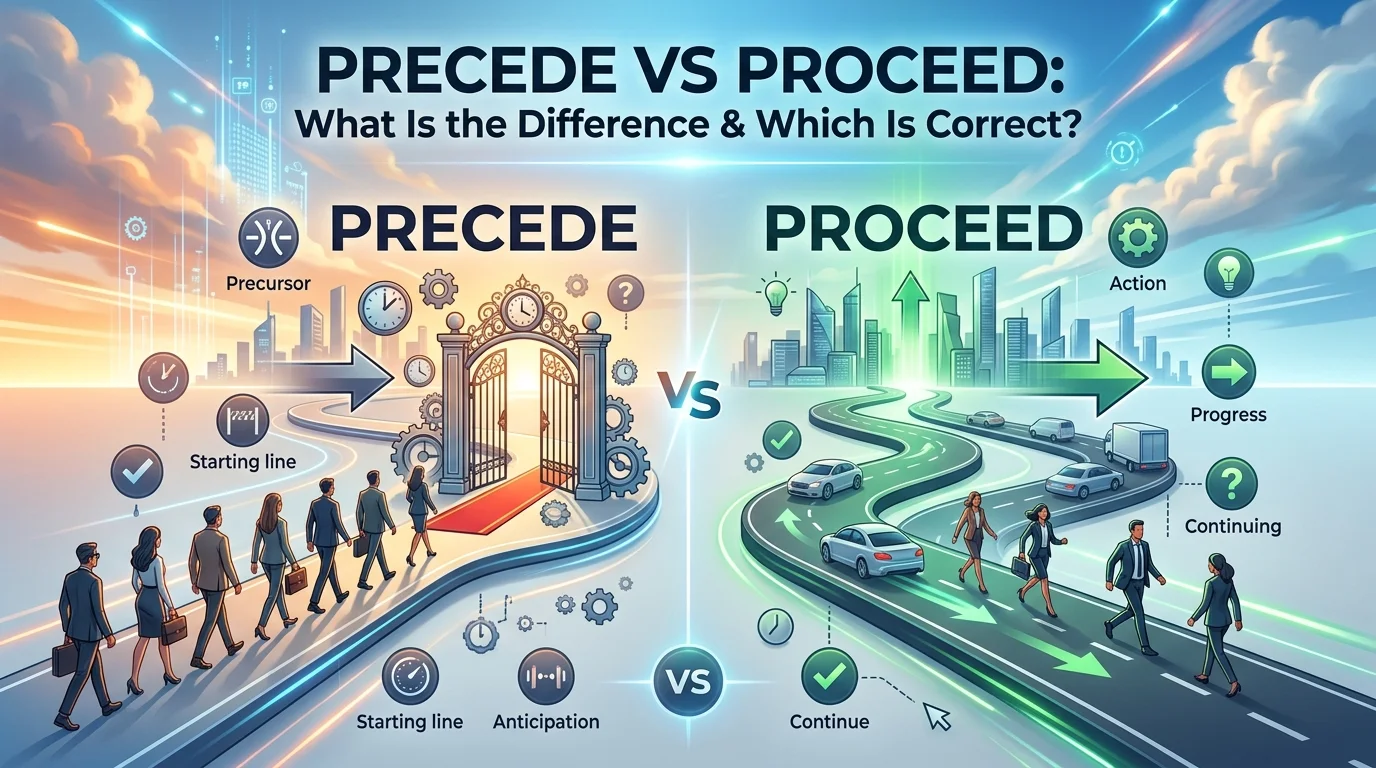
Many English learners and writers confuse precede and proceed because the words look and sound similar. However, they have completely different meanings and are used in different situations. Understanding the distinction between these two words can help you avoid common grammar mistakes and improve both your writing and speaking skills. This guide explains the meanings, grammar rules, differences, examples, and practical usage of precede and proceed in a simple and easy-to-understand way.
Comparison Overview
Precede and proceed are both verbs, but they describe different actions.
- Precede means to come before something in time, order, rank, or position.
- Proceed means to move forward, continue, or carry on with an action or process.
Although only one letter differs between them, their meanings are not interchangeable. Knowing when to use each word is important for clear communication.
| Feature | Precede | Proceed |
| Part of Speech | Verb | Verb |
| Meaning | To come before | To move forward or continue |
| Focus | Order or sequence | Action or progress |
| Common Contexts | Time, rank, position | Instructions, meetings, processes |
| Example | The introduction precedes the conclusion. | Please proceed to the next page. |
Definition of Precede
Precede means to come before something else in time, order, sequence, rank, or position.
When one thing happens earlier than another or appears before another, it precedes it.
Examples
- Breakfast precedes lunch.
- A warning signal preceded the storm.
- The title page precedes the table of contents.
- Training usually precedes employment.
- The opening ceremony preceded the competition.
Definition of Proceed
Proceed means to move forward, continue, advance, or carry on with an activity, process, or action.
It is commonly used when someone is instructed to continue doing something or when a process moves to the next stage.
Examples
- Please proceed with your presentation.
- The meeting will proceed as planned.
- After payment, proceed to checkout.
- The investigation proceeded smoothly.
- We can proceed once everyone arrives.
Main Differences Between Precede and Proceed
The primary difference is that precede relates to something that comes before, while proceed relates to moving forward.
| Aspect | Precede | Proceed |
| Basic Meaning | Come before | Continue forward |
| Refers To | Sequence and order | Action and progress |
| Time Relation | Earlier event | Next action |
| Usage Type | Position-based | Movement-based |
| Example | Chapter 1 precedes Chapter 2. | Proceed to Chapter 2. |
Key Difference in Meaning
- Precede = before
- Proceed = continue
Key Difference in Function
- Precede describes a relationship between two things.
- Proceed describes an action being taken.
Common Situations Where They Are Confused
People often confuse these words because they are spelled similarly.
Incorrect:
- Please precede to the next page.
Correct:
- Please proceed to the next page.
Incorrect:
- The introduction proceeded the main discussion.
Correct:
- The introduction preceded the main discussion.
Grammar Guide
Both precede and proceed are verbs, but they function differently within sentences.
How Each Term Is Used in Sentences
Precede Pattern
- Subject + precede + object
Examples:
- The speech preceded the ceremony.
- Research preceded the experiment.
- The warning preceded the accident.
Proceed Pattern
- Subject + proceed + with/to + object
Examples:
- We proceeded with the project.
- Please proceed to the exit.
- The team proceeded carefully.
Common Mistakes Learners Make
- Using precede when giving directions.
- Using proceed when describing order.
- Confusing sequence with continuation.
- Assuming the words are interchangeable.
- Misspelling one word for the other.
Simple Rules to Remember
- If it means before, use precede.
- If it means continue, use proceed.
- Think of precede = prior.
- Think of proceed = progress.
Quick Tips for Writing and Speaking
- Check whether you are discussing order or movement.
- Use precede for timelines and sequences.
- Use proceed for instructions and actions.
- Read the sentence aloud to confirm the meaning.
- Replace precede with “come before” to test accuracy.
When to Use Each One
Use Precede When
- Talking about order.
- Discussing events in sequence.
- Referring to rank or position.
- Explaining timelines.
- Describing what comes first.
Examples:
- The announcement preceded the launch.
- A brief discussion preceded the vote.
- Chapter 2 precedes Chapter 3.
Use Proceed When
- Giving instructions.
- Continuing an activity.
- Moving to the next step.
- Advancing a process.
- Carrying on with work.
Examples:
- Proceed with caution.
- Please proceed to registration.
- The project proceeded successfully.
When NOT to Use Each One
Do Not Use Precede
- When asking someone to continue.
- When giving directions.
- When describing progress.
- When moving through a process.
- When talking about advancement.
Incorrect:
- Precede to the next question.
Correct:
- Proceed to the next question.
Do Not Use Proceed
- When discussing sequence.
- When describing what comes first.
- When talking about earlier events.
- When comparing order.
- When referring to position.
Incorrect:
- The introduction proceeded the first chapter.
Correct:
- The introduction preceded the first chapter.
Which One to Use (Decision Guide)
Ask yourself the following question:
Is something coming before another thing?
- Yes → Use precede.
Is someone continuing, advancing, or moving forward?
- Yes → Use proceed.
Quick Decision Chart
| Situation | Correct Word |
| Something happens first | Precede |
| Continue a process | Proceed |
| Earlier in sequence | Precede |
| Move to the next step | Proceed |
| Comes before | Precede |
| Carry on | Proceed |
Real-World Practical Examples
Precede Examples
- Orientation sessions precede regular classes at the university.
- Data collection preceded scientific analysis.
- The opening remarks preceded the conference presentation.
- Testing preceded the software release.
- A market survey preceded the product launch.
Proceed Examples
- Students may proceed to the examination hall.
- The scientist proceeded with the experiment.
- Customers should proceed to checkout after shopping.
- The company proceeded with expansion plans.
- After saving the file, proceed to the next step.
Self-Assessment (Fill in the Blanks)
- The introduction will ______ the main chapter.
- Please ______ to the next section.
- A warning message ______ the system shutdown.
- After approval, we can ______ with construction.
- The keynote speech ______ the awards ceremony.
- You may now ______ to the interview room.
- Research often ______ product development.
- The meeting will ______ despite the delay.
- A short discussion ______ the final vote.
- Please ______ with your explanation.
- The training program ______ employment.
- The project will ______ according to schedule.
- The title page ______ the contents page.
- We should ______ carefully after reviewing the report.
- The announcement ______ the celebration.
- Please ______ to the registration desk.
- Initial testing ______ full production.
- The investigation continued and ______ successfully.
- The opening act ______ the main performance.
- After reading the instructions, ______ to the next question.
The Correct Word Is ______ Because ______
- The correct word is ______ because it refers to sequence.
- The correct word is ______ because it means continue.
- The correct word is ______ because it describes an earlier event.
- The correct word is ______ because it indicates moving forward.
- The correct word is ______ because it comes before another event.
- The correct word is ______ because it means advance to a location.
- The correct word is ______ because it refers to order.
- The correct word is ______ because it means continue despite obstacles.
- The correct word is ______ because it happened first.
- The correct word is ______ because it means carry on.
Answers
- precede
- proceed
- preceded
- proceed
- preceded
- proceed
- precedes
- proceed
- preceded
- proceed
- precedes
- proceed
- precedes
- proceed
- preceded
- proceed
- preceded
- proceeded
- preceded
- proceed
- precede
- proceed
- precede
- proceed
- precede
- proceed
- precede
- proceed
- precede
- proceed
Final Verdict
Precede and proceed may look similar, but they serve very different purposes in English. Precede means that something comes before another thing in time, order, or position. Proceed means to continue, advance, or move forward with an action or process. If you are talking about sequence, choose precede. If you are talking about progress or continuation, choose proceed. Remembering the simple association of precede = before and proceed = continue will help you select the correct word confidently in writing, speaking, academic work, and professional communication.
Conclusion About Precede vs Proceed
Understanding the difference between precede and proceed makes English communication clearer and more accurate. Although these two verbs look similar, their meanings work in completely opposite directions. Precede is used when something comes earlier in time, order, or position, while proceed is used when someone continues, advances, or moves forward with an action or process. Mastering this distinction helps avoid common grammar mistakes in writing, speaking, academic tasks, and professional communication. Whether you are describing sequences in events or giving instructions in daily life, choosing the correct word ensures your message is precise and easy to understand. By remembering that precede relates to “before” and proceed relates to “continue,” learners can confidently use both terms in the right context. With practice and awareness, these words become simple tools for expressing ideas clearly and naturally in any situation.
FAQs About Precede vs Proceed
What does precede mean in simple words?
Precede means something happens or comes before another thing in time, order, or position. It is often used to describe sequences, such as events, steps, or ranks. When one item is earlier than another in any arrangement, it is said to precede it in clear and simple terms.
What does proceed mean in simple English?
Proceed means to continue, move forward, or carry on with an action or process. It is commonly used in instructions, directions, or steps where someone is asked to keep going. It helps describe progress or advancement in activities, making it useful in both formal and everyday communication.
Can precede and proceed be used interchangeably?
No, precede and proceed cannot be used interchangeably because they have opposite meanings. Precede refers to something coming before, while proceed refers to continuing or moving forward. Using one in place of the other can change the meaning of a sentence completely and create confusion for the reader.
How do I remember the difference between precede and proceed?
A simple way to remember is that precede is linked with “before,” while proceed is linked with “progress.” If something happens earlier, use precede. If something continues or moves forward, use proceed. This memory trick helps learners choose the correct word easily in different situations.
Is precede used for time or order?
Yes, precede is mainly used to describe time, order, or sequence. It shows that one event, object, or action comes before another. For example, an introduction precedes a main chapter. It helps explain arrangement and structure in both written and spoken English clearly.
Where is proceed commonly used?
Proceed is commonly used in instructions, formal directions, meetings, and step-by-step processes. It tells someone to continue or move forward. For example, “Please proceed to the next step” is often used in exams, forms, and official procedures where progress is required.
What is a common mistake with precede?
A common mistake is using precede when giving directions or instructions. Many learners wrongly say “precede to the next step,” which is incorrect. The correct word is proceed because it involves movement forward, not sequence. Confusing these meanings leads to grammatical errors in writing and speech.
Is proceed always formal?
Proceed can be both formal and informal depending on the context. It is often used in formal instructions, legal language, or official procedures, but it can also appear in everyday speech when asking someone to continue. Its flexibility makes it a widely used and useful verb.
Does precede mean the same as before?
Yes, precede is closely related to the idea of “before.” It indicates that something happens earlier in sequence or time. However, it is used in more structured or formal sentences compared to simply saying “before.” It adds clarity in describing order and arrangement.
Why is it important to learn precede and proceed?
Learning precede and proceed is important because they are commonly used in writing, exams, instructions, and communication. Understanding their difference helps avoid confusion and improves grammar accuracy. It also strengthens clarity in expressing sequences and actions in both academic and real-life situations.

Sophia Turner is a grammar-focused writer who covers similes, word-versus-word meanings, and correct English usage. Her content is designed for learners who want quick answers, logical explanations, and practical guidance for improving writing accuracy and style.