
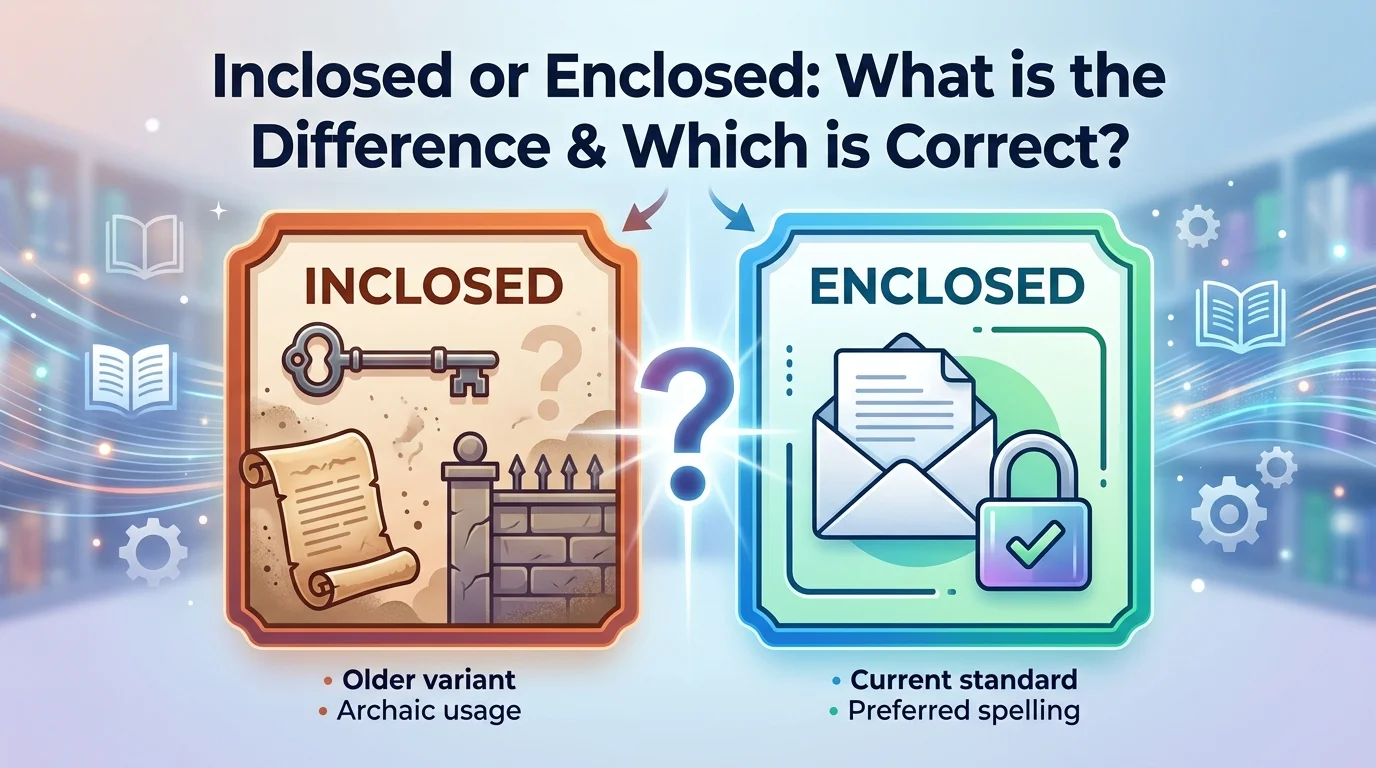
Understanding the difference between “inclosed” and “enclosed” is important for clear and correct English writing. These two words often cause confusion because they look similar and are sometimes used in older texts. This guide explains their meanings, differences, and proper usage in modern English in a simple and practical way.
Comparison Overview
“Inclosed” and “enclosed” both relate to the idea of surrounding, closing off, or enclosing something within boundaries. However, only one form is widely accepted in modern English. “Enclosed” is the standard spelling used today in formal writing, communication, and professional contexts, while “inclosed” is an older or archaic variation that is rarely used.
Definition of Inclosed
“Inclosed” is an old spelling of the word used in earlier English literature and historical documents. It carries the same meaning as “enclosed,” which is to surround, shut in, or place something within boundaries. Although it is still understood, it is considered outdated and not commonly used in modern writing.
Definition of Enclosed
“Enclosed” is the correct and modern standard spelling. It means to surround something completely or to include something within a container, space, or boundary. It is widely used in letters, business communication, instructions, and everyday writing.
Main Differences Between Inclosed and Enclosed
The main difference between these two terms lies in usage and acceptance. “Enclosed” is the preferred and standard form in modern English, while “inclosed” is outdated and rarely used today. Both words share the same meaning, but “enclosed” appears in official writing, education, and professional communication. “Inclosed” may still appear in historical texts but is not recommended for current usage.
Comparison Table
| Feature | Inclosed | Enclosed |
| Usage | Archaic | Modern |
| Acceptance | Rare | Standard |
| Meaning | Same as enclosed | To surround or include |
| Writing context | Old literature | Formal and informal writing |
Grammar Guide
How each term is used in sentences
Both terms function as verbs or adjectives depending on context. However, “enclosed” is the grammatically preferred form today.
Examples:
- Please find the document enclosed in the email.
- The garden is enclosed by a wooden fence.
Common mistakes learners make
Many learners mistakenly assume both spellings are equally correct in modern English. Another common mistake is using “inclosed” in formal writing, which can appear outdated or incorrect.
Simple rules to remember
- Use “enclosed” in all modern writing
- Treat “inclosed” as historical or outdated
- If unsure, always choose “enclosed”
Quick tips for writing and speaking
- In emails and letters, use “enclosed”
- Avoid “inclosed” in academic or business writing
- Think of “enclosed” as the safe, correct option
When to Use Each One
Use “enclosed” when writing emails, official documents, instructions, or any modern communication. It is also correct in both formal and informal contexts. “Inclosed” should only be used when quoting historical texts or discussing old literature.
When NOT to Use Each One
Avoid using “inclosed” in modern academic writing, business communication, or professional documents. It may look incorrect or outdated. Even in casual writing, “enclosed” is always the better choice.
Which One to Use (Decision Guide)
If you are writing anything today, choose “enclosed.” Only consider “inclosed” if you are analyzing old manuscripts or historical English texts. In all practical situations, “enclosed” is the correct and preferred form.
Real-World Practical Examples
Inclosed Examples
- The letter was inclosed in a sealed envelope in older correspondence.
- Historical records show the note was inclosed within the package.
- The document was inclosed in a wooden box in the archive.
- Old manuscripts mention items inclosed in parchment covers.
- The message was inclosed with the shipment in early trade letters.
Enclosed Examples
- Please find the receipt enclosed with this email.
- The garden is enclosed by a stone wall.
- The form is enclosed in the application packet.
- The package was enclosed in protective wrapping.
- The instructions were enclosed inside the box.
Self-Assessment (Fill in the Blanks)
- I received the letter ______ in the envelope.
- The garden is ______ by a fence.
- The document was ______ with the application.
- Old texts used the word ______ instead of enclosed.
- Please find the brochure ______ in the email.
- The area is ______ to protect wildlife.
- The note was ______ in the package.
- Modern English prefers the word ______.
- The file was ______ in the folder.
- Historical letters often used ______ spelling.
- The instructions were ______ inside the box.
- The property is ______ by trees.
- The report was ______ with the letter.
- Writers today use ______ in formal writing.
- The message was ______ in parchment.
- The space is ______ for safety reasons.
- The paper was ______ in the shipment.
- Only ______ is acceptable in modern English.
- The artifact was ______ in a case.
- The parcel was ______ before shipping.
Answers
- enclosed
- enclosed
- enclosed
- inclosed
- enclosed
- enclosed
- inclosed
- enclosed
- enclosed
- inclosed
- enclosed
- enclosed
- enclosed
- enclosed
- inclosed
- enclosed
- enclosed
- enclosed
- enclosed
- enclosed
Final Verdict
“Inclosed” and “enclosed” share the same meaning, but only one is suitable for modern English. “Enclosed” is the correct, standard, and widely accepted form used in all types of writing today. “Inclosed” belongs to older English and should generally be avoided unless referencing historical texts. For clear, professional, and accurate communication, “enclosed” is always the best choice.
Conclusion About Inclosed or Enclosed
Inclosed or Enclosed represents a common confusion in English spelling where both terms share the same meaning but differ in usage and acceptance. While “inclosed” appears in older texts, “enclosed” is the modern and standard form used in everyday communication, education, and professional writing. Choosing the correct spelling ensures clarity, credibility, and proper tone in writing. Today, “enclosed” is universally preferred, making it the safe and accurate choice for all contexts.
FAQs
Is “inclosed” still correct in modern English?
“Inclosed” is technically understandable, but it is considered outdated in modern English. It appears mostly in historical documents and older literature. In current writing standards, it is not preferred, and using it may make your text look old-fashioned or incorrect. The correct and widely accepted form today is “enclosed,” which should always be used in formal and informal communication.
What does “enclosed” mean in writing?
“Enclosed” means something is included within or surrounded by something else. In writing, it is commonly used to indicate that an item, document, or file is included with a letter or message. For example, “Please find the document enclosed” means the document is attached or included within the communication.
Why is “inclosed” no longer used?
“Inclosed” fell out of regular usage as English spelling evolved toward standardization. Over time, “enclosed” became the accepted form in dictionaries and formal grammar rules. Because language simplifies for consistency, “inclosed” is now seen as archaic and is rarely used except in historical references.
Can I use “inclosed” in academic writing?
It is not recommended to use “inclosed” in academic writing. Modern academic standards require the use of “enclosed” for clarity and correctness. Using the outdated spelling may be considered incorrect or unprofessional. Always use “enclosed” when writing essays, research papers, or formal documents.
What is the difference between “enclosed” and “attached”?
“Enclosed” usually refers to physical items included in a letter or package, while “attached” is more commonly used for digital files in emails. For example, a printed document is “enclosed,” but a PDF sent by email is “attached.” Both indicate inclusion but are used in different contexts.
Is “enclosed” formal or informal?
“Enclosed” is both formal and informal, making it highly versatile. It is commonly used in business letters, official communication, emails, and casual writing. Its neutrality and clarity make it suitable for almost any context where you want to indicate inclusion of additional material.
Where did the word “inclosed” come from?
“Inclosed” comes from older forms of English spelling before standardization rules were widely established. It was commonly used in historical letters and early printed works. Over time, spelling conventions changed, and “enclosed” became the standardized and preferred version in modern English usage.
Can “enclosed” be used in emails?
Yes, “enclosed” can be used in emails, although “attached” is more common for digital files. You can still use “enclosed” in formal email writing, especially when maintaining a traditional or professional tone. Both terms are acceptable depending on context and preference.
Is there any difference in meaning between the two?
No, there is no difference in meaning between “inclosed” and “enclosed.” Both refer to something being surrounded or included. The only difference lies in usage, where “enclosed” is the modern standard and “inclosed” is outdated and rarely used today.
Which word should I learn for exams and writing?
For exams, academic tasks, and professional writing, you should always learn and use “enclosed.” It is the correct modern spelling recognized by grammar standards and dictionaries. “Inclosed” may appear in older texts, but it is not required for modern language use.

Ethan Clarke is a language writer who specializes in breaking down similes, word meanings, and commonly confused terms. His work focuses on clear explanations, practical examples, and simple comparisons that help readers understand how English