
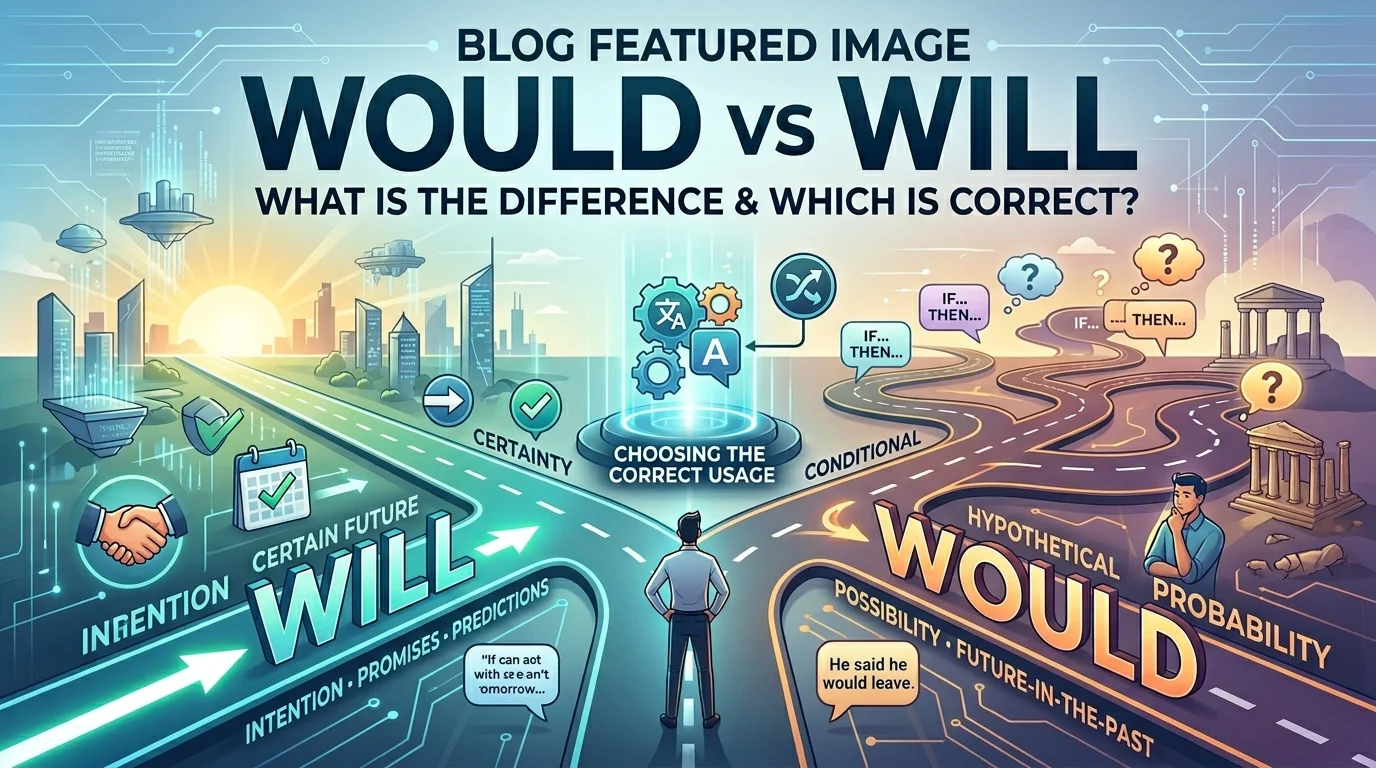
Understanding the difference between would and will is important because both words are commonly used to talk about actions, intentions, requests, and future events. Although they are related, they are not interchangeable in every situation. Knowing when to use would and will helps improve grammar, writing, speaking, and overall communication skills.
Comparison Overview
Will and would are modal verbs in English grammar. They help express future actions, intentions, possibilities, requests, habits, and hypothetical situations.
Generally:
| Word | Main Use |
| Will | Future actions, promises, decisions, predictions |
| Would | Polite requests, hypothetical situations, past future actions, preferences |
While will often expresses certainty about the future, would usually expresses possibility, politeness, imagination, or a less direct meaning.
Definition of Will
Will is a modal verb used primarily to talk about future actions, predictions, promises, decisions, and intentions.
It shows that something is expected to happen or that someone intends to do something.
Examples:
- I will call you tomorrow.
- She will finish the project next week.
- It will probably rain tonight.
The word will often indicates confidence or certainty about a future event.
Definition of Would
Would is the past form of will, but it has several additional uses in modern English.
It is commonly used for:
- Polite requests
- Hypothetical situations
- Preferences
- Future actions viewed from the past
Examples:
- Would you help me?
- I would travel more if I had time.
- He said he would arrive at noon.
The word would often sounds softer, more polite, or more conditional than will.
Main Differences Between Would and Will
| Feature | Will | Would |
| Basic Meaning | Future certainty | Hypothetical or conditional action |
| Time Reference | Present or future | Past, conditional, or imagined situations |
| Politeness | Direct | More polite |
| Requests | Will you help me? | Would you help me? |
| Preferences | Less common | Commonly used |
| Conditions | Rarely used | Frequently used |
Certainty vs Possibility
Will suggests stronger certainty.
Example:
- I will attend the meeting.
Would suggests possibility or dependency on conditions.
Example:
- I would attend if I were available.
Direct vs Polite
Will is more direct.
- Will you open the window?
Would is more polite.
- Would you open the window?
Real vs Imagined Situations
Will often describes real future events.
- She will graduate next year.
Would often describes imagined situations.
- She would travel the world if she won the lottery.
Uses of Will in Everyday English
Future Plans
- I will visit my grandparents next weekend.
Predictions
- Technology will continue to improve.
Promises
- I will always support you.
Offers
- I will carry your bag.
Instant Decisions
- I will answer the phone.
Uses of Would in Everyday English
Polite Requests
- Would you pass the salt?
Preferences
- I would rather stay home.
Hypothetical Situations
- I would buy a house if I had enough money.
Future in the Past
- He said he would call later.
Polite Offers
- Would you like some coffee?
Grammar Guide
How Each Term Is Used in Sentences
Will Sentence Patterns
Subject + will + base verb
Examples:
- She will study tonight.
- They will arrive soon.
- We will start tomorrow.
Would Sentence Patterns
Subject + would + base verb
Examples:
- I would help if I could.
- She would travel more.
- They would agree with that idea.
Common Mistakes Learners Make
Using Would for Certain Future Events
Incorrect:
- I would see you tomorrow.
Correct:
- I will see you tomorrow.
Using Will in Hypothetical Situations
Incorrect:
- I will buy a mansion if I won the lottery.
Correct:
- I would buy a mansion if I won the lottery.
Forgetting Politeness Differences
Direct:
- Will you help me?
More polite:
- Would you help me?
Simple Rules to Remember
- Use will for future facts and decisions.
- Use would for imagined situations.
- Use would for polite requests.
- Use will for promises and predictions.
- Use would when a condition affects the outcome.
Quick Tips for Writing and Speaking
- Formal requests often use would.
- Predictions commonly use will.
- Conditional sentences usually use would.
- Business communication often prefers would for politeness.
- Everyday future plans usually use will.
When to Use Each One
Use Will When
- Talking about future events
- Making promises
- Giving assurances
- Making predictions
- Making quick decisions
Examples:
- I will send the report.
- She will arrive soon.
- We will help you.
Use Would When
- Being polite
- Discussing imaginary situations
- Talking about preferences
- Referring to future actions from a past viewpoint
- Making conditional statements
Examples:
- Would you join us?
- I would move abroad if possible.
- He said he would return.
When NOT to Use Each One
Do Not Use Will
- For hypothetical situations
- For unreal conditions
- For polite formal requests when softer language is preferred
Incorrect:
- I will buy that car if I won the lottery.
Correct:
- I would buy that car if I won the lottery.
Do Not Use Would
- For certain future plans
- For definite promises
- For guaranteed future events
Incorrect:
- The train would leave at 9 a.m. tomorrow.
Correct:
- The train will leave at 9 a.m. tomorrow.
Which One to Use (Decision Guide)
Ask yourself these questions:
Is it a real future event?
Use will.
Example:
- I will attend the conference.
Is it imaginary or conditional?
Use would.
Example:
- I would attend if I had time.
Are you making a polite request?
Use would.
Example:
- Would you help me?
Are you making a promise?
Use will.
Example:
- I will be there.
Are you expressing a preference?
Use would.
Example:
- I would rather stay home.
Real-World Practical Examples
Will Examples
- Education: I will submit my assignment tomorrow.
- Daily Life: I will cook dinner tonight.
- Science: Researchers believe temperatures will increase.
- Business: We will launch the new product next month.
- Technology: Artificial intelligence will continue evolving.
Would Examples
- Education: I would study abroad if I received a scholarship.
- Daily Life: I would choose tea instead of coffee.
- Science: The experiment would fail without proper controls.
- Business: Investors would support the proposal if profits increased.
- Conversation: Would you mind closing the door?
Self-Assessment (Fill in the Blanks)
- I ______ call you tomorrow because I promised.
The correct word is ______ because it expresses a future promise. - I ______ travel the world if I had unlimited money.
The correct word is ______ because the situation is hypothetical. - ______ you like another cup of tea?
The correct word is ______ because it is a polite offer. - The company ______ announce the results next week.
The correct word is ______ because it refers to a future event. - She said she ______ visit us later.
The correct word is ______ because it is future from a past viewpoint. - I ______ help you carry those boxes.
The correct word is ______ because it is an offer. - We ______ buy a larger house if we earned more money.
The correct word is ______ because it depends on a condition. - The weather ______ improve tomorrow.
The correct word is ______ because it is a prediction. - ______ you please explain this topic?
The correct word is ______ because it creates a polite request. - He ______ finish the project by Friday.
The correct word is ______ because it describes a future expectation. - I ______ never break my promise.
The correct word is ______ because it expresses commitment. - They ______ attend if transportation were available.
The correct word is ______ because the situation is conditional. - The software ______ receive an update next month.
The correct word is ______ because it is a future event. - She ______ rather stay home tonight.
The correct word is ______ because it expresses preference. - We ______ contact you soon.
The correct word is ______ because it refers to the future. - He ______ help if he knew the answer.
The correct word is ______ because the action is hypothetical. - ______ you mind waiting a moment?
The correct word is ______ because it is a polite question. - The students ______ complete the exam next week.
The correct word is ______ because it refers to a future action. - I ______ accept the offer if the salary were higher.
The correct word is ______ because it depends on a condition. - She ______ definitely succeed with enough practice.
The correct word is ______ because it is a future prediction.
Answers
- will, will
- would, would
- Would, would
- will, will
- would, would
- will, will
- would, would
- will, will
- Would, would
- will, will
- will, will
- would, would
- will, will
- would, would
- will, will
- would, would
- Would, would
- will, will
- would, would
- will, will
Final Verdict
The difference between would and will comes down to certainty, conditions, and politeness. Use will when talking about definite future actions, promises, predictions, and decisions. Use would when discussing hypothetical situations, expressing preferences, making polite requests, or describing future events from a past perspective. If the action is expected to happen, choose will. If the action depends on a condition or is imagined, choose would. Mastering this distinction will make your English clearer, more natural, and grammatically accurate.
Conclusion About Would vs Will
Understanding the difference between would vs will is essential for using English accurately and confidently. Although both modal verbs are closely related, they serve different purposes in communication. Will is mainly used for future actions, promises, decisions, and predictions, while would is commonly used for hypothetical situations, polite requests, preferences, and conditional statements. Choosing the correct word depends on the context and the level of certainty you want to express. If you are talking about something that is expected to happen, will is usually the right choice. If the situation is imagined, conditional, or requires a more polite tone, would is often the better option. By practicing their usage in everyday conversations, writing, and reading, learners can avoid common mistakes and communicate more naturally. Mastering would vs will helps improve both spoken and written English, making your message clearer, more professional, and easier for others to understand.
FAQs
What is the main difference between would and will?
The main difference is that will is used for definite future actions, predictions, and promises, while would is used for hypothetical situations, polite requests, preferences, and conditional statements. Will expresses greater certainty, whereas would often suggests possibility or dependence on a condition.
Is would the past tense of will?
Yes, would is traditionally considered the past form of will. It is often used when reporting speech or describing future actions from a past perspective. However, it also has several additional uses, including polite requests and conditional situations.
Can would and will be used interchangeably?
No, they cannot always be used interchangeably. While they are related, each serves a different grammatical purpose. Replacing one with the other can change the meaning of a sentence or make it grammatically incorrect.
When should I use will in a sentence?
Use will when talking about future plans, predictions, promises, offers, or decisions made at the moment of speaking. It is the standard choice for expressing actions that are expected to happen in the future.
When should I use would in a sentence?
Use would when discussing imaginary situations, conditional outcomes, polite requests, preferences, or future events viewed from a past point in time. It often makes statements sound softer and less direct.
Why is would considered more polite than will?
Would is generally viewed as more polite because it sounds less direct and less demanding. For example, “Would you help me?” is usually considered more courteous than “Will you help me?” in many social and professional situations.
Is would used in conditional sentences?
Yes, would is frequently used in conditional sentences, especially when talking about unreal or hypothetical situations. It often appears in sentences that describe what could happen if certain conditions were met.
Can will be used for requests?
Yes, will can be used for requests, such as “Will you open the door?” However, in formal or polite situations, many speakers prefer would because it sounds more respectful and considerate.
Which is more common in everyday conversation, would or will?
Both are extremely common in everyday English. Will appears frequently when discussing future events, while would is commonly used in polite conversations, preferences, and hypothetical discussions. Their usage depends on context rather than frequency alone.
How can I remember the difference between would and will?
A simple rule is to remember that will usually refers to a real future action, while would often refers to an imagined, conditional, or polite situation. Think of will as certainty and would as possibility or courtesy.

Daniel Brooks is an English educator with a passion for explaining similes and word comparisons in plain language. He covers topics like versus meanings, correct usage, and figurative language to help writers avoid common mistakes and improve clarity in everyday writing.
