
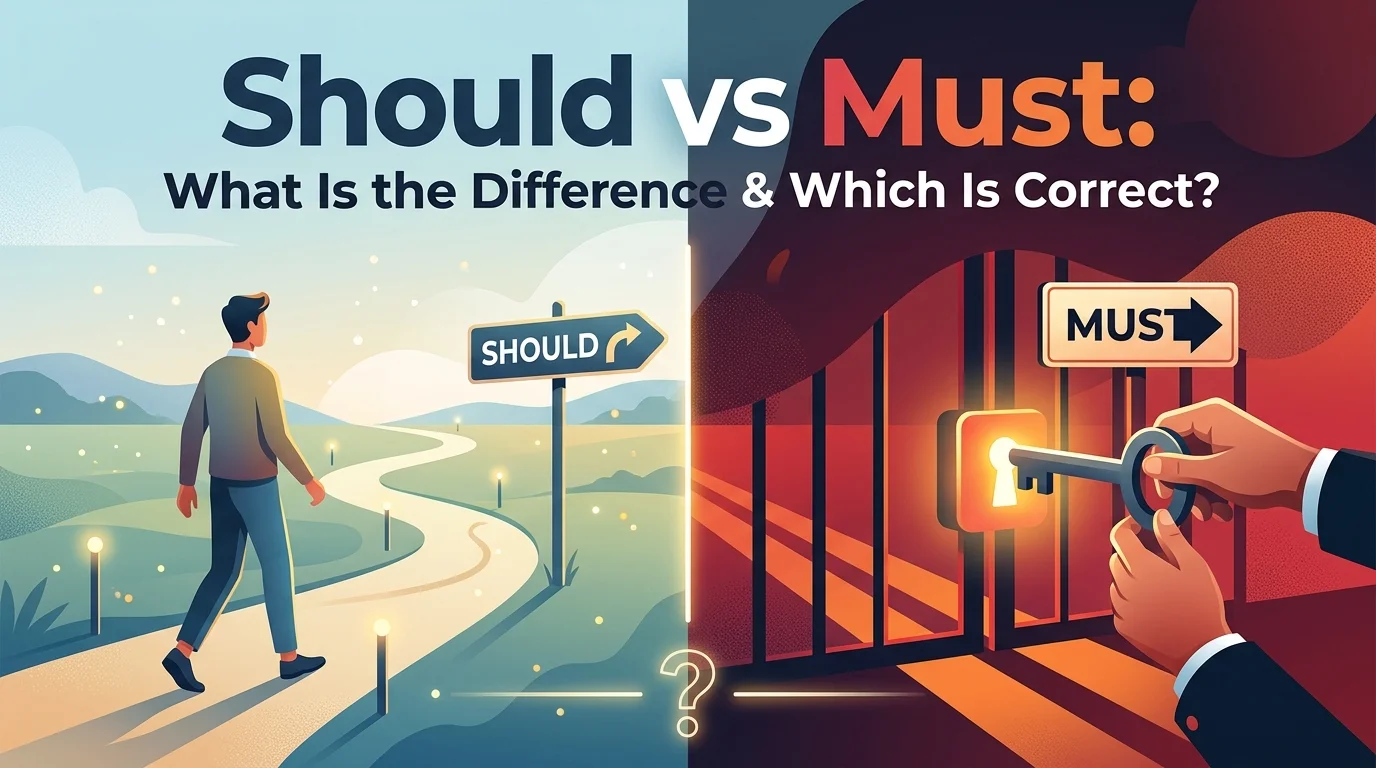
Understanding the difference between should and must is important because both words are commonly used to give advice, express obligations, and communicate expectations. While they may seem similar, they carry different levels of importance and necessity. Learning when to use each one correctly can improve both your writing and speaking skills.
Comparison Overview
Should and must are modal verbs in English grammar. They help express opinions, recommendations, obligations, duties, and requirements.
The main difference is that should usually expresses advice, recommendations, or expectations, while must expresses strong obligation, necessity, or requirements that cannot be ignored.
| Feature | Should | Must |
| Meaning | Advice or recommendation | Strong obligation or necessity |
| Strength | Moderate | Strong |
| Common Use | Suggestions and expectations | Rules and requirements |
| Formality | Common in everyday conversation | Common in rules, laws, and instructions |
| Choice Available? | Usually yes | Usually no |
Definition of Should
Should is a modal verb used to give advice, recommendations, opinions, or express what is considered the right thing to do.
It suggests that something is desirable or beneficial, but it is not usually mandatory.
Examples:
- You should drink more water.
- Students should complete their assignments on time.
- We should respect other people.
In these examples, the action is recommended but not absolutely required.
Definition of Must
Must is a modal verb used to express strong obligation, necessity, duty, or requirements.
It indicates that something is essential and often leaves little or no choice.
Examples:
- You must wear a seatbelt.
- Employees must follow safety rules.
- You must submit the application before the deadline.
In these cases, the action is required rather than simply recommended.
Main Differences Between Should and Must
The distinction between should and must is primarily based on the level of obligation.
| Aspect | Should | Must |
| Obligation Level | Moderate | Strong |
| Purpose | Advice and recommendations | Requirements and duties |
| Consequences | Usually minor if ignored | Often serious if ignored |
| Tone | Polite and flexible | Firm and direct |
| Choice | Usually available | Often unavailable |
Examples:
- You should study for the exam. (Good advice)
- You must attend the exam. (Required)
- You should save money. (Recommendation)
- You must pay your taxes. (Legal obligation)
Should vs Must in Everyday Communication
People often choose between should and must depending on how strongly they want to express an idea.
Using should sounds more polite and less demanding.
Example:
- You should try this restaurant.
Using must sounds stronger and more urgent.
Example:
- You must evacuate the building immediately.
The choice affects how the listener interprets the message.
Should vs Must in Formal Writing
In formal writing, policies, contracts, regulations, and instructions often use must because it clearly indicates requirements.
Examples:
- Applicants must provide identification.
- Visitors must follow security procedures.
Meanwhile, should often appears in guidelines and recommendations.
Examples:
- Employees should maintain professional conduct.
- Reports should be submitted electronically.
Grammar Guide
Both should and must are modal verbs.
They share similar grammatical structures.
Pattern:
Subject + Modal Verb + Base Verb
Examples:
- I should study.
- She should exercise.
- We must leave.
- They must follow instructions.
Modal verbs do not change according to subject.
Correct:
- He should go.
- They should go.
Correct:
- He must go.
- They must go.
How Each Term Is Used in Sentences
Should
Pattern:
Subject + should + base verb
Examples:
- You should read more books.
- They should arrive soon.
- We should help our neighbors.
Must
Pattern:
Subject + must + base verb
Examples:
- You must obey the rules.
- Employees must wear badges.
- Drivers must stop at red lights.
Common Mistakes Learners Make
Mistake 1: Using should when a rule exists
Incorrect:
- You should wear a helmet while operating this machine.
Better:
- You must wear a helmet while operating this machine.
Mistake 2: Using must for casual advice
Incorrect:
- You must try this ice cream.
Better:
- You should try this ice cream.
Mistake 3: Adding “to” after modal verbs
Incorrect:
- You should to study.
- You must to leave.
Correct:
- You should study.
- You must leave.
Simple Rules to Remember
- Use should for advice.
- Use must for obligations.
- If there is a choice, use should.
- If there is no choice, use must.
- Never add “to” after should or must.
Quick Tips for Writing and Speaking
- Use should when giving recommendations.
- Use must when expressing requirements.
- Choose should for a softer tone.
- Choose must for urgency or authority.
- Consider whether the action is optional or mandatory.
When to Use Each One
Use Should When
- Giving advice
- Making recommendations
- Expressing expectations
- Offering opinions
- Suggesting improvements
Examples:
- You should exercise regularly.
- We should arrive early.
- Students should review their notes.
Use Must When
- Stating rules
- Expressing necessity
- Giving official instructions
- Describing legal obligations
- Emphasizing urgency
Examples:
- You must stop at the checkpoint.
- Employees must complete training.
- Drivers must carry a valid license.
When NOT to Use Each One
Avoid Should When
- Referring to strict requirements
- Explaining laws
- Giving mandatory instructions
- Expressing unavoidable obligations
Incorrect:
- Citizens should pay taxes.
Better:
- Citizens must pay taxes.
Avoid Must When
- Giving casual advice
- Making gentle suggestions
- Offering personal recommendations
- Expressing preferences
Incorrect:
- You must watch this movie.
Better:
- You should watch this movie.
Which One to Use (Decision Guide)
Ask yourself these questions:
Is it advice or a recommendation?
Use should.
Example:
- You should drink more water.
Is it a requirement or obligation?
Use must.
Example:
- You must wear protective equipment.
Can the person choose?
Use should.
Example:
- You should learn another language.
Is there no choice?
Use must.
Example:
- You must submit the form today.
Real-World Practical Examples
Should Examples
- Education: Students should review lessons daily.
- Daily Life: You should get enough sleep.
- Business: Managers should communicate clearly.
- Technology: Users should update software regularly.
- Health: People should exercise several times a week.
Must Examples
- Education: Students must complete final examinations.
- Daily Life: Drivers must obey traffic laws.
- Business: Employees must follow company policies.
- Technology: Users must enter a password to access the system.
- Science: Researchers must follow safety protocols.
Self-Assessment (Fill in the Blanks)
- I will use ______ when giving advice.
The correct word is ______ because it expresses a recommendation. - I will use ______ when describing a legal requirement.
The correct word is ______ because it expresses obligation. - You ______ exercise regularly.
The correct word is ______ because it is advice. - Employees ______ wear safety equipment.
The correct word is ______ because it is mandatory. - We ______ arrive early if possible.
The correct word is ______ because it is a suggestion. - Drivers ______ stop at red lights.
The correct word is ______ because it is a rule. - Students ______ read more books.
The correct word is ______ because it is advice. - Visitors ______ show identification.
The correct word is ______ because it is required. - You ______ try the new restaurant.
The correct word is ______ because it is a recommendation. - Passengers ______ fasten their seatbelts.
The correct word is ______ because it is compulsory. - We ______ save money for emergencies.
The correct word is ______ because it is advice. - Staff members ______ follow security procedures.
The correct word is ______ because it is a requirement. - You ______ improve your writing by practicing.
The correct word is ______ because it is guidance. - Applicants ______ submit all required documents.
The correct word is ______ because it is mandatory. - Children ______ brush their teeth regularly.
The correct word is ______ because it is good advice. - Laboratory workers ______ wear protective clothing.
The correct word is ______ because it is required. - You ______ call ahead before visiting.
The correct word is ______ because it is recommended. - Citizens ______ obey the law.
The correct word is ______ because it is obligatory. - We ______ reduce waste whenever possible.
The correct word is ______ because it is advice. - Everyone ______ evacuate immediately during the emergency.
The correct word is ______ because it is essential.
Answers
- should, should
- must, must
- should, should
- must, must
- should, should
- must, must
- should, should
- must, must
- should, should
- must, must
- should, should
- must, must
- should, should
- must, must
- should, should
- must, must
- should, should
- must, must
- should, should
- must, must
Final Verdict
The difference between should and must comes down to the strength of the message. Use should when giving advice, suggestions, recommendations, or expressing what is generally a good idea. Use must when expressing obligations, requirements, rules, duties, or situations where there is little or no choice. If the action is optional but recommended, choose should. If the action is required or necessary, choose must. Understanding this distinction will help you communicate more accurately and confidently in both spoken and written English.
Conclusion About Should vs Must
Understanding the difference between should vs must is essential for clear and accurate communication in English. Although both words are modal verbs, they serve different purposes and express different levels of necessity. Should is typically used when giving advice, recommendations, or expressing what is generally a good idea, while must is used to show strong obligations, requirements, or situations where something is necessary. Choosing the right word helps your message sound more natural and precise. Whether you are writing an email, having a conversation, studying grammar, or creating professional documents, knowing when to use should and when to use must can improve both your confidence and language skills. By remembering that should suggests choice and must signals necessity, you can easily make the correct decision in most situations and communicate your ideas more effectively.
FAQs
What is the main difference between should and must?
The main difference is the level of obligation. Should is used for advice, recommendations, or expectations, while must is used for strong obligations, rules, or necessities. If something is optional but recommended, use should. If it is required or unavoidable, use must.
Is should weaker than must?
Yes, should is generally weaker than must. Should suggests that something is a good idea or recommended action, whereas must indicates that an action is necessary or required. This difference makes must sound stronger and more authoritative than should.
Can should and must be used in the same sentence?
Yes, they can be used together when expressing different levels of importance. For example, “You should prepare for the meeting, but you must attend it.” In this sentence, preparation is recommended, while attendance is required.
Is must always used for rules?
Not always. While must is commonly used for rules and regulations, it can also express personal necessity or strong conclusions. For example, “I must finish this project today” expresses personal obligation rather than an official rule.
When should I use should in writing?
Use should when offering suggestions, recommendations, opinions, or guidance. It is especially useful in articles, reports, educational content, and professional communication where you want to advise someone without sounding too forceful.
Can must be used for personal opinions?
Yes, must can sometimes express a strong personal opinion or recommendation. For example, “You must see this movie” shows strong enthusiasm. However, in many contexts, should may sound more natural and less demanding.
Do should and must have the same grammar structure?
Yes, both follow the same basic structure. They are modal verbs and are followed directly by the base form of the main verb. For example, “You should study” and “You must study” are both grammatically correct patterns.
Is it incorrect to use should instead of must?
It depends on the context. If an action is truly required, using should may weaken the meaning and create confusion. In situations involving laws, rules, safety instructions, or mandatory requirements, must is usually the better choice.
Which is more polite, should or must?
Should is generally considered more polite because it sounds like advice rather than a command. Must can sound firm and authoritative, which is appropriate for instructions and obligations but may seem too strong in casual conversations.
How can I easily remember should vs must?
A simple rule is to think about choice. If the person has a choice and you are offering advice, use should. If there is little or no choice because the action is required, use must. This guideline works in most everyday situations.

Ethan Clarke is a language writer who specializes in breaking down similes, word meanings, and commonly confused terms. His work focuses on clear explanations, practical examples, and simple comparisons that help readers understand how English