
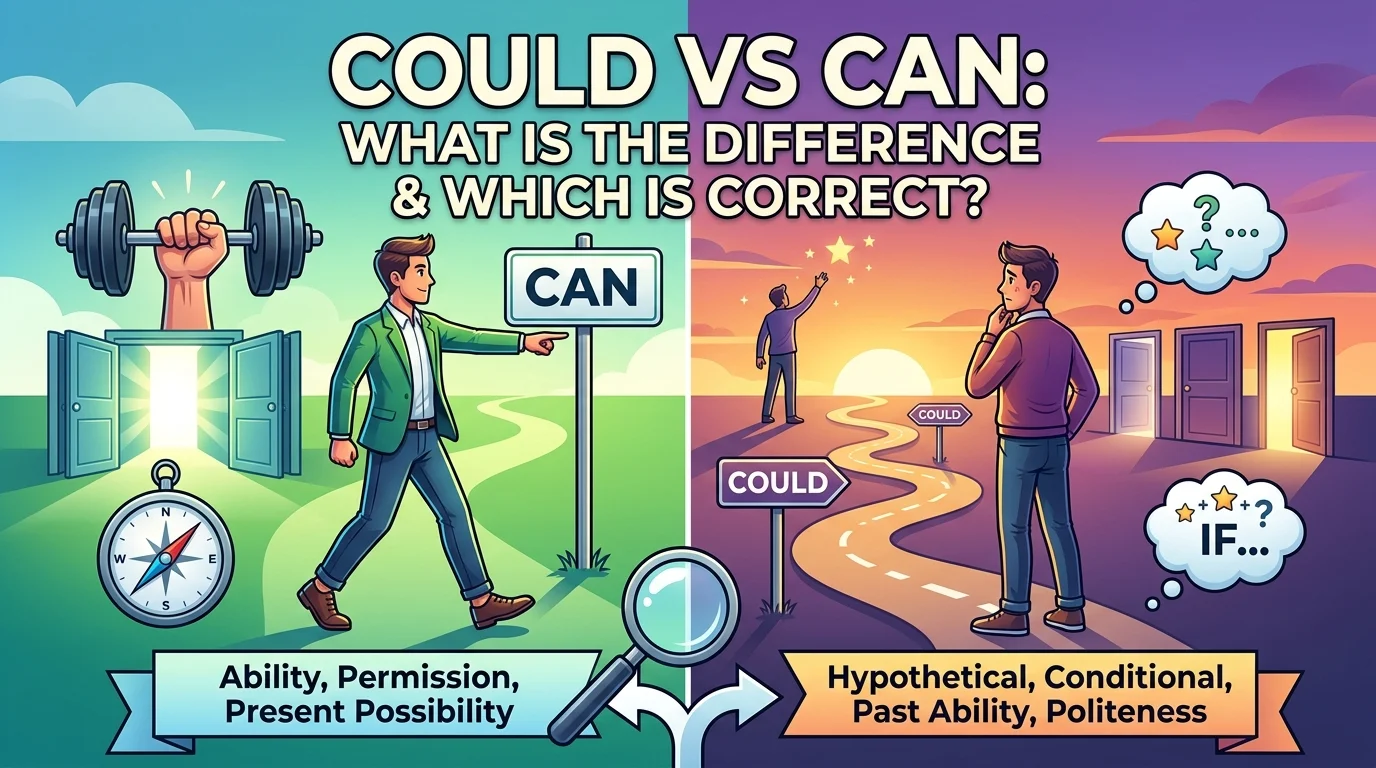
Understanding the difference between could and can is important because both words are commonly used in English to talk about ability, possibility, requests, and permission. While they are closely related, they are not always interchangeable. Knowing when to use could and can correctly helps improve grammar, communication, and confidence in both writing and speaking.
Comparison Overview
Can and could are modal verbs in English grammar. They help express ability, possibility, permission, and requests.
Generally:
| Term | Main Use |
| Can | Present ability, permission, possibility |
| Could | Past ability, polite requests, possibility, hypothetical situations |
Although could is the past form of can, it has several additional uses that make it different from simply being a past tense version.
Definition of Can
Can is a modal verb used to express present ability, permission, possibility, or capability.
It describes what someone is able to do now or what is possible in the current situation.
Examples:
- I can swim.
- She can speak French.
- You can leave early today.
- This device can store thousands of files.
The core purpose of can is to show capability or permission in the present.
Definition of Could
Could is a modal verb that often expresses past ability, polite requests, possibility, or hypothetical situations.
It is commonly used when talking about something that was possible in the past or something that may happen under certain conditions.
Examples:
- I could run faster when I was younger.
- Could you help me?
- It could rain tomorrow.
- We could travel abroad next year.
The core purpose of could is to show past ability, uncertainty, politeness, or conditional possibility.
Main Differences Between Could and Can
| Feature | Can | Could |
| Time Reference | Usually present | Usually past or hypothetical |
| Ability | Present ability | Past ability |
| Permission | Direct permission | Polite permission |
| Requests | Direct request | More polite request |
| Possibility | Stronger possibility | Less certain possibility |
| Formality | Less formal | More formal and polite |
Ability
Can describes current ability.
Example:
- I can solve this problem.
Could describes past ability.
Example:
- I could solve difficult problems when I was a student.
Requests
Can is direct.
Example:
- Can you open the window?
Could sounds more polite.
Example:
- Could you open the window?
Possibility
Can often describes general possibility.
Example:
- Accidents can happen.
Could suggests a possible outcome.
Example:
- Accidents could happen if you are careless.
Hypothetical Situations
Could is commonly used in imaginary or conditional situations.
Example:
- If I had more time, I could learn Japanese.
Can is generally not used in this way.
Can vs Could in Requests and Permission
Many learners struggle with requests and permission because both words seem similar.
| Situation | Better Choice |
| Casual request | Can |
| Polite request | Could |
| Asking permission casually | Can |
| Asking permission formally | Could |
Examples:
- Can I borrow your pen?
- Could I borrow your pen?
- Can you help me?
- Could you help me?
Both are correct, but could sounds more respectful and polite.
Can vs Could in Possibility
When discussing possibility, the level of certainty changes.
Examples with can:
- Extreme weather can affect crops.
- Technology can improve education.
Examples with could:
- The project could succeed.
- The weather could change later.
Here, could indicates uncertainty.
Grammar Guide
How Each Term Is Used in Sentences
Can Sentence Pattern
Subject + can + base verb
Examples:
- She can drive.
- They can learn quickly.
- We can start now.
Could Sentence Pattern
Subject + could + base verb
Examples:
- He could swim at age five.
- They could arrive late.
- I could help if needed.
Common Mistakes Learners Make
Using Could for Current Ability
Incorrect:
- I could speak English very well. (when talking about now)
Correct:
- I can speak English very well.
Using Can for Past Ability
Incorrect:
- I can swim when I was six.
Correct:
- I could swim when I was six.
Using Can in Formal Requests
Less polite:
- Can you assist me?
More polite:
- Could you assist me?
Simple Rules to Remember
- Use can for present ability.
- Use could for past ability.
- Use could for polite requests.
- Use could for hypothetical situations.
- Use can for current permission.
Quick Tips for Writing and Speaking
- Choose can in everyday conversations.
- Choose could when being polite.
- Use could when discussing possibilities.
- Use could in conditional sentences.
- Use can when describing what someone is able to do right now.
When to Use Each One
Use Can When
- Talking about present abilities.
- Giving permission.
- Making direct requests.
- Describing current possibilities.
- Discussing capabilities.
Examples:
- I can drive.
- You can enter now.
- Can you call me?
Use Could When
- Discussing past abilities.
- Making polite requests.
- Talking about uncertain possibilities.
- Describing hypothetical situations.
- Asking permission formally.
Examples:
- I could play piano as a child.
- Could you explain this?
- It could happen tomorrow.
When NOT to Use Each One
Do Not Use Can
- For past abilities.
- For hypothetical situations.
- When maximum politeness is needed.
Incorrect:
- I can run fast when I was young.
Do Not Use Could
- For definite present ability.
- For strong certainty.
- When describing something that is definitely true now.
Incorrect:
- I could speak English fluently. (if referring to present ability)
Which One to Use (Decision Guide)
Ask yourself these questions:
Are You Talking About Present Ability?
Use can.
Example:
- I can swim.
Are You Talking About Past Ability?
Use could.
Example:
- I could swim when I was seven.
Are You Making a Polite Request?
Use could.
Example:
- Could you help me?
Are You Giving Permission?
Use can.
Example:
- You can go now.
Are You Talking About a Possible Outcome?
Use could.
Example:
- The plan could succeed.
Real-World Practical Examples
Can Examples
- Education: Students can access online courses.
- Daily Life: I can cook dinner tonight.
- Technology: This software can detect errors.
- Business: We can increase sales through marketing.
- Science: Scientists can observe distant galaxies.
Could Examples
- Education: I could read basic books at age six.
- Daily Life: Could you pass the salt?
- Technology: The system could fail during overload.
- Business: The company could expand internationally.
- Science: New discoveries could change current theories.
Self-Assessment (Fill in the Blanks)
- I ______ speak three languages now.
- When I was ten, I ______ ride a bicycle.
- ______ you help me with my homework?
- You ______ enter the building now.
- The weather ______ change later.
- Birds ______ fly long distances.
- I ______ run faster when I was younger.
- ______ I borrow your notebook?
- Technology ______ improve productivity.
- The project ______ succeed if funding increases.
- She ______ play the piano today.
- He ______ solve advanced puzzles as a child.
- ______ you explain this topic?
- Students ______ use calculators during the exam.
- The results ______ vary depending on conditions.
- We ______ start the meeting now.
- They ______ stay longer if necessary.
- I ______ swim very well now.
- She ______ dance professionally when she was younger.
- The machine ______ process thousands of records daily.
The correct word is ______ because ______.
Answers
- can
- could
- Could
- can
- could
- can
- could
- Could
- can
- could
- can
- could
- Could
- can
- could
- can
- could
- can
- could
- can
Final Verdict
Both can and could are essential modal verbs, but they serve different purposes. Can is primarily used for present ability, permission, and capability, while could is commonly used for past ability, polite requests, possibilities, and hypothetical situations. If you are describing what is possible or achievable right now, choose can. If you are discussing the past, being polite, or expressing uncertainty, choose could. Understanding these differences will help you communicate more naturally and accurately in English.
Conclusion About Could vs Can
Understanding the difference between could vs can is an important step toward using English more accurately and naturally. Although both words are modal verbs that express ability, possibility, requests, and permission, they are used in different situations. Can is generally used for present ability, current permission, and direct communication, while could is commonly used for past ability, polite requests, uncertain possibilities, and hypothetical situations. Choosing the correct word helps make your meaning clearer and improves both spoken and written English. Whether you are writing an email, having a conversation, studying grammar, or preparing for an exam, knowing when to use can and could can make a noticeable difference. By remembering the simple rules and examples covered in this guide, you can confidently decide which word fits your sentence and communicate more effectively in everyday situations.
FAQs
What is the main difference between could and can?
The main difference is that can usually refers to present ability, permission, or possibility, while could often refers to past ability, polite requests, hypothetical situations, or less certain possibilities. The choice depends on the context and intended meaning.
Can could and can be used interchangeably?
Sometimes they can be used in similar situations, especially when making requests. However, they are not always interchangeable because could is generally more polite and can also express past ability or hypothetical situations that can cannot.
Is could the past tense of can?
Yes, could is traditionally considered the past form of can when talking about ability. For example, “I can swim” refers to the present, while “I could swim when I was five” refers to the past.
Which is more polite, could or can?
Could is usually considered more polite and formal than can. For example, “Could you help me?” sounds softer and more respectful than “Can you help me?” in many situations.
Can I use could for present situations?
Yes, could can be used in present situations when discussing possibilities, making polite requests, or talking about hypothetical outcomes. However, it is not typically used to describe a definite present ability.
When should I use can for permission?
Use can when giving or asking for permission in everyday situations. For example, “Can I leave early today?” is a common and natural way to ask permission in casual conversation.
Does could always refer to the past?
No. While could can describe past ability, it is also frequently used for polite requests, possibilities, suggestions, and conditional situations in the present or future.
Can could express possibility?
Yes, could often expresses possibility. For example, “It could rain this evening” means rain is possible but not certain. This use indicates less certainty than a direct statement of fact.
Why do English learners confuse could and can?
Learners often confuse them because both words share similar meanings related to ability and possibility. The differences in time reference, politeness, and certainty can make choosing the correct word challenging without practice.
How can I remember the difference between could and can?
A simple rule is to remember that can usually refers to what is possible or allowed now, while could often refers to the past, polite requests, or situations that are possible but not guaranteed.

Sarah Mitchell is an experienced writer and grammar teacher with over 10 years of expertise in English language education. She helps learners improve their grammar, writing, and communication skills through clear explanations and practical examples. Sarah creates learner-friendly content focused on real-life English, making language learning simple, effective, and confidence-building.