
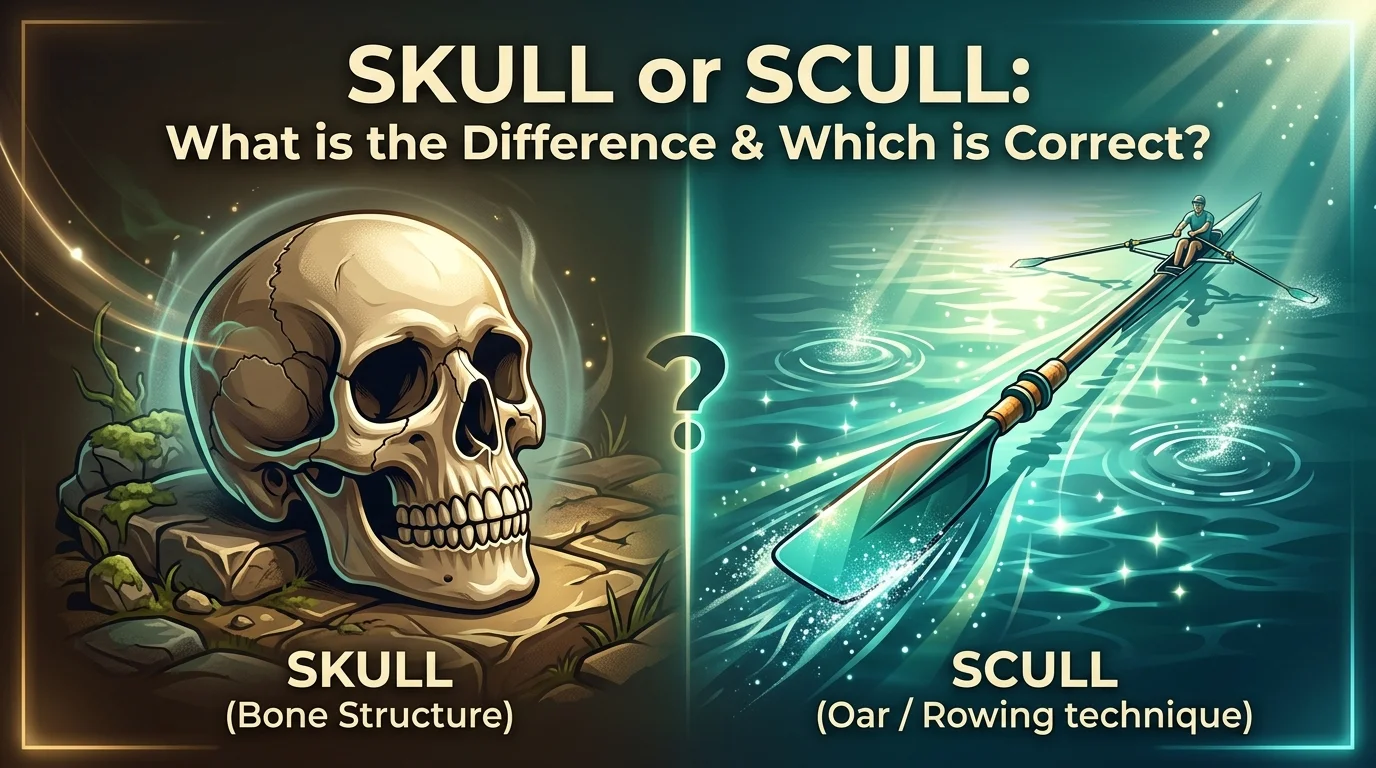
The words “skull” and “scull” often confuse English learners because they sound similar but have completely different meanings. One refers to a part of the human body, while the other relates to rowing or a type of oar movement. Understanding the difference helps avoid spelling mistakes and improves clarity in writing and communication.
Comparison Overview
“Skull” and “scull” are homophones, meaning they are pronounced in a similar way but differ in meaning, usage, and context. “Skull” belongs to anatomy and biology, while “scull” is used mainly in sports, especially rowing, or as a verb describing a rowing technique. Confusing them can completely change the meaning of a sentence.
Definition of Skull
The “skull” is the bony structure in the human or animal body that forms the head. It protects the brain and supports the face. It is a fundamental concept in anatomy, medicine, biology, and forensic science.
Definition of Scull
“Scull” has two main meanings. As a noun, it refers to a type of small rowing boat. As a verb, it means to propel a boat using a single oar or a pair of oars moved in a specific way, often from the stern.
Main Differences Between Skull and Scull
The primary difference is meaning and usage. “Skull” is anatomical and relates to biology and medicine, while “scull” is nautical and related to rowing sports. “Skull” refers to a physical part of the body, whereas “scull” refers to an activity or equipment in water transportation. One is static and biological, the other is dynamic and action-based.
| Feature | Skull | Scull |
| Field | Anatomy | Rowing / Sports |
| Meaning | Bone structure of the head | Rowing boat or rowing action |
| Usage | Medical, biological contexts | Sports, boating contexts |
| Type | Noun | Noun and verb |
Grammar Guide
“Skull” is always used as a noun and refers to a fixed anatomical structure. “Scull” can function as both a noun and a verb depending on the sentence. Understanding their grammatical roles helps prevent misuse in writing and speaking.
How each term is used in sentences
Skull: Used as a singular or plural noun in anatomical descriptions.
Scull: Used as a noun for boats or as a verb for rowing actions.
Examples:
- The doctor examined the patient’s skull.
- The rower learned how to scull across the lake.
Common mistakes learners make
Many learners confuse the spelling due to similar pronunciation. A frequent error is using “skull” when referring to rowing or “scull” when talking about anatomy. Another mistake is assuming both words can be interchangeable.
Simple rules to remember
Skull relates to the head and bones.
Scull relates to rowing and water movement.
If it involves the body, use “skull.” If it involves boats or rowing, use “scull.”
Quick tips for writing and speaking
Associate “skull” with “skill of protection” since it protects the brain.
Associate “scull” with “sea activity” since it is used in water sports.
When to Use Each One
Use “skull” when discussing anatomy, biology, medicine, injuries, or fossils. Use “scull” when talking about rowing sports, boats, or water-based movement techniques. The context of the sentence will always guide the correct choice.
When NOT to Use Each One
Do not use “skull” when referring to sports or boats. Do not use “scull” when discussing the human body or medical topics. Mixing them can lead to confusion and incorrect meaning in communication.
Which One to Use (Decision Guide)
If you are referring to bones, head structure, or medical terms, choose “skull.” If you are referring to rowing, boats, or water movement, choose “scull.” Ask yourself: is this about biology or boating? That answer will guide the correct spelling.
Real-World Practical Examples
Skull Examples
- The archaeologist discovered an ancient human skull.
- The helmet protects the skull during accidents.
- A CT scan of the skull was performed in the hospital.
- The museum displayed a dinosaur skull fossil.
- A skull fracture can be very serious.
Scull Examples
- The athlete learned how to scull efficiently during training.
- They used a small boat to scull across the river.
- He mastered the technique of sculling in rowing competitions.
- The team practiced scull rowing every morning.
- She decided to scull instead of using a motorboat.
Self-Assessment (Fill in the Blanks)
- The doctor studied the patient’s ______ carefully.
- A ______ is a bone structure that protects the brain.
- The athlete learned how to ______ across the lake.
- A small rowing boat is called a ______.
- The museum displayed a dinosaur ______.
- Rowers often ______ during early morning practice.
- A fractured ______ requires medical attention.
- The team trained to improve their ______ technique.
- The ______ is part of human anatomy.
- She used a single oar to ______ the boat.
- A ______ injury can be very dangerous.
- The sports team practiced synchronized ______.
- Scientists examined the ancient animal ______.
- He enjoys learning how to ______ competitively.
- The protective helmet covers the ______.
- The rowing club teaches beginners how to ______.
- The fossilized ______ was found underground.
- They went to ______ across the river for fun.
- The structure of the human ______ is complex.
- Competitive athletes often train in ______ boats.
Answers
- skull
- skull
- scull
- scull
- skull
- scull
- skull
- scull
- skull
- scull
- skull
- sculling
- skull
- scull
- skull
- scull
- skull
- scull
- skull
- scull
Final Verdict
“Skull” and “scull” may sound alike, but they belong to completely different worlds. One is biological and relates to the human body, while the other is nautical and linked to rowing. Remembering their contexts makes it easy to choose the correct word every time. If it involves anatomy, use “skull.” If it involves rowing or boats, use “scull.”
Conclusion About Skull or Scull
Wrapping up the comparison between Skull or Scull, it becomes clear that these two words may sound alike but serve entirely different purposes in language. “Skull” belongs to the world of anatomy, representing the protective bone structure of the head, while “scull” is rooted in rowing and water sports, describing both a boat and a rowing technique. Once you understand their distinct contexts, it becomes much easier to use them correctly in writing and conversation. This simple distinction helps improve clarity, especially in academic, medical, and sports-related communication. By remembering their unique meanings and associations, you can avoid common spelling confusion and express ideas more accurately. With consistent practice, distinguishing Skull or Scull becomes second nature, strengthening both your vocabulary and writing confidence.
Frequently Asked Questions
What does skull mean in simple terms?
Skull refers to the bony structure that forms the head in humans and animals. It protects the brain and supports facial features. It is a key part of the skeleton and is widely studied in anatomy, biology, and medical sciences for its protective and structural role.
What does scull mean in sports?
Scull refers to a rowing technique where a person uses one or two oars to move a boat. It also describes a small type of rowing boat. This term is commonly used in competitive rowing and water sports training.
Why are skull and scull confusing words?
They are confusing because they sound almost identical when spoken but have completely different meanings and spellings. This similarity often leads to spelling mistakes, especially among English learners who are unfamiliar with their distinct contexts.
Is skull related to medicine?
Yes, skull is strongly related to medicine and anatomy. It is studied in fields like biology, surgery, and forensic science. Doctors and researchers often refer to the skull when discussing injuries, brain protection, or skeletal structure.
Is scull used outside sports?
Scull is mostly used in rowing and boating contexts. Outside sports, it is rarely used in everyday language. It may appear in technical or historical references related to water transport or traditional rowing methods.
How can I easily remember skull and scull?
A simple way to remember is to link skull with “head and brain protection” and scull with “sea or rowing activity.” This association helps you quickly choose the correct word based on context.
Can skull and scull be used in the same sentence?
Yes, but only if the sentence compares both meanings. For example, you might describe anatomy and rowing in a single discussion, but in normal writing they are rarely used together due to their unrelated meanings.
What is the origin of the word skull?
The word skull comes from Old Norse and Middle English origins, referring to the bone structure of the head. Over time, it became a standard anatomical term used in modern English.
Is scull a verb or noun?
Scull can be both a verb and a noun. As a noun, it refers to a rowing boat. As a verb, it describes the action of rowing using a specific technique with oars.
Which word is more commonly used, skull or scull?
Skull is more commonly used because it appears in everyday topics like health, anatomy, and education. Scull is more specialized and mainly used in sports and rowing contexts.

Sophia Turner is a grammar-focused writer who covers similes, word-versus-word meanings, and correct English usage. Her content is designed for learners who want quick answers, logical explanations, and practical guidance for improving writing accuracy and style.