
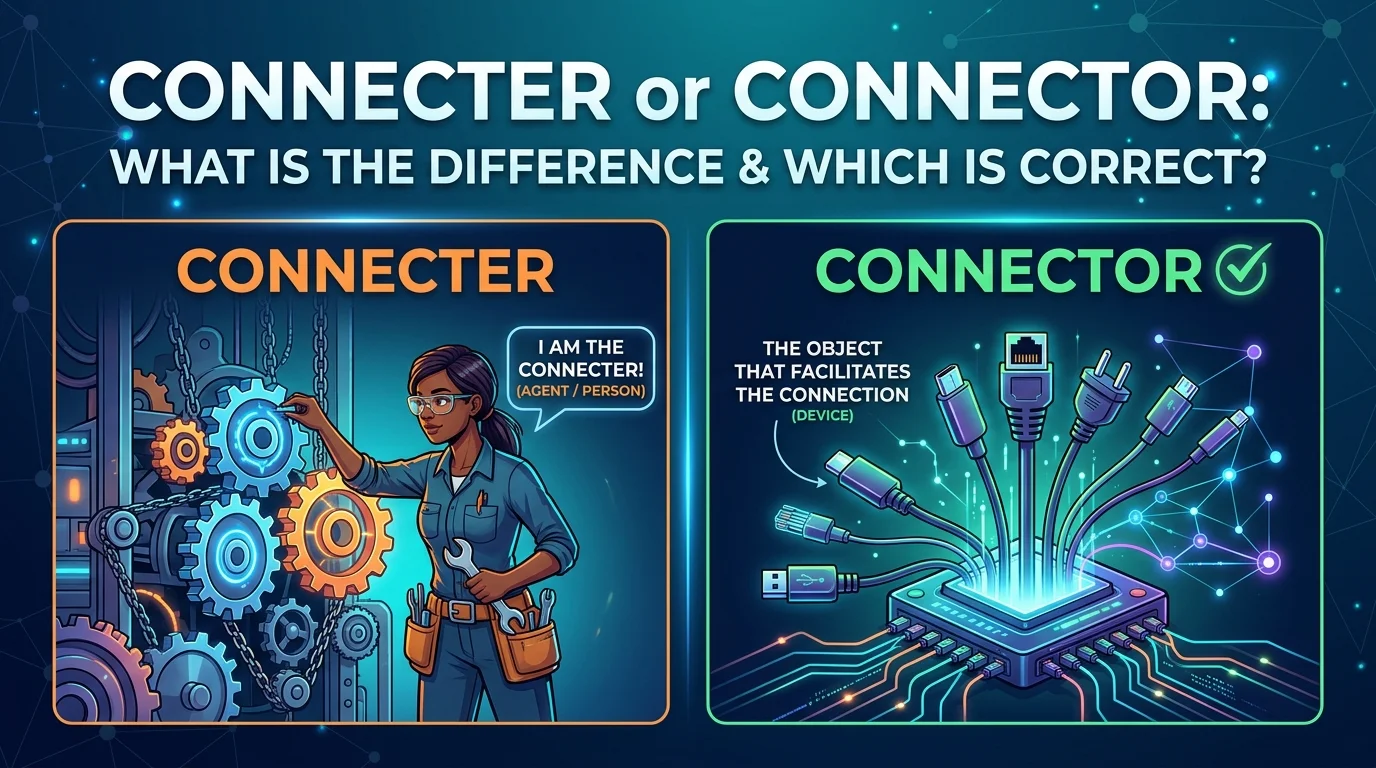
Many people get confused between Connecter and Connector because the words look very similar and both come from the idea of connecting things. However, only one of them is commonly accepted in modern English. Understanding the difference is important for correct grammar, professional writing, technical communication, and everyday usage. This guide explains their meanings, differences, usage rules, and practical examples.
Comparison Overview
The words Connecter and Connector are related to the verb connect, but they serve different roles in English.
| Term | Part of Speech | Meaning | Common Usage |
| Connecter | Noun (rare) | A person or thing that connects | Rare and largely outdated |
| Connector | Noun | A device, link, word, or element that joins things together | Standard and widely accepted |
Today, connector is the preferred spelling in almost all situations.
Definition of Connecter
Connecter is a noun derived from the verb connect. Historically, it referred to a person or thing that connects separate elements.
Although technically correct in some older dictionaries, the term is rarely used in modern English. Most writers and speakers prefer connector instead.
Key Characteristics of Connecter
- Rarely used today
- Considered outdated in many contexts
- May occasionally appear in historical texts
- Often replaced by “connector”
Definition of Connector
Connector is the standard noun used to describe something that joins, links, or connects two or more things.
The word is widely used in grammar, technology, engineering, business, transportation, and everyday communication.
Key Characteristics of Connector
- Standard modern English term
- Common in technical and everyday language
- Refers to physical or abstract connections
- Accepted worldwide in professional writing
Main Differences Between Connecter and Connector
| Feature | Connecter | Connector |
| Modern acceptance | Rare | Very common |
| Dictionary preference | Limited | Standard |
| Professional writing | Usually avoided | Recommended |
| Technical usage | Rarely used | Frequently used |
| Everyday English | Uncommon | Common |
| Grammar texts | Rare | Standard |
The main distinction is simple:
- Connecter is an uncommon and mostly outdated noun.
- Connector is the correct and preferred term in modern English.
Historical Development of the Terms
English often creates nouns by adding suffixes to verbs.
For the verb connect, two noun forms appeared:
- Connecter
- Connector
Over time, English speakers overwhelmingly adopted connector, especially in technical and academic fields. As a result, connecter became rare.
Today, connector dominates dictionaries, textbooks, manuals, and professional documents.
Connector in Technology and Engineering
The word connector is especially important in technical fields.
Examples include:
- USB connector
- Cable connector
- Network connector
- Electrical connector
- Audio connector
In these situations, “connecter” would sound incorrect or unusual.
Connector in Grammar and Writing
In grammar, a connector is a word or phrase that links ideas.
Examples include:
- however
- therefore
- because
- although
- meanwhile
These words help improve sentence flow and logical relationships.
Grammar Guide
Both words function primarily as nouns.
| Word | Part of Speech | Status |
| Connecter | Noun | Rare |
| Connector | Noun | Standard |
How each term is used in sentences
Connecter
- The old document referred to a connecter between departments.
- The connecter helped link the two systems.
- A historical manual mentioned a connecter device.
Connector
- The USB connector is damaged.
- This connector links the monitor to the computer.
- Use a connector word to join the ideas.
- The engineer replaced the connector.
- The cable connector fits perfectly.
Common mistakes learners make
- Using connecter in modern technical writing.
- Assuming both words are equally common.
- Using connecter in business reports.
- Using connecter in academic papers.
- Replacing connector with connecter unnecessarily.
Simple rules to remember
- If you’re writing modern English, use connector.
- If referring to technology, always use connector.
- If discussing grammar links, use connector.
- Treat connecter as an uncommon historical variation.
Quick tips for writing and speaking
- Choose connector for professional communication.
- Use connector in essays and reports.
- Use connector when discussing devices.
- Avoid connecter unless quoting older sources.
When to Use Each One
Use Connecter When
- Referring to rare historical writings
- Quoting older documents
- Discussing obsolete language forms
Use Connector When
- Writing modern English
- Discussing electronics
- Talking about grammar
- Writing technical documents
- Creating business reports
- Describing links between systems
When NOT to Use Each One
Do Not Use Connecter
- In technical manuals
- In academic papers
- In business communication
- In software documentation
- In educational materials
Do Not Use Connector
There are very few situations where connector is incorrect. It is the preferred choice in nearly all modern contexts.
Which One to Use (Decision Guide)
Ask yourself the following questions:
Are you writing modern English?
→ Use Connector
Are you discussing technology?
→ Use Connector
Are you talking about grammar or linking ideas?
→ Use Connector
Are you quoting a historical source that uses “connecter”?
→ Use Connecter
For almost every writer and speaker, connector is the correct choice.
Real-World Practical Examples
Connecter Examples
- The nineteenth-century text described a connecter between two regions.
- An old dictionary listed connecter as a noun.
- The archived document mentioned a connecter device.
- Historians found the term connecter in early records.
- The antique manual referred to a connecter mechanism.
Connector Examples
- The USB connector stopped working. (Technology)
- The electrical connector was replaced. (Engineering)
- Use “however” as a connector between ideas. (Grammar)
- The connector linked the network cables. (Business Technology)
- The train connector joined two carriages. (Transportation)
Self-Assessment (Fill in the Blanks)
- The USB ______ is broken.
- Modern technical manuals prefer the word ______.
- The network ______ links the devices.
- The correct grammar term is ______.
- An old document used the word ______.
- The cable ______ fits the port.
- Most dictionaries recommend ______.
- The engineer replaced the ______.
- The rare historical spelling is ______.
- The sentence needs a logical ______.
- The HDMI ______ supports video output.
- Modern writers choose ______.
- The outdated form is ______.
- The technician inspected the ______.
- The grammar ______ improves flow.
- Historical records sometimes contain ______.
- The broken ______ prevented communication.
- The standard English form is ______.
- The business report used the term ______.
- The uncommon variation is ______.
Answers
- Connector
- Connector
- Connector
- Connector
- Connecter
- Connector
- Connector
- Connector
- Connecter
- Connector
- Connector
- Connector
- Connecter
- Connector
- Connector
- Connecter
- Connector
- Connector
- Connector
- Connecter
Final Verdict
The comparison between Connecter and Connector is straightforward. While both words originated from the verb connect, modern English overwhelmingly favors connector. It is the standard term used in technology, engineering, grammar, business, education, and everyday communication. The word connecter survives mainly as a rare historical variant and is seldom seen in contemporary writing. If you are unsure which word to choose, the safest and most accurate option is almost always connector. Using connector ensures clarity, professionalism, and grammatical correctness, making it the preferred choice for nearly all modern contexts.
Conclusion About Connecter or Connector
Understanding the difference between Connecter and Connector can help you write more accurately and confidently. While both words originated from the same root verb, modern English strongly favors connector as the standard noun for a person, device, word, or element that joins things together. Whether you are discussing technology, grammar, engineering, business, or everyday communication, connector is the form most readers expect and recognize. The term connecter still exists in some historical references and older sources, but it is rarely used in current writing. If your goal is clear, professional, and grammatically correct communication, choosing connector is almost always the best decision. By remembering this simple distinction, you can avoid common spelling confusion and ensure your writing sounds natural, modern, and polished in any context.
FAQs
Is connector the correct spelling in modern English?
Yes, connector is the standard and widely accepted spelling in modern English. It is commonly used in technology, grammar, engineering, business, and everyday communication. Most dictionaries, style guides, and professional publications recommend connector as the preferred form.
Is connecter a real word?
Yes, connecter is a real word and appears in some dictionaries. However, it is considered uncommon and largely outdated in modern usage. Most writers and speakers use connector instead because it is more familiar and widely accepted.
What is the main difference between connecter and connector?
The primary difference is usage frequency and acceptance. Connector is the standard modern term, while connecter is a rare historical variant. In nearly all contemporary writing situations, connector is the preferred choice.
Should I use connecter in academic writing?
No, academic writing should generally use connector. It is the recognized form in educational materials, research papers, textbooks, and scholarly publications. Using connecter may appear outdated or unusual to readers.
What does connector mean in grammar?
In grammar, a connector is a word or phrase that links ideas, clauses, or sentences. Examples include words such as “however,” “therefore,” and “because.” Connectors help improve flow, coherence, and logical relationships in writing.
What does connector mean in technology?
In technology, a connector is a device or component that joins two systems, cables, or pieces of equipment. Examples include USB connectors, HDMI connectors, network connectors, and electrical connectors used in various devices.
Can connecter and connector be used interchangeably?
Although they share a similar origin, they are not commonly interchangeable in modern English. Connector is overwhelmingly preferred, and using connecter may confuse readers who are unfamiliar with the older variant.
Why is connector more common than connecter?
Over time, English usage evolved to favor connector. Technical industries, educational institutions, publishers, and dictionaries adopted connector as the standard term, causing connecter to become increasingly rare.
How can I remember which word to use?
A simple rule is to always choose connector when writing modern English. Whether the topic is grammar, technology, business, or everyday communication, connector is usually the correct and safest option.
Are there situations where connecter is still appropriate?
Connecter may be appropriate when quoting historical texts, discussing language history, or analyzing older documents that use the term. Outside these specialized contexts, connector remains the preferred choice.