
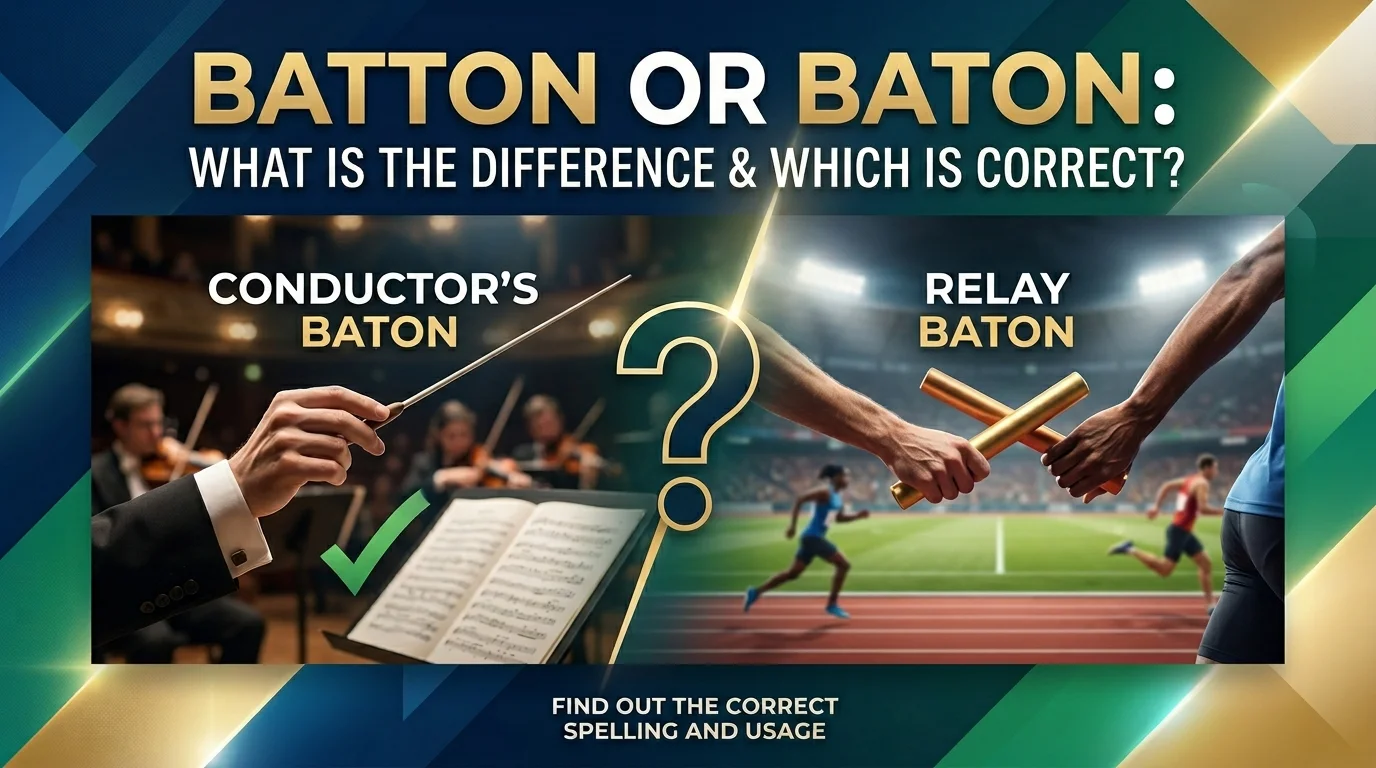
Many people confuse Batton and Baton because they look and sound similar. However, only one of them is a standard English word in most situations. Understanding the difference helps improve spelling, writing accuracy, and communication. This guide explains their meanings, usage, grammar rules, examples, and practical tips so you can confidently choose the correct term.
Comparison Overview
Batton and Baton are often mistaken for each other due to their similar spelling. However, they are not interchangeable.
- Baton is a recognized English word with several meanings.
- Batton is generally considered a misspelling of Baton in modern English, although it can occasionally appear as a surname or a rare variant in specific contexts.
For everyday writing, education, business, and communication, Baton is usually the correct choice.
| Feature | Batton | Baton |
| Standard English Word | Rarely | Yes |
| Common Usage | Mostly misspelling | Common |
| Meaning | Usually none in standard usage | A stick, staff, relay object, conductor’s wand |
| Found in Dictionaries | Rarely as standard word | Yes |
| Recommended for Writing | No | Yes |
Definition of Batton
Batton is generally not considered a standard English word in modern usage. Most often, it appears because someone accidentally adds an extra “t” when writing Baton.
In some rare cases, Batton may appear as:
- A surname
- A place name
- A specialized or historical spelling variation
For standard English writing, Batton is usually regarded as an incorrect spelling.
Definition of Baton
A Baton is a short stick or rod used for specific purposes.
Common meanings include:
- A conductor’s wand used to direct musicians
- A relay race stick passed between runners
- A ceremonial staff carried by officials
- A police baton used for law enforcement
The exact meaning depends on the context.
Common Uses of Baton
- Music conducting
- Athletics
- Law enforcement
- Military ceremonies
- Formal events
Main Differences Between Batton and Baton
The primary difference is correctness and usage.
| Aspect | Batton | Baton |
| Spelling Status | Usually incorrect | Correct |
| Dictionary Recognition | Limited | Widely recognized |
| Everyday Usage | Rare | Common |
| Professional Writing | Not recommended | Recommended |
| Educational Usage | Incorrect in most cases | Correct |
Meaning
- Batton generally has no accepted meaning in standard English.
- Baton refers to a specific object used in music, sports, ceremonies, and law enforcement.
Usage
- Batton is usually a spelling mistake.
- Baton is the accepted spelling.
Context
- Use Baton in formal, academic, and professional writing.
- Avoid Batton unless referring to a specific name or proper noun.
Common Contexts Where Baton Is Used
In Music
A conductor uses a baton to guide an orchestra’s performance.
In Sports
Relay runners pass a baton from one teammate to another.
In Law Enforcement
Officers may carry a baton as part of their equipment.
In Ceremonies
Military leaders may carry ceremonial batons during official events.
Grammar Guide
How Each Term Is Used in Sentences
Batton
- This spelling is generally considered incorrect.
- It should usually be replaced with Baton.
Examples:
- Incorrect: The runner dropped the batton.
- Correct: The runner dropped the baton.
Baton
- Functions as a noun.
- Refers to a physical object.
Examples:
- The conductor raised the baton.
- She passed the baton to her teammate.
Common Mistakes Learners Make
- Adding an extra “t” and writing Batton.
- Assuming both spellings are equally correct.
- Using Batton in academic writing.
- Misspelling Baton in sports reports.
- Confusing Baton with unrelated words.
Simple Rules to Remember
- Think of Baton = one t.
- If referring to a conductor, relay race, or ceremonial stick, use Baton.
- Avoid Batton in standard writing.
Quick Tips for Writing and Speaking
- Proofread carefully for spelling errors.
- Remember that Baton is the dictionary spelling.
- Use spell-check tools when writing formal documents.
- Learn Baton through common phrases like “pass the baton.”
- If unsure, choose Baton.
When to Use Each One
Use Baton When:
- Discussing relay races
- Talking about orchestra conductors
- Referring to police equipment
- Describing ceremonial staffs
- Writing formal English
Examples:
- The athlete passed the baton.
- The conductor lifted the baton.
- The officer carried a baton.
Use Batton When:
- Referring to a person named Batton
- Referring to a specific proper noun with that spelling
Outside those situations, Baton is generally preferred.
When NOT to Use Each One
Do Not Use Batton
- In academic essays
- In business documents
- In news articles
- In sports reporting
- In formal communication
Do Not Use Baton
- When referring to a person or place officially named Batton
- When quoting a source that intentionally uses Batton as a name
Which One to Use (Decision Guide)
Ask yourself these questions:
- Are you referring to a conductor’s stick?
- Use Baton.
- Are you talking about a relay race object?
- Use Baton.
- Is it a ceremonial or police stick?
- Use Baton.
- Is Batton part of someone’s official name?
- Use Batton.
For almost all everyday situations, Baton is the correct choice.
Real-World Practical Examples
Batton Examples
- Mr. Batton spoke at the conference.
- The Batton family attended the event.
- Batton was listed on the membership roster.
- The award was presented to Sarah Batton.
- The Batton name appeared in historical records.
Baton Examples
- The runner passed the baton during the relay race.
- The conductor waved the baton to begin the concert.
- The police officer carried a baton while on duty.
- The military leader displayed a ceremonial baton.
- The manager used the phrase “pass the baton” during succession planning.
Self-Assessment (Fill in the Blanks)
- The conductor raised the ______ before the orchestra began.
- The correct word is ______ because it refers to a relay race stick.
- The athlete passed the ______ to her teammate.
- The correct word is ______ because it is the standard spelling.
- The officer carried a ______ while on patrol.
- The correct word is ______ because Batton is usually a misspelling.
- The orchestra followed the movement of the ______.
- The correct word is ______ because it appears in dictionaries.
- The runner dropped the ______ near the finish line.
- The correct word is ______ because it refers to sports equipment.
- I will use ______ when discussing a music conductor.
- The correct word is ______ because it is accepted in formal writing.
- The ceremonial ______ symbolized authority.
- The correct word is ______ because it names an official object.
- The relay team successfully exchanged the ______.
- The correct word is ______ because it has one “t.”
- The police ______ remained attached to the officer’s belt.
- The correct word is ______ because it fits the context.
- I will use ______ when describing a conductor’s wand.
- The correct word is ______ because it is the recognized English spelling.
Answers
- Baton
- Baton
- Baton
- Baton
- Baton
- Baton
- Baton
- Baton
- Baton
- Baton
- Baton
- Baton
- Baton
- Baton
- Baton
- Baton
- Baton
- Baton
- Baton
- Baton
Final Verdict
When comparing Batton and Baton, the correct choice in nearly all situations is Baton. It is the standard English spelling used for a conductor’s wand, a relay race stick, a police baton, and ceremonial staffs. Batton is generally considered a spelling mistake unless it appears as a person’s name or another proper noun. If you are writing for school, work, publishing, or everyday communication, choose Baton. Remember the simple rule: if you mean the object used in music, sports, ceremonies, or law enforcement, use Baton with one “t.” This small spelling difference can make your writing clearer, more professional, and grammatically correct.
Conclusion About Batton or Baton
Understanding the difference between Batton and Baton can help you avoid a common spelling mistake and communicate more clearly in both writing and speech. While the two words look very similar, Baton is the correct and widely accepted English word used to describe a conductor’s wand, a relay race stick, a ceremonial staff, or a police baton. In contrast, Batton is generally considered an incorrect spelling unless it is part of a specific name or proper noun.
Whether you are writing an academic paper, preparing business content, reporting on sports, or simply improving your English skills, choosing the correct spelling makes your communication more professional and accurate. A simple way to remember the difference is that Baton contains only one “t” and is the standard dictionary spelling. By understanding the meaning, grammar, and usage of each term, you can confidently select the right word whenever the situation arises.
FAQs
Is Baton the correct spelling?
Yes, Baton is the correct spelling in standard English. It is used for a conductor’s wand, a relay race stick, a ceremonial staff, or a police baton. This is the spelling recognized by dictionaries and style guides, making it the preferred choice in formal and informal writing.
Is Batton a real word?
Batton is not commonly recognized as a standard English word. In most cases, it is simply a misspelling of Baton. However, it may appear as a surname, place name, or proper noun in specific contexts where the spelling is intentional.
What does Baton mean?
A baton is a short stick or rod used for a particular purpose. Common examples include the stick passed during a relay race, the wand used by an orchestra conductor, or a ceremonial staff carried during official events and functions.
Why do people confuse Batton and Baton?
People often confuse these words because they are pronounced similarly and differ by only one letter. The extra “t” in Batton can easily be added by mistake, especially when typing quickly or relying on pronunciation rather than correct spelling.
Is Batton ever correct?
Batton can be correct when it is part of a person’s name, family name, business name, or another proper noun. Outside of those situations, Baton is generally the correct spelling for the object commonly referenced in sports, music, and ceremonies.
How is Baton used in sports?
In sports, a baton is used in relay races. One runner carries the baton and passes it to the next teammate during a designated exchange zone. Successful baton exchanges are essential for completing the race efficiently and avoiding penalties.
How is Baton used in music?
In music, a conductor uses a baton to guide musicians through a performance. The baton helps communicate timing, rhythm, tempo, and expression, allowing the orchestra or ensemble to perform together in a coordinated manner.
Is Baton a noun or a verb?
Baton is primarily a noun. It refers to a physical object used in music, athletics, law enforcement, or ceremonial settings. It is not commonly used as a verb in standard English grammar and is generally treated only as a noun.
What is the easiest way to remember the correct spelling?
A simple memory trick is to remember that Baton has only one “t.” Whenever you think of a relay race, orchestra conductor, or ceremonial stick, use Baton. If you see Batton, double-check whether it is a name or a spelling error.
Should I use Baton in formal writing?
Yes, you should use Baton in formal writing whenever referring to the object itself. It is the accepted spelling in academic papers, business documents, news articles, books, and professional communication, making your writing more accurate and credible.

Daniel Brooks is an English educator with a passion for explaining similes and word comparisons in plain language. He covers topics like versus meanings, correct usage, and figurative language to help writers avoid common mistakes and improve clarity in everyday writing.