
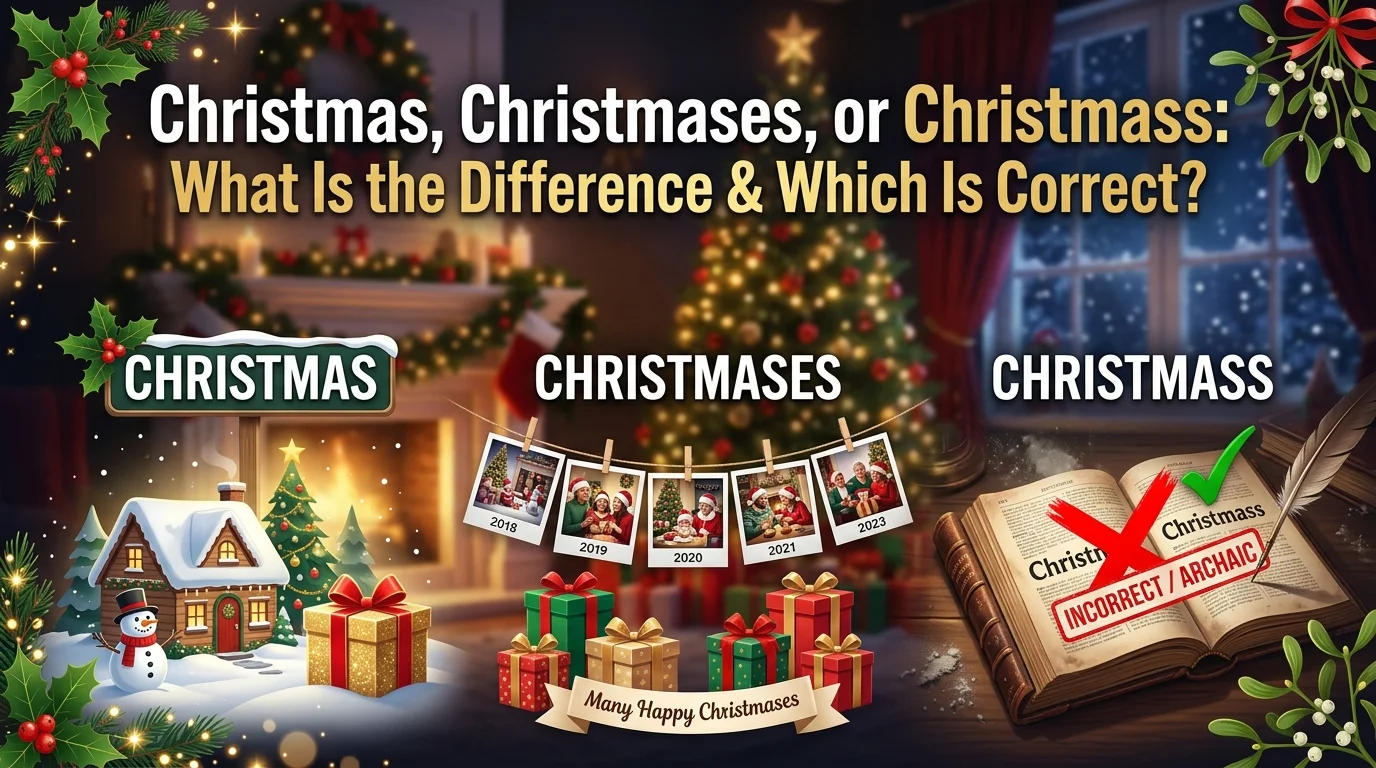
Many English learners and writers get confused when they see Christmas, Christmases, and Christmass. While these words look very similar, they have different meanings and levels of correctness. Understanding the distinction is important for proper grammar, spelling, and communication. This guide explains each term in simple language and helps you choose the correct word with confidence.
Comparison Overview
The words Christmas, Christmases, and Christmass are related to the holiday celebrated on December 25. However, they are not interchangeable in all situations.
- Christmas is the standard and correct singular form.
- Christmases is the correct plural form when referring to multiple Christmas celebrations or years.
- Christmass is generally considered a misspelling of Christmas and is not accepted in standard English.
Understanding these differences helps improve both writing accuracy and grammar skills.
Definition of Christmas
Christmas is a noun that refers to the Christian holiday celebrating the birth of Jesus Christ. It is also commonly associated with gift-giving, family gatherings, decorations, and festive traditions.
Meaning
- A holiday celebrated on December 25.
- A festive season associated with celebrations and traditions.
Example
- We celebrate Christmas every year with our family.
Definition of Christmases
Christmases is the plural form of Christmas. It is used when talking about more than one Christmas celebration, multiple years of Christmas memories, or several Christmas seasons.
Meaning
- More than one Christmas.
- Multiple Christmas celebrations or occasions.
Example
- We spent many wonderful Christmases at our grandparents’ house.
Definition of Christmass
Christmass is generally considered an incorrect spelling of Christmas. It is not recognized as a standard English word in modern dictionaries.
Meaning
- Misspelling of Christmas.
- Not recommended in formal or informal writing.
Example
- Incorrect: Merry Christmass to everyone!
- Correct: Merry Christmas to everyone!
Main Differences Between Christmas, Christmases, and Christmass
| Feature | Christmas | Christmases | Christmass |
| Part of Speech | Noun | Plural Noun | Misspelling |
| Meaning | One Christmas holiday | Multiple Christmas holidays | Incorrect form |
| Grammar Status | Correct | Correct | Incorrect |
| Common Usage | Very common | Less common | Not accepted |
| Dictionary Recognition | Yes | Yes | No |
| Example | Christmas is tomorrow. | We remember those Christmases fondly. | Incorrect spelling. |
Common Contexts Where These Terms Appear
| Context | Correct Term |
| Holiday greeting | Christmas |
| Talking about one holiday season | Christmas |
| Talking about many holiday seasons | Christmases |
| Formal writing | Christmas / Christmases |
| Academic writing | Christmas / Christmases |
| Standard English | Christmas / Christmases |
| Any professional communication | Never use Christmass |
Grammar Guide
How Each Term Is Used in Sentences
Christmas
- Christmas is my favorite holiday.
- We celebrate Christmas in December.
- Christmas brings families together.
Christmases
- Those Christmases were unforgettable.
- We enjoyed many Christmases abroad.
- Different Christmases create different memories.
Christmass
- Christmass is incorrect.
- Avoid using Christmass in writing.
- Replace Christmass with Christmas.
Common Mistakes Learners Make
- Adding an extra “s” and writing Christmass.
- Using Christmases when only one Christmas is being discussed.
- Assuming Christmass is an alternative spelling.
- Using the plural form unnecessarily.
- Misspelling holiday greetings.
Simple Rules to Remember
- One holiday = Christmas
- More than one holiday = Christmases
- Extra “s” at the end of Christmas = incorrect
Quick Tips for Writing and Speaking
- Use Christmas for most situations.
- Use Christmases only when discussing multiple years or celebrations.
- Spell-check holiday greetings before sending them.
- Never use Christmass in professional writing.
- Remember that Christmas already ends with the letters “s”.
When to Use Each One
Use Christmas When
- Referring to the holiday itself.
- Writing greetings.
- Discussing traditions.
- Talking about a single year’s celebration.
- Mentioning the Christmas season.
Use Christmases When
- Referring to several Christmas celebrations.
- Comparing holiday seasons across years.
- Sharing memories from multiple Christmases.
- Discussing traditions over time.
- Talking about historical Christmas celebrations.
Use Christmass When
- Never in standard English.
- Only when discussing spelling mistakes or language errors.
When NOT to Use Each One
Do Not Use Christmas
- When discussing multiple Christmas celebrations.
Incorrect:
- We enjoyed many Christmas at the lake.
Correct:
- We enjoyed many Christmases at the lake.
Do Not Use Christmases
- When referring to a single holiday.
Incorrect:
- Christmases is next week.
Correct:
- Christmas is next week.
Do Not Use Christmass
Incorrect:
- Merry Christmass!
Correct:
- Merry Christmas!
Which One to Use (Decision Guide)
Ask yourself these questions:
Are you talking about one holiday?
Use Christmas.
Example:
- Christmas is approaching quickly.
Are you talking about several holiday seasons?
Use Christmases.
Example:
- We remember those Christmases fondly.
Are you writing Christmass?
Stop and correct it to Christmas.
Example:
- Merry Christmas!
Real-World Practical Examples
Christmas Examples
- Our family gathers every Christmas for dinner.
- Christmas decorations filled the office.
- The school closes during Christmas break.
- Christmas shopping begins early each year.
- Christmas traditions vary around the world.
Christmases Examples
- We spent several Christmases in Canada.
- Those Christmases created lifelong memories.
- Different Christmases brought different experiences.
- The book describes Christmases from the author’s childhood.
- Their family celebrated Christmases in many countries.
Christmass Examples
- Merry Christmass! (Incorrect)
- The student accidentally wrote Christmass. (Incorrect spelling)
- Christmass appeared in the draft. (Spelling error)
- The greeting card misspelled Christmas as Christmass.
- Spell-check corrected Christmass automatically.
Self-Assessment (Fill in the Blanks)
- We celebrate ______ every December.
- The correct word for the holiday is ______.
- We remember many wonderful ______ from childhood.
- Merry ______ to all our friends.
- Those ______ were filled with happiness.
- The spelling ______ is incorrect.
- My favorite holiday is ______.
- Several ______ were spent overseas.
- She decorated the house for ______.
- The greeting card should say Merry ______.
- We enjoyed many family ______ together.
- ______ is celebrated on December 25.
- The teacher corrected ______ in the essay.
- Those ______ remain special memories.
- Never write ______ in formal documents.
- The company party was held before ______.
- Our grandparents hosted many ______.
- The correct holiday name is ______.
- We compare different ______ throughout our lives.
- The spelling ______ should be avoided because it is incorrect.
Answers
- Christmas
- Christmas
- Christmases
- Christmas
- Christmases
- Christmass
- Christmas
- Christmases
- Christmas
- Christmas
- Christmases
- Christmas
- Christmass
- Christmases
- Christmass
- Christmas
- Christmases
- Christmas
- Christmases
- Christmass
Final Verdict
Christmas is the standard and correct word for the holiday celebrated on December 25. Christmases is the proper plural form used when referring to multiple Christmas celebrations, seasons, or years. Christmass is simply a spelling mistake and should be avoided in all forms of writing. If you are talking about one holiday, choose Christmas. If you are discussing several holiday seasons, choose Christmases. Whenever you see Christmass, correct it to Christmas to ensure accurate and professional English usage.
Conclusion About Christmas, Christmases, or Christmass
Understanding the difference between Christmas, Christmases, and Christmass can help you write and speak English more accurately. In most situations, Christmas is the correct word because it refers to the well-known holiday celebrated each year. When talking about multiple holiday seasons, memories, or celebrations across different years, Christmases is the proper plural form. On the other hand, Christmass is considered a misspelling and should be avoided in both formal and informal writing.
Remembering this simple distinction can prevent common grammar and spelling mistakes. Whether you are writing holiday greetings, sharing family memories, creating academic content, or communicating professionally, choosing the correct term improves clarity and credibility. By using Christmas for a single celebration and Christmases for multiple celebrations, you can confidently express your ideas and ensure your writing follows standard English conventions.
FAQs
What does Christmas mean?
Christmas is a holiday celebrated on December twenty-fifth to honor the birth of Jesus Christ. It is also associated with family gatherings, gift exchanges, festive decorations, and cultural traditions observed in many parts of the world.
Is Christmases a real word?
Yes, Christmases is a real and grammatically correct English word. It is the plural form of Christmas and is used when referring to multiple Christmas celebrations, holiday seasons, or memories from different years.
Is Christmass correct English?
No, Christmass is not considered correct standard English. It is generally treated as a spelling mistake of Christmas and should be corrected whenever it appears in writing or printed materials.
When should I use Christmases?
You should use Christmases when discussing more than one Christmas celebration or season. For example, if you are talking about holiday experiences from several years, Christmases is the appropriate choice.
Why do people write Christmass?
People often write Christmass because Christmas already ends with the letter “s,” which can create confusion. However, standard English spelling does not include the extra “s” at the end of the word.
Can I say Merry Christmases?
In most situations, people say “Merry Christmas” because they are referring to the current holiday. “Merry Christmases” is uncommon and usually only appears when discussing multiple Christmas celebrations collectively.
Is Christmas a noun?
Yes, Christmas is a noun. It names a specific holiday and can function as a proper noun when referring to the annual celebration observed on December twenty-fifth.
Are Christmas and Christmases interchangeable?
No, they are not interchangeable. Christmas refers to one holiday, while Christmases refers to multiple holiday seasons or celebrations. Using the correct form depends on whether the meaning is singular or plural.
How can I remember the difference easily?
A simple rule is to use Christmas for one holiday and Christmases for more than one. If you see Christmass, remember that it is a misspelling and should be replaced with Christmas.
Which form should I use in professional writing?
Professional writing should use Christmas when referring to a single holiday and Christmases when discussing multiple celebrations. Avoid using Christmass because it is not recognized as a correct spelling in standard English.