
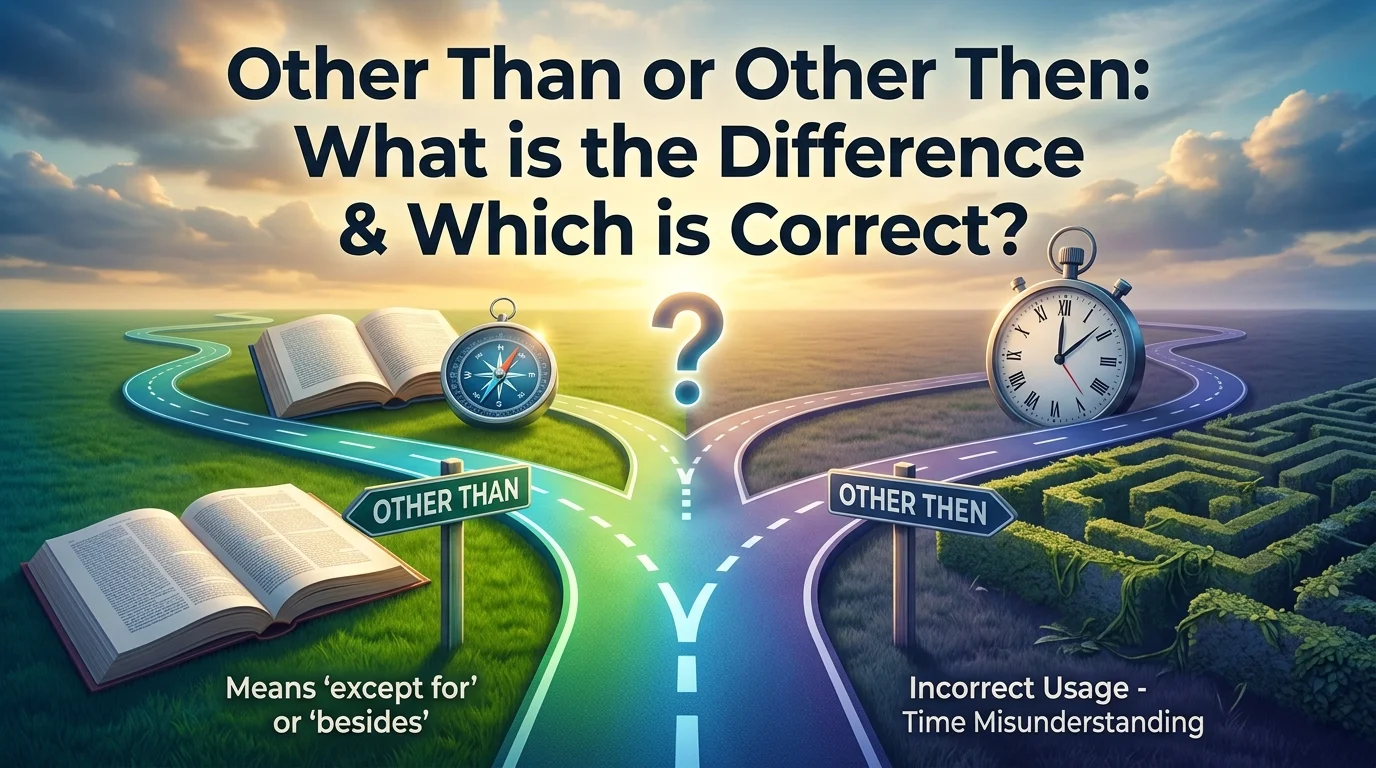
Many English learners confuse other than and other then because they look and sound similar. However, only one of these expressions is considered correct in standard English. Understanding the difference helps improve grammar, writing accuracy, and communication skills. This guide explains their meanings, usage, grammar rules, examples, and common mistakes in a simple and practical way.
Comparison Overview
The comparison between other than and other then is actually a comparison between a correct English phrase and a common spelling mistake.
Other than is a proper English expression used to mean except for, apart from, or besides.
Other then is generally considered incorrect because the word then relates to time, sequence, or consequence rather than exclusion. In most situations where people write other then, they actually mean other than.
| Feature | Other Than | Other Then |
| Correct English phrase | Yes | No (usually incorrect) |
| Meaning | Except for, apart from | Refers to time if used separately |
| Common in writing | Yes | No |
| Accepted in formal English | Yes | No |
| Grammar status | Correct phrase | Common error |
Definition of Other Than
Other than is a phrase used to show exclusion, exception, or difference.
It often means:
- Except for
- Apart from
- Besides
- Different from
Examples:
- Everyone attended the meeting other than John.
- I don’t need anything other than water.
- The report contains no errors other than a small typo.
The phrase helps identify something that is excluded from a group or statement.
Definition of Other Then
Other then is generally not a standard English phrase.
The word then means:
- At that time
- Next
- Afterward
- In that case
Examples of then alone:
- We ate dinner and then watched a movie.
- Finish your work, then leave.
When people write other then, it is usually a spelling mistake and they actually intend to write other than.
Main Differences Between Other Than and Other Then
| Aspect | Other Than | Other Then |
| Meaning | Exception or exclusion | Time or sequence (through “then”) |
| Grammar | Correct phrase | Usually incorrect phrase |
| Function | Shows something excluded | Indicates what happens next |
| Usage | Common and accepted | Usually an error |
| Formal Writing | Accepted | Not accepted |
The biggest difference is that than and then have completely different grammatical purposes.
- Than is used in comparisons and exclusions.
- Then is used for time and sequence.
Because other than expresses exclusion, the correct word is than, not then.
Why People Confuse Other Than and Other Then
Several factors cause confusion:
- Similar pronunciation
- Similar spelling
- Fast typing errors
- Lack of familiarity with than vs then rules
Many learners memorize the phrase incorrectly because they focus on sound rather than meaning.
Understanding Than vs Then
Than
Used for:
- Comparisons
- Exceptions
- Differences
Examples:
- Taller than
- Better than
- Other than
Then
Used for:
- Time
- Order
- Sequence
Examples:
- First this, then that.
- Back then
- Since then
Remembering this distinction automatically helps you choose the correct phrase.
Grammar Guide
How each term is used in sentences
Other Than
Pattern:
- Other than + noun
- Other than + pronoun
- Other than + phrase
Examples:
- Other than Sarah, everyone agreed.
- I want nothing other than peace.
- Other than being tired, he felt fine.
Other Then
This phrase is generally not used in standard English.
Incorrect examples:
- Other then Sarah, everyone agreed.
- I need nothing other then coffee.
Correct versions:
- Other than Sarah, everyone agreed.
- I need nothing other than coffee.
Common mistakes learners make
- Writing then instead of than.
- Confusing exclusion with sequence.
- Assuming both spellings are acceptable.
- Using spell-check without checking context.
- Mixing comparison and time-related words.
Simple rules to remember
- If you mean except for, use other than.
- If you are discussing time, use then.
- The phrase other than is correct.
- The phrase other then is usually wrong.
Quick tips for writing and speaking
- Think of other than as meaning except for.
- Replace the phrase with apart from to test correctness.
- If the sentence still makes sense, use other than.
- Remember that then relates to time.
When to Use Each One
Use Other Than When
- Excluding someone or something
- Showing exceptions
- Comparing alternatives
- Identifying differences
Examples:
- Other than the weather, the trip was perfect.
- I speak no language other than English.
- Other than a few delays, everything went smoothly.
Use Other Then When
Generally, you should not use this phrase.
Instead, use:
- Other than
- Then
- And then
depending on the intended meaning.
When NOT to Use Each One
Do Not Use Other Than
- When discussing time sequences
- When describing chronological order
Incorrect:
- We arrived other than left.
Correct:
- We arrived and then left.
Do Not Use Other Then
- For exceptions
- For exclusions
- In formal writing
- In academic writing
Incorrect:
- Other then James, nobody came.
Correct:
- Other than James, nobody came.
Which One to Use (Decision Guide)
Ask yourself one question:
Do I mean “except for” or “apart from”?
If yes, use other than.
Examples:
- Other than math, I enjoy all subjects.
- Other than traffic, the drive was easy.
If you are talking about time, sequence, or what happens next, use then by itself rather than the phrase other then.
Examples:
- We finished lunch and then returned to work.
- Complete the form, then submit it.
For almost every comparison between other than and other then, the correct choice is other than.
Real-World Practical Examples
Other Than Examples
Education
- Other than science, she enjoys every subject.
- No students other than Ali passed the test.
- The assignment had no issues other than formatting.
- Other than grammar, the essay was excellent.
- I studied nothing other than mathematics today.
Daily Life
- Other than milk, we need no groceries.
- Everyone other than Dad arrived on time.
- Other than the rain, it was a great day.
- I drink nothing other than water.
- Other than traffic, the trip was pleasant.
Business
- Other than budget concerns, the project is ready.
- No departments other than sales attended.
- Other than a minor delay, production succeeded.
- We received no complaints other than shipping issues.
- Other than costs, the proposal was approved.
Technology
- Other than battery life, the phone performs well.
- No software other than the approved program may be installed.
- Other than security updates, no changes were made.
- The system showed no errors other than one warning.
- Other than storage limitations, the device is reliable.
Writing and Communication
- Other than punctuation mistakes, the article was strong.
- No edits were needed other than spelling corrections.
- Other than clarity, the message was effective.
- Other than one paragraph, everything flowed well.
- I changed nothing other than the headline.
Other Then Examples
Because other then is generally incorrect, the following examples demonstrate common errors.
- Other then John, everyone attended. ❌
- I need nothing other then coffee. ❌
- Other then grammar, the essay was fine. ❌
- Other then a delay, the project succeeded. ❌
- Other then this issue, everything works. ❌
Correct versions:
- Other than John, everyone attended. ✔
- I need nothing other than coffee. ✔
- Other than grammar, the essay was fine. ✔
- Other than a delay, the project succeeded. ✔
- Other than this issue, everything works. ✔
Self-Assessment (Fill in the Blanks)
- I will use ______ when referring to an exception.
- The correct word is ______ because it means except for.
- Everyone attended ______ Sarah.
- I need nothing ______ water.
- The report was perfect ______ one typo.
- The correct word is ______ because exclusion is intended.
- We finished lunch and ______ returned home.
- The correct word is ______ because the sentence refers to time.
- No language ______ English was spoken.
- Other ______ the weather, the trip was excellent.
- The correct word is ______ because it introduces an exception.
- Back ______, life was simpler.
- Complete your homework and ______ relax.
- Nobody ______ James understood the lesson.
- The correct word is ______ because comparison or exclusion is involved.
- Since ______, the company has grown.
- I want nothing other ______ peace.
- The correct word is ______ because it is the standard phrase.
- Everyone ______ the manager signed the form.
- Other ______ a few corrections, the document is complete.
Answers
- other than
- other than
- other than
- other than
- other than
- other than
- then
- then
- other than
- than
- other than
- then
- then
- other than
- than
- then
- than
- other than
- other than
- than
Final Verdict
When comparing other than and other then, the correct choice in standard English is almost always other than. The phrase other than means except for, apart from, or besides, making it useful for expressing exclusions and exceptions. In contrast, other then is generally a spelling mistake caused by confusion between than and then. Remember that than is used for comparisons and exclusions, while then relates to time and sequence. If your sentence can be replaced with except for or apart from, choose other than. Following this simple rule will help you write more accurately, avoid common grammar errors, and communicate with greater confidence in both formal and everyday English.
Conclusion About Other Than or Other Then
Understanding the difference between other than and other then is essential for clear and accurate English communication. While these expressions may look similar, they serve very different purposes. Other than is the correct phrase used to mean except for, apart from, or besides, making it a common and useful part of everyday writing and speech. In contrast, other then is generally considered a grammatical error that results from confusing than with then. Since then relates to time or sequence, it does not work in phrases that express exclusion or exceptions. By remembering that other than is the standard and accepted form, you can avoid one of the most common English mistakes. Whether you’re writing essays, emails, business documents, or casual messages, choosing the correct phrase will improve your grammar, strengthen your credibility, and help your message sound more natural and professional.
FAQs
Is “other than” grammatically correct?
Yes, other than is a grammatically correct English phrase. It is commonly used to mean except for, apart from, or besides. It appears in both formal and informal writing and is accepted in academic, professional, and everyday communication.
Is “other then” ever correct?
In most situations, other then is incorrect. People usually write it by mistake when they mean other than. Since then relates to time or sequence, it does not properly express exclusion or exception in standard English grammar.
What does “other than” mean?
Other than means except for, apart from, or excluding. It is used when you want to identify something that is not included in a group, statement, or situation. The phrase is common in both spoken and written English.
Why do people confuse “other than” and “other then”?
People often confuse these phrases because than and then are similar in spelling and pronunciation. However, they have different meanings. Than is used for comparisons and exclusions, while then refers to time, order, or sequence.
Can I use “other than” in formal writing?
Yes, other than is widely accepted in formal writing. It can be used in academic papers, business reports, legal documents, and professional correspondence whenever you need to express an exception or exclusion clearly.
Is “other than” a preposition?
Yes, other than often functions as a prepositional phrase. It introduces a noun, pronoun, or phrase that is excluded from the main statement. In some contexts, it may also act similarly to a conjunction.
What is the easiest way to remember the correct phrase?
A simple trick is to replace other than with except for. If the sentence still makes sense, other than is the correct choice. This quick test helps prevent confusion between than and then.
Can “other than” be used in speech?
Absolutely. Other than is very common in everyday conversation. Native speakers regularly use it when discussing exceptions, preferences, differences, or exclusions in casual and professional settings.
What is the difference between “than” and “then”?
Than is mainly used for comparisons and exclusions, such as better than or other than. Then refers to time, sequence, or what happens next, such as finish your work, then go home.
How can I avoid making this mistake?
Focus on the meaning of the sentence before choosing the word. If you’re talking about an exception, use than. If you’re talking about time or sequence, use then. Careful proofreading can also help catch errors.

Sophia Turner is a grammar-focused writer who covers similes, word-versus-word meanings, and correct English usage. Her content is designed for learners who want quick answers, logical explanations, and practical guidance for improving writing accuracy and style.