
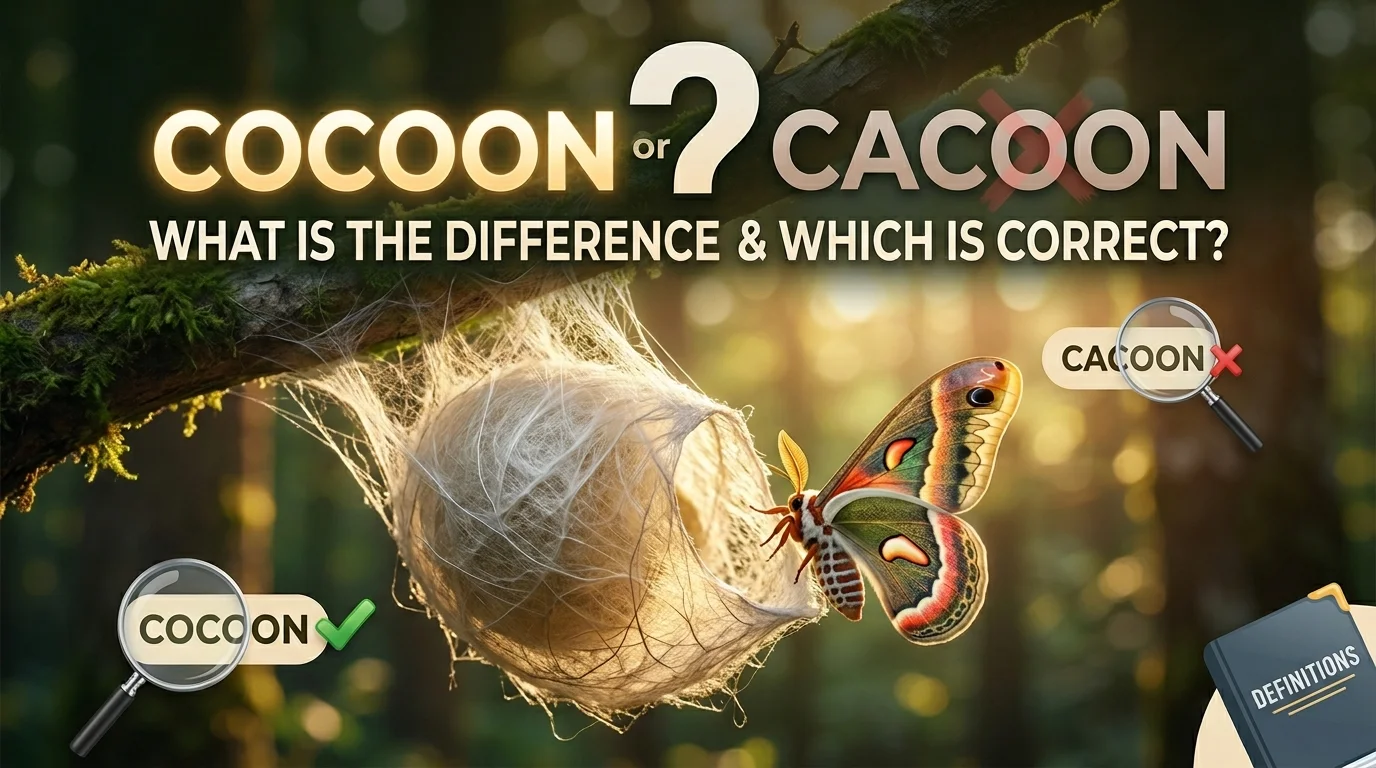
Many English learners and writers get confused between cacoon and cocoon because the words look very similar. However, only one of them is considered the standard English spelling. Understanding the difference helps you avoid spelling mistakes and use the correct word in writing, education, science, and everyday communication.
Comparison Overview
The terms cacoon and cocoon are often compared because they differ by only one letter. While they may appear interchangeable, they are not treated the same in standard English.
| Term | Meaning | Correct English Spelling | Common Usage |
| Cacoon | Misspelling of cocoon | No | Incorrect |
| Cocoon | Protective covering made by insects; a place of safety or isolation | Yes | Correct |
In modern English dictionaries, cocoon is the accepted spelling, while cacoon is generally regarded as a spelling error.
Definition of Cacoon
Cacoon is not recognized as a standard English word in most dictionaries.
People usually write cacoon by mistake when they actually mean cocoon. The confusion occurs because both spellings sound similar when spoken.
Core purpose:
- No accepted meaning in standard English.
- Common spelling mistake.
- Should usually be replaced with cocoon.
Definition of Cocoon
A cocoon is a protective silk covering created by certain insects, especially moths, during a stage of development before becoming adults.
The word is also used figuratively to describe a place, situation, or environment that provides comfort, protection, or isolation.
Core meanings:
- An insect’s protective case.
- A state of shelter or protection.
- An environment that separates someone from outside influences.
Main Differences Between Cacoon and Cocoon
| Feature | Cacoon | Cocoon |
| Dictionary Recognition | No | Yes |
| Correct Spelling | No | Yes |
| Used in Science | No | Yes |
| Used in Everyday English | No | Yes |
| Accepted in Formal Writing | No | Yes |
| Figurative Meaning | No | Yes |
The biggest difference is simple: cocoon is the correct English word, while cacoon is generally a misspelling.
Why the Confusion Happens
Many spelling errors occur because English words do not always match pronunciation perfectly.
Reasons people write cacoon:
- Similar sound.
- Typing mistakes.
- Lack of familiarity with the word.
- Phonetic spelling attempts.
The correct spelling always uses “co” at the beginning:
Cocoon ✓
Cacoon ✗
Cocoon in Literal and Figurative Meanings
Literal Meaning
A cocoon is a protective shell made by insects.
Example:
- The moth emerged from its cocoon.
Figurative Meaning
A cocoon can describe emotional or physical protection.
Example:
- She stayed in a cocoon of comfort during the winter.
Grammar Guide
How Each Term Is Used in Sentences
Cacoon
Since it is considered incorrect, it should generally not be used in sentences.
Incorrect:
- The butterfly came out of its cacoon.
Correct:
- The butterfly came out of its cocoon.
Cocoon
Used as a noun.
Examples:
- The insect built a cocoon.
- The child felt safe in a cocoon of blankets.
- The company created a cocoon of support for employees.
Common Mistakes Learners Make
- Writing cacoon instead of cocoon.
- Assuming both spellings are acceptable.
- Using the wrong spelling in academic work.
- Using cacoon in scientific contexts.
- Forgetting that dictionaries recognize only cocoon.
Simple Rules to Remember
- Think of the word beginning with co.
- Remember that dictionaries list cocoon, not cacoon.
- If referring to insects or protection, use cocoon.
- Avoid cacoon in formal writing.
- Spell-check usually flags cacoon as incorrect.
Quick Tips for Writing and Speaking
- Always write cocoon.
- Proofread for spelling errors.
- Use cocoon in both literal and figurative contexts.
- Remember that cacoon is generally a typo.
- Learn the correct spelling through repetition.
When to Use Each One
Use Cocoon When
- Talking about insect development.
- Writing science assignments.
- Describing protection or shelter.
- Using figurative language.
- Writing professionally.
Examples:
- The caterpillar formed a cocoon.
- The cabin became a cocoon of warmth.
Use Cacoon When
Generally, you should not use it.
The only time you may encounter it is:
- As a typo.
- In spelling discussions.
- When correcting writing mistakes.
When NOT to Use Each One
Do Not Use Cocoon Incorrectly
Avoid using cocoon:
- As a verb without proper context.
- When another word fits better.
- When discussing unrelated concepts.
Do Not Use Cacoon
Avoid cacoon in:
- Academic papers.
- Business documents.
- School assignments.
- Professional emails.
- Scientific writing.
Which One to Use (Decision Guide)
Ask yourself:
Are you referring to an insect covering or a protective environment?
If yes, use:
Cocoon
Are you wondering whether “cacoon” is an alternative spelling?
If yes:
No. Use cocoon instead.
Decision summary:
| Situation | Correct Choice |
| Insect protection case | Cocoon |
| Figurative protection | Cocoon |
| School writing | Cocoon |
| Scientific article | Cocoon |
| Formal communication | Cocoon |
| Alternative spelling | Not Cacoon |
Real-World Practical Examples
Cacoon Examples
These examples show incorrect usage that should be corrected.
- The caterpillar stayed inside its cacoon. → Cocoon
- Scientists studied the cacoon. → Cocoon
- The moth left the cacoon. → Cocoon
- She wrapped herself in a cacoon of blankets. → Cocoon
- The article misspelled cocoon as cacoon.
Cocoon Examples
- The caterpillar spun a cocoon before transforming.
- The moth emerged from the cocoon in spring.
- The baby slept in a cocoon of soft blankets.
- The retreat provided a cocoon of peace and relaxation.
- The company created a cocoon of support for new employees.
Self-Assessment (Fill in the Blanks)
- The caterpillar built a ______ before becoming a moth.
- The correct dictionary spelling is ______.
- The scientist examined the insect’s ______.
- The word ______ is usually considered a misspelling.
- She created a ______ of comfort with pillows and blankets.
- The moth emerged from its ______.
- In formal writing, use ______ instead of cacoon.
- The protective silk case is called a ______.
- The spelling ______ should generally be avoided.
- The teacher corrected the word to ______.
- The butterfly developed inside a ______.
- The accepted English word is ______.
- The child felt safe in a ______ of warmth.
- Most dictionaries do not recognize ______.
- The insect remained inside its ______.
- The correct spelling starts with the letters ______.
- The article accidentally used ______ instead of cocoon.
- A moth may spend time inside a ______.
- The figurative expression uses the word ______.
- Writers should choose ______ in professional documents.
Answers
- Cocoon
- Cocoon
- Cocoon
- Cacoon
- Cocoon
- Cocoon
- Cocoon
- Cocoon
- Cacoon
- Cocoon
- Cocoon
- Cocoon
- Cocoon
- Cacoon
- Cocoon
- Co
- Cacoon
- Cocoon
- Cocoon
- Cocoon
Final Verdict
When comparing cacoon and cocoon, the answer is straightforward. Cocoon is the correct and universally accepted English spelling. It refers to the protective covering created by certain insects and is also widely used as a metaphor for safety, comfort, or isolation. Cacoon, on the other hand, is generally considered a misspelling and should not be used in formal, academic, professional, or everyday writing unless you are specifically discussing spelling mistakes. If you are unsure which version to choose, remember that dictionaries, educators, scientists, and professional writers all use cocoon. By consistently choosing cocoon, you can communicate clearly, avoid common spelling errors, and ensure your writing follows standard English conventions.
Conclusion About Cacoon or Cocoon
Understanding the difference between cacoon and cocoon is simpler than many people think. While both spellings may appear similar, only cocoon is recognized as the correct English word. It refers to the protective covering created by certain insects and is also commonly used as a metaphor for comfort, safety, or isolation. In contrast, cacoon is generally considered a spelling mistake and should be avoided in formal, academic, and professional writing.
Whether you are writing an essay, preparing a report, learning English, or simply improving your vocabulary, choosing the correct spelling helps make your communication clearer and more professional. Remember that dictionaries, teachers, editors, and language experts consistently use cocoon. If you ever find yourself unsure, think of the insect’s protective shell and choose cocoon with confidence. Using the correct form will strengthen your writing and help you avoid one of the most common spelling confusions related to this word.
FAQs
Is cocoon the correct spelling?
Yes, cocoon is the correct and standard English spelling. It appears in dictionaries and is used in scientific, educational, and everyday writing. If you are referring to an insect’s protective covering or a figurative sense of protection, cocoon is the appropriate word to use.
Is cacoon a real English word?
Generally, cacoon is not recognized as a standard English word. Most dictionaries treat it as a misspelling of cocoon. When writing formally or informally, it is best to use cocoon to ensure accuracy and clarity.
What does cocoon mean in biology?
In biology, a cocoon is a protective casing spun by certain insects, especially moths, during a stage of development. The insect remains inside the cocoon until it is ready to emerge in a more mature form.
Can cocoon be used figuratively?
Yes, cocoon is often used figuratively to describe a place or situation that provides comfort, safety, privacy, or protection. For example, someone may describe their home as a cocoon during cold weather or stressful times.
Why do people spell cocoon as cacoon?
People often write cacoon because the pronunciation can lead to spelling confusion. It is a common phonetic mistake where writers guess the spelling based on sound rather than the standard dictionary form.
Is cocoon a noun or a verb?
Cocoon is primarily used as a noun referring to an insect’s protective covering. However, it can occasionally function as a verb, meaning to wrap, protect, or isolate someone in a comfortable or sheltered environment.
Should I use cacoon in academic writing?
No, you should avoid using cacoon in academic writing. Teachers, editors, and educational institutions recognize cocoon as the correct spelling. Using the wrong form may be marked as a spelling error.
How can I remember the correct spelling of cocoon?
A simple way to remember it is to focus on the beginning letters co in cocoon. Reading and writing the word regularly can also help reinforce the correct spelling and reduce future mistakes.
Is cocoon used outside science?
Yes, cocoon is widely used outside scientific contexts. Writers, journalists, and speakers often use it to describe feelings of comfort, security, protection, or emotional isolation in everyday situations.
Which word should I use: cacoon or cocoon?
You should always use cocoon unless you are specifically discussing a spelling mistake. Cocoon is the accepted English word, while cacoon is generally considered an incorrect spelling that should be corrected.