
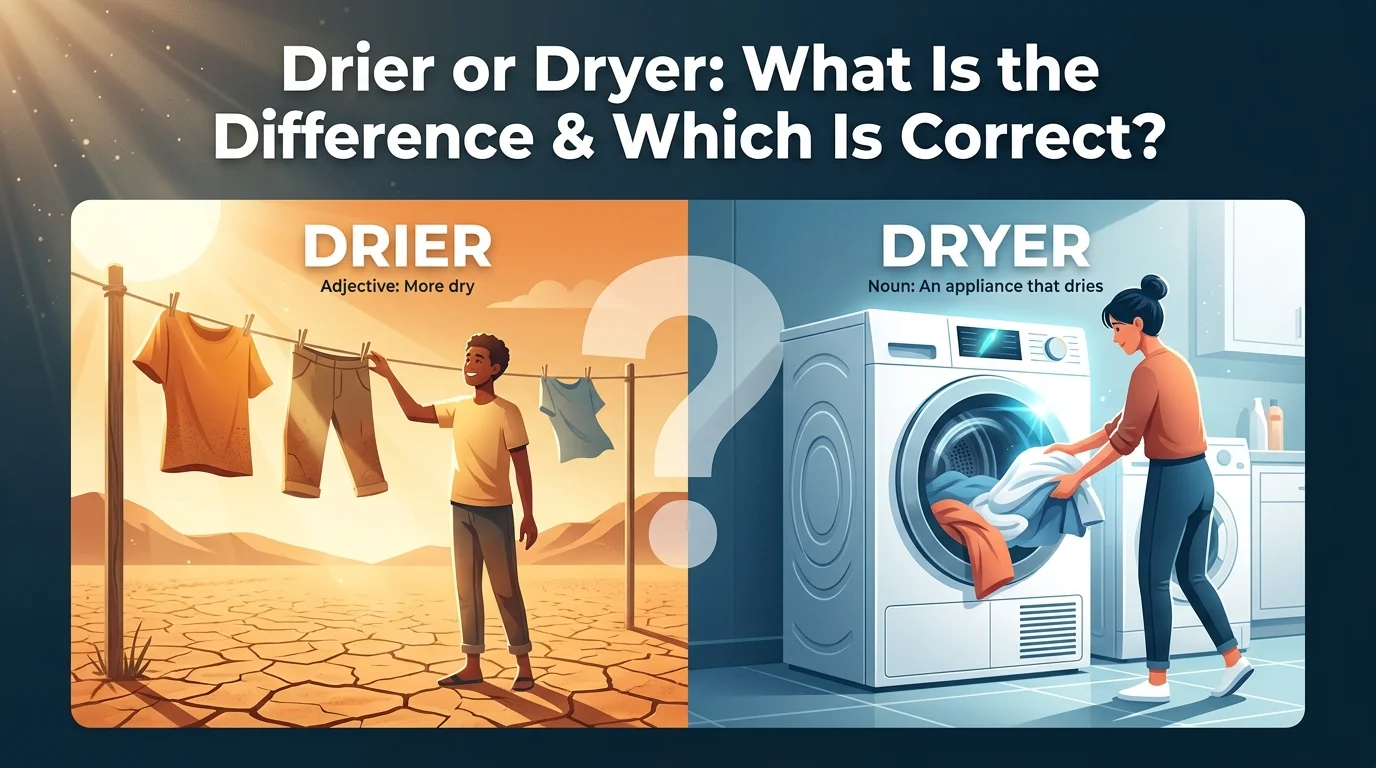
When writing or speaking English, many people get confused between drier and dryer because they sound exactly the same. While both words are related to dryness, they have different meanings and grammatical functions. Understanding the difference can help you avoid common mistakes and use the correct word confidently in everyday writing and conversation.
Comparison Overview
The words drier and dryer are closely related but serve different purposes.
- Drier is usually the comparative form of the adjective dry.
- Dryer is primarily a noun that refers to a machine or device used for drying something.
Because they are pronounced the same way, writers often accidentally choose the wrong spelling. Knowing their meanings and grammatical roles makes the distinction much easier.
| Word | Part of Speech | Meaning |
| Drier | Adjective (comparative) | More dry; less wet |
| Dryer | Noun | A machine or device that dries things |
Definition of Drier
Drier is the comparative form of the adjective dry. It is used when comparing two things and indicating that one has less moisture than the other.
Examples:
- This towel is drier than the other one.
- The climate here is drier than in the coastal region.
- My clothes became drier after hanging in the sun.
The word focuses on the condition or state of having less moisture.
Definition of Dryer
Dryer is a noun that refers to a machine, tool, or appliance used to remove moisture.
Examples:
- Put the clothes in the dryer.
- She used a hair dryer before leaving.
- The grain dryer helped farmers preserve crops.
The word focuses on an object that performs the drying action.
Main Differences Between Drier and Dryer
Although the words sound identical, they have distinct meanings and uses.
| Feature | Drier | Dryer |
| Part of Speech | Adjective | Noun |
| Function | Describes a condition | Names a device |
| Meaning | More dry | Machine that dries |
| Example | The air is drier today. | The dryer is running. |
| Comparison? | Yes | No |
Key difference:
- Use drier when comparing moisture levels.
- Use dryer when talking about equipment or appliances.
Pronunciation and Spelling Differences
One reason learners confuse these words is that they are pronounced exactly the same.
| Word | Pronunciation |
| Drier | /DRY-er/ |
| Dryer | /DRY-er/ |
Since pronunciation does not help distinguish them, correct spelling depends entirely on context.
Common Contexts Where They Appear
Drier Contexts
- Weather reports
- Climate discussions
- Fabric conditions
- Scientific observations
- Comparisons involving moisture
Dryer Contexts
- Laundry rooms
- Beauty salons
- Home appliances
- Industrial equipment
- Agricultural machinery
Grammar Guide
How Each Term Is Used in Sentences
Drier
Pattern:
Subject + be verb + drier + than + comparison
Examples:
- Today is drier than yesterday.
- This soil is drier than that soil.
- The desert is much drier than the forest.
Dryer
Pattern:
Subject + verb + dryer
Examples:
- The dryer stopped working.
- We bought a new dryer.
- The hair dryer is on the shelf.
Common Mistakes Learners Make
- Writing “dryer” when comparing moisture.
- Incorrect: This towel is dryer than that one.
- Correct: This towel is drier than that one.
- Writing “drier” when referring to a machine.
- Incorrect: Put the clothes in the drier.
- Correct: Put the clothes in the dryer.
- Assuming both spellings are interchangeable.
- They are not interchangeable because they have different grammatical functions.
Simple Rules to Remember
- If it means more dry, choose drier.
- If it means a machine, choose dryer.
- Comparison equals drier.
- Appliance equals dryer.
Quick Tips for Writing and Speaking
- Look for comparison words such as than.
- If a machine is involved, use dryer.
- Think of laundry appliances when you see dryer.
- Think of moisture comparisons when you see drier.
When to Use Each One
Use Drier When
- Comparing weather conditions
- Comparing moisture levels
- Describing fabrics or surfaces
- Discussing climate
- Comparing environmental conditions
Examples:
- Arizona is drier than Florida.
- The paint became drier overnight.
Use Dryer When
- Talking about household appliances
- Referring to hair-styling tools
- Discussing industrial drying equipment
- Mentioning machines that remove moisture
Examples:
- The dryer needs repair.
- My hair dryer is broken.
When NOT to Use Each One
Do Not Use Drier
- For machines or appliances
- For equipment that dries objects
Incorrect:
- I bought a new drier.
Correct:
- I bought a new dryer.
Do Not Use Dryer
- When comparing levels of dryness
- When describing moisture conditions
Incorrect:
- The weather is dryer today.
Correct:
- The weather is drier today.
Which One to Use (Decision Guide)
Ask yourself this question:
Are you comparing how dry something is?
- Yes → Use drier.
- No → Continue.
Are you talking about a machine or device that dries things?
- Yes → Use dryer.
- No → Recheck the sentence context.
Quick Decision Chart:
| Situation | Correct Word |
| Comparing weather | Drier |
| Comparing fabrics | Drier |
| Comparing soil moisture | Drier |
| Laundry appliance | Dryer |
| Hair appliance | Dryer |
| Industrial drying machine | Dryer |
Real-World Practical Examples
Drier Examples
- The desert became drier after months without rain.
- This towel feels drier than the one on the rack.
- Scientists observed drier soil conditions this year.
- The climate is becoming drier in some regions.
- The paint looked drier after several hours.
Dryer Examples
- The clothes dryer finished its cycle.
- She packed a travel hair dryer.
- The hotel room included a hair dryer.
- The factory installed a new grain dryer.
- The technician repaired the dryer this morning.
Self-Assessment (Fill in the Blanks)
- The weather is ______ than it was last week.
- Put the wet clothes into the ______.
- This towel is ______ than that one.
- My hair ______ stopped working.
- The desert is much ______ than the rainforest.
- We bought a new clothes ______.
- The soil became ______ after the heatwave.
- The ______ needs maintenance.
- Today’s air feels ______ than yesterday’s.
- She used a hair ______ before the meeting.
- The paint looks ______ now.
- The laundry ______ is running.
- This region is ______ than the coast.
- The grain ______ processed the harvest.
- My shirt became ______ in the sunlight.
- The appliance repairman fixed the ______.
- The climate is becoming ______ each year.
- The hotel provided a hair ______.
- The ground is ______ after several sunny days.
- The washing machine and ______ are side by side.
Answers
- Drier
- Dryer
- Drier
- Dryer
- Drier
- Dryer
- Drier
- Dryer
- Drier
- Dryer
- Drier
- Dryer
- Drier
- Dryer
- Drier
- Dryer
- Drier
- Dryer
- Drier
- Dryer
Final Verdict
The difference between drier and dryer is simple once you understand their roles. Drier is the comparative form of dry and is used when comparing levels of moisture or dryness. Dryer, on the other hand, is a noun that refers to a machine or device that removes moisture, such as a clothes dryer or hair dryer. Although both words sound identical, they are not interchangeable. Whenever you are comparing how dry something is, choose drier. Whenever you are referring to equipment designed to dry something, choose dryer. Keeping this distinction in mind will help you write more accurately and avoid one of the most common spelling confusions in English.
Conclusion About Drier or Dryer
Understanding the difference between drier and dryer is essential for clear and accurate English communication. Although these words sound exactly the same, they serve very different purposes. Drier is the comparative form of dry and is used when comparing the level of moisture between two things. Dryer, on the other hand, is a noun that refers to a machine or device designed to remove moisture, such as a clothes dryer or hair dryer.
Many learners confuse these spellings because their pronunciation is identical, but the context usually makes the correct choice easy to identify. If you are describing something as being more dry than another thing, use drier. If you are talking about an appliance or tool, use dryer. By remembering this simple distinction, you can avoid common mistakes and write with greater confidence. Mastering the use of drier or dryer will improve both your grammar and your overall communication skills.
FAQs
What is the difference between drier and dryer?
The main difference is that drier is an adjective used for comparison, meaning more dry, while dryer is a noun that refers to a machine or device used to remove moisture. The correct choice depends on whether you are describing a condition or naming an appliance.
Is drier a real word?
Yes, drier is a correct English word. It is the comparative form of the adjective dry and is used when comparing two things. For example, “This climate is drier than the one near the coast” is grammatically correct.
Is dryer only used for appliances?
In modern English, dryer is primarily used as a noun for machines and devices that dry things, such as clothes dryers and hair dryers. It is generally not used as a comparative adjective when comparing moisture levels.
Why do people confuse drier and dryer?
People often confuse these words because they are pronounced the same way. Since pronunciation does not reveal the spelling, writers must rely on the meaning and context of the sentence to choose the correct word.
Which is correct: drier weather or dryer weather?
Drier weather is correct because weather conditions are being compared. Since the sentence describes a level of dryness rather than a machine, the comparative adjective drier should be used.
Can dryer be used as an adjective?
In standard usage, dryer is mainly a noun. When expressing a comparison of dryness, drier is generally preferred. Using dryer as a comparative adjective is considered uncommon and often incorrect in modern writing.
How can I remember the difference between drier and dryer?
A simple trick is to remember that dryer contains the word often associated with a drying machine. If you are talking about an appliance, choose dryer. If you are comparing moisture levels, choose drier.
Is drier commonly used in weather reports?
Yes, meteorologists and weather reports frequently use drier when comparing atmospheric conditions. For example, they may say that a region will experience drier air or drier conditions during a particular season.
What are some examples of dryer in a sentence?
Examples include: “The dryer finished the laundry cycle,” “She bought a new hair dryer,” and “The technician repaired the dryer.” In each sentence, dryer refers to a machine or device.
Can drier and dryer ever be interchangeable?
No, they generally are not interchangeable. Drier refers to a comparison of dryness, while dryer refers to equipment that removes moisture. Using one in place of the other can change the meaning and create grammatical errors.

Amelia Wright focuses on making figurative language easy to understand. Her writing explains similes, metaphors, and word meanings using relatable examples. She aims to help readers recognize subtle differences in usage and apply them correctly in both academic and casual writing.