
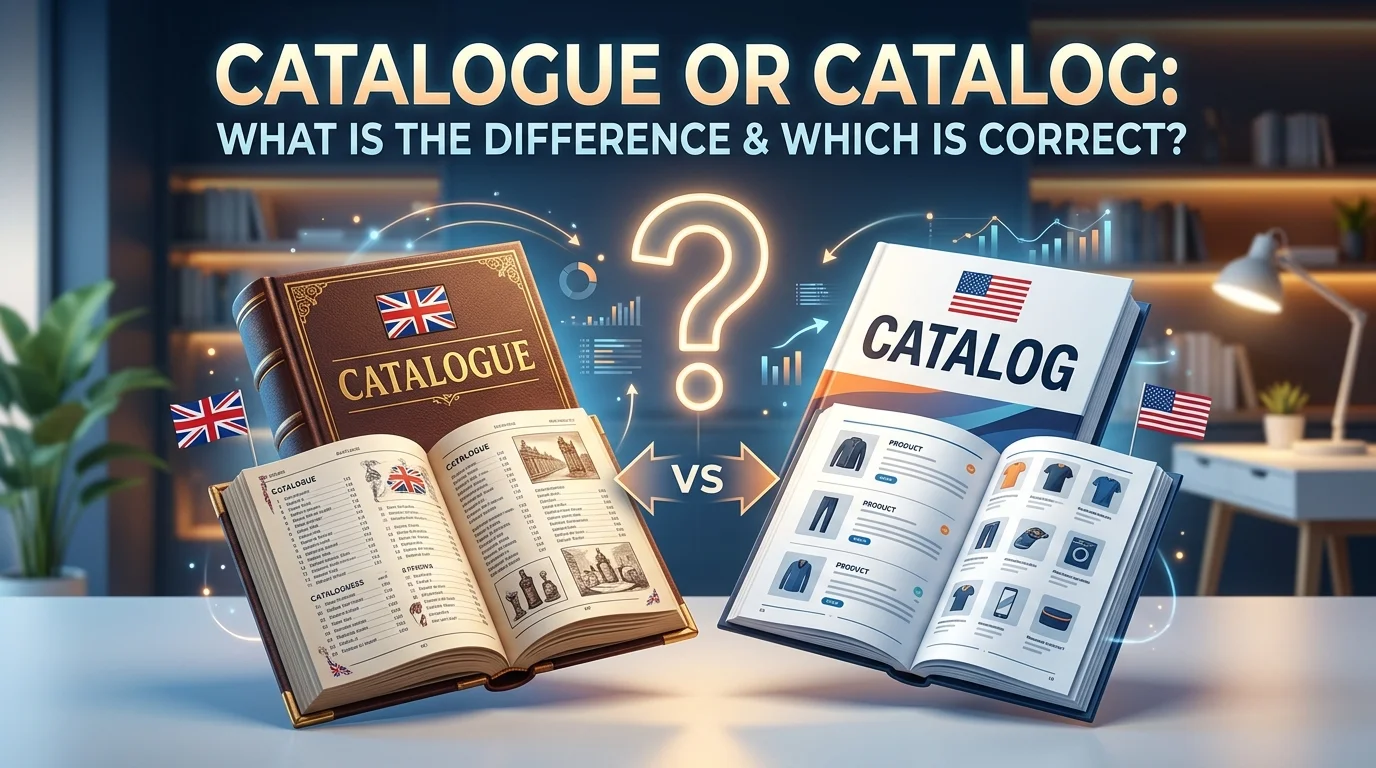
The words “catalogue” and “catalog” often confuse writers because they look and sound almost identical, yet their usage depends largely on regional spelling conventions. Both refer to an organized list of items, but their differences lie in English variations, especially between British and American usage. Understanding this distinction helps improve writing accuracy and clarity in formal, academic, and professional contexts.
Comparison Overview
Catalogue and catalog share the same meaning and function in language. They both describe a systematically arranged list of products, items, services, or information. The main difference is spelling preference: “catalogue” is commonly used in British English, while “catalog” is preferred in American English. Despite this spelling variation, their grammatical roles and meanings remain identical.
Definition of Catalogue
Catalogue is the British English spelling used for a structured list of items, such as books, products, or courses. It can function as both a noun and a verb. As a noun, it refers to a detailed list, while as a verb, it means to organize or record items in a list.
Definition of Catalog
Catalog is the American English spelling of the same word. It also refers to an organized list of items and functions as both a noun and a verb. In everyday usage in the United States, “catalog” is the standard form used in publishing, education, and business.
Main Differences Between Catalogue and Catalog
The key difference lies in spelling preference based on regional English standards. Catalogue is widely used in the UK, Australia, and other Commonwealth countries, while catalog is dominant in the US. Both share identical meanings and grammatical roles, and neither is more correct than the other. The choice depends on your audience and writing style guide.
Comparison Table
| Feature | Catalogue | Catalog |
| Region | British English | American English |
| Usage | UK, Commonwealth countries | United States |
| Meaning | Organized list of items | Organized list of items |
| Grammar | Noun and verb | Noun and verb |
Grammar Guide
Both catalogue and catalog function as nouns and verbs, depending on sentence structure. As nouns, they refer to a collection or listing. As verbs, they describe the action of organizing items systematically.
How each term is used in sentences
Noun usage:
- The museum released a new catalogue of ancient artifacts.
- The store printed a seasonal catalog for customers.
Verb usage:
- The librarian catalogued all new books.
- The company cataloged its entire inventory online.
Common mistakes learners make
A common mistake is mixing British and American spellings within the same document. Another frequent error is assuming they have different meanings when they do not. Some learners also incorrectly add or remove the final “-ue” without consistency.
Simple rules to remember
Use “catalogue” for British English writing and “catalog” for American English writing. Keep the spelling consistent throughout a single document. Remember that both words mean the same thing, only the spelling changes.
Quick tips for writing and speaking
Choose the spelling based on your audience. If writing for international readers, stick to one style guide. In spoken English, both forms are pronounced the same, so context does not change pronunciation.
When to Use Each One
Use “catalogue” when writing for British English audiences, academic papers following UK standards, or Commonwealth publications. Use “catalog” when writing for American English audiences, US-based businesses, or modern digital platforms that follow US conventions.
When NOT to Use Each One
Avoid switching between both spellings in the same document. Do not treat them as different words with different meanings. Also avoid using both forms in technical writing unless referencing regional differences intentionally.
Which One to Use (Decision Guide)
If your audience is in the United States, choose “catalog.” If your audience is in the United Kingdom or follows British English standards, choose “catalogue.” If no specific audience is defined, pick one style and remain consistent throughout your writing.
Real-World Practical Examples
Catalogue Examples
- The university published a catalogue of available courses.
- She browsed the furniture catalogue before buying a sofa.
- The library catalogue helped students find research materials quickly.
- The museum catalogue included detailed descriptions of each exhibit.
- He updated the product catalogue for the new season.
Catalog Examples
- The online store released a digital catalog of electronics.
- She checked the fashion catalog for summer outfits.
- The company catalog listed all available services.
- He cataloged the files into different folders on his computer.
- The bookstore catalog helped customers find new releases.
Self-Assessment (Fill in the Blanks)
- I found the book in the university ______.
- The US company updated its product ______.
- She decided to ______ all the items in the archive.
- The museum released a new ______ for visitors.
- In American English, the correct spelling is ______.
- The librarian will ______ the new arrivals today.
- The fashion ______ was published last week.
- He used the library ______ to locate the reference book.
- The store’s seasonal ______ includes discounts.
- They plan to ______ the entire collection digitally.
- British English prefers the spelling ______.
- The website features a digital ______ of products.
- She helped ______ rare manuscripts in the archive.
- The exhibition ______ was very detailed.
- The company will ______ new inventory items.
- Students used the course ______ to select subjects.
- The museum staff ______ all artifacts carefully.
- The online ______ makes shopping easier.
- He checked the book ______ for availability.
- The librarian created a new ______ system.
Answers
- catalogue
- catalog
- catalog
- catalogue
- catalog
- catalog
- catalogue
- catalogue
- catalog
- catalog
- catalogue
- catalog
- catalog
- catalogue
- catalog
- catalogue
- cataloged
- catalog
- catalogue
- catalog
Final Verdict
Catalogue and catalog are two spellings of the same word with identical meanings and grammatical roles. The only real difference is regional usage, with “catalogue” preferred in British English and “catalog” in American English. Choosing the correct form depends entirely on your audience and consistency in writing style. Once this rule is understood, using either word correctly becomes simple and natural.
Conclusion About Catalogue or Catalog
Catalogue and catalog are two spellings that often create confusion, but the difference is actually simple and easy to remember. Both words carry the same meaning and refer to an organized list of items such as products, books, or services. The only distinction lies in regional usage, where catalogue is preferred in British English while catalog is commonly used in American English. Neither spelling is more correct than the other, and both are widely accepted in their respective regions. What truly matters is consistency in writing and choosing the form that matches your audience. Once you understand this small but important rule, using catalogue or catalog becomes effortless in both formal and everyday writing.
FAQs About Catalogue or Catalog
What is the difference between catalogue and catalog?
Both words have the same meaning, referring to an organized list of items. The only difference is spelling. Catalogue is used in British English, while catalog is the American English form. Their usage depends on regional writing style rather than meaning or function.
Are catalogue and catalog interchangeable?
Yes, they are interchangeable in meaning. However, they should not be mixed within the same document. Writers should choose one spelling style based on their audience or the required language standard and remain consistent throughout their content.
Which spelling is more correct, catalogue or catalog?
Neither spelling is more correct. Both are valid English forms. The choice depends entirely on whether you are using British English or American English conventions. Each is correct within its own regional context.
Is catalogue British or American English?
Catalogue is the British English spelling. It is commonly used in the United Kingdom, Australia, and other Commonwealth countries. It follows traditional English spelling patterns that retain the final “ue” ending.
Is catalog used in formal writing?
Yes, catalog is widely used in formal writing, especially in the United States. It appears in academic papers, business documents, and digital platforms that follow American English standards. It is fully acceptable and professional.
Can catalogue and catalog be used as verbs?
Yes, both words can function as verbs. They mean to organize, list, or record items systematically. For example, libraries catalog books, and museums catalogue artifacts depending on regional spelling preference.
Why do Americans drop the ‘ue’ in catalog?
American English simplified many British spellings over time for ease and consistency. Dropping the “ue” in catalog is part of this linguistic simplification, making it shorter while retaining the same pronunciation and meaning.
Do catalogue and catalog have different pronunciations?
No, both words are pronounced the same way. The difference is only in spelling, not in speech. Whether written as catalogue or catalog, the spoken form remains identical in all English dialects.
Which should I use for a website audience?
Use catalogue if your audience follows British English conventions and catalog if they follow American English. For global websites, it is best to pick one version and stay consistent to maintain clarity and professionalism.
Is there any difference in meaning between catalogue and catalog?
No, there is absolutely no difference in meaning. Both refer to a structured list of items or information. The only variation is regional spelling, not definition, usage, or grammatical function.

Daniel Brooks is an English educator with a passion for explaining similes and word comparisons in plain language. He covers topics like versus meanings, correct usage, and figurative language to help writers avoid common mistakes and improve clarity in everyday writing.
